**An error in the location has been corrected from an earlier version**
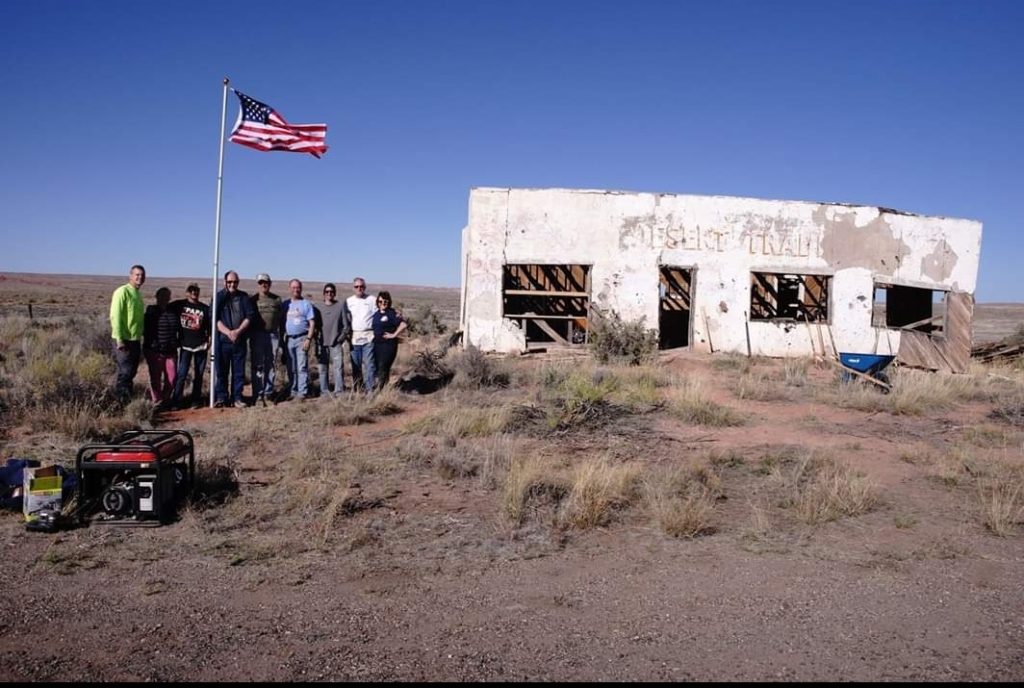
As the Mother Road celebrates 93 years travel this month, remnants of businesses that once dotted the landscape along Route 66 are now seeing new life. Amongst those is the Painted Desert Trading Post, located east of Adamana several miles to the north of Interstate 40.
In 2008, St. Louis resident and co-founder of the Route 66 Co-op, Rich Dinkela and his wife traveled down Old Route 66 as part of their vacation that year. During their trip, the Route 66 preservationists decided they’d make a stop at an iconic landmark known as the Painted Desert Trading Post. According to Dinkela, the off-putting appearance of the old run-down building wasn’t enough to overshadow its significance to the history of Old Route 66 and just shy of a decade later he would begin his mission to restore it.
The Painted Desert Trading Post (PDTP) opened its doors sometime in the earlier 1940’s. Owners, Dotch and Alberta Windsor depended on the traffic from the busy road to keep them in business. The couple sold curios, food goods and fuel from a gravity fed pump.
Being in such a remote area and having no means of communication or electricity, the store closed before the approach of the 50’s as Interstate 40 began its pass through the area.
The trading post would remain unoccupied and fall victim to vandalism, harsh weather and neglect for more than a half a century before beginning its journey to revitalization.
According to Dinkela, the lack of care for the nearly 70-year-old building was obvious by the amount of animal feces and physical condition of the structure itself. “I put some barbed wire fence around it in 2012 to keep the cattle out,” said Dinkela but added that a great deal of damage had already been done.
While checking in on what he calls the “crown jewel” one day in 2017 Dinkela noticed it was for sale. Worried about the fate of the already deteriorating building, Dinkela made a move to purchase the property himself. After further considerations of the financial responsibility, Dinkela enlisted several people who he knew shared his passion for preserving the road’s history.
Dinkela began making phone calls to his potential partners. “We had six people on board in less than an hour,” said Dinkela. He eventually acquired a total of nine partners including Kenneth Strauss, Jim Ross, Shellee Graham, Nick Gerlich, Mike Ward, Frank Maloney, Steve Rider, Richard Walker, Judy Walker and David Wickline, who together formed the Route 66 Co-op and purchased the property and the 94 acres surrounding it.
Because members of the co-op all live in different areas across the country, they are limited to how often they can meet and how much time they can make available, but generally meet twice a year. The co-op began phase one of the clean-up in February of 2018 when they were able to jack up the severely sunken foundation. The group returned in October of 2018, and March and October of this year to complete phase two and three, which included replacing the roof and rebuilding the existing structure and concrete foundation. The crew and volunteers were tasked with ripping out and replacing walls, installing new base plates, reframing entrances and windows, creating a new foundation and reforming the gas station pad in front of the building.
Though they received a grant from the National Service Route 66 Corridor Preservations Program in the amount of $20,000, Dinkela said the support they received worldwide by way of donation was so overwhelming that the grant almost wasn’t even necessary but will be used for maintenance and other costs to preserve the site.
When he was asked what motivated him and the rest of the co-op to approach the project so aggressively, he said he hopes to motivate more people to be pro-active in preserving the history of the road.
“We’re just a bunch of Route 66 roadies who believe in preserving these places. Holbrook is a historic relic,” he said, referencing the Bucket of Blood Saloon and Mr. Maestas Family Restaurant, which he considers a major contributor to the history of Route 66 for the stories the staff will tell alone.
Though they are still working on the building, Dinkela said the trading post has already attracted visitors from all over. The co-op allows anyone who wishes to view the old trading post to do so but must request access through an administrator. There is no cost to visit the site, but donations are always welcomed and encouraged as they do go towards costs of locks, fencing and other materials needed to maintain the property and it’s security. Donations can be made at www.paypal.me/pdtp.com.
Dinkela said volunteers are always welcomed and can keep up with the newest developments on their Facebook page “Route 66 Painted Desert Trading Post” and contact an administrator for more information.