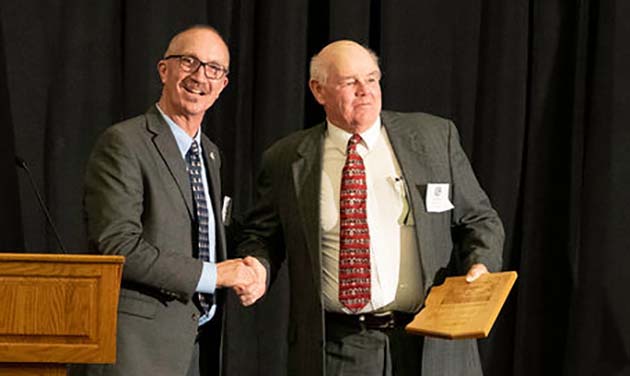
The Arizona Farm and Ranch Experience Hall of Fame inducted two local ranch families, the Jeffers family and the Reidhead family, who were honored at a banquet in March of this year. Arizona’s Farm and Ranch Experience inducts eight honorees into the Arizona Farming and Ranching Hall of Fame annually; five living and three posthumously.
Honorees represent farming and ranching families, educators, members of the agribusiness community and members of the scientific community; all of whom have created a significant and enduring legacy for future generations.
The Jeffers Family
The Jeffers family has been in the Holbrook area since 1940 when they established their cattle ranch. Before coming to Arizona, they had ranches in New Mexico, Mexico and Texas. William Sr. was born in Weed, N.M., and his father may have been also. But their story begins when they left their ranches in the Guadalupe Mountains near Morton, Texas, and they headed to Arizona.
Texas was particularly hard hit with drought in 1940. David Jeffers, his son, William and James H., David’s brother, James’ wife Elvira and their son, J. C. “Cooney”, arrived in the Holbrook area believing that the grass was better here than in Texas or New Mexico. Approximately 450 cattle were shipped by train to the two ranches.
David and his son located their ranch north of Holbrook and James, Elvira and their son’s ranch was south of the Little Colorado River, out of Holbrook. A partnership was formed between the two families. Unfortunately, drought hit in Arizona in 1941 and the process was reversed with shipping the cattle back to Crow Flat, Texas. Then in 1942, conditions improved in Arizona and they once again shipped their cattle back to the two ranches. Before William came to Arizona with his father, he had led cattle drives out of Mexico.
One story he told the family was the time Pancho Villa raided his camp and took all their supplies and cattle. The cowboys, getting advance notice, had hidden in the mountains and were not harmed by Pancho and his men. Pancho took cattle, horses and food to supply his army as they fought for control of Mexico.
But William was never deterred from being a cattle man. It was natural that he would accompany his father into Arizona to begin a new ranch. Their original homestead was made up of three townships encompassing an area north of Hennessey Buttes. The grandfather and father worked the ranch together until the grandfather passed away while working on the ranch in 1946. James had also passed away in 1952.
William Sr. continued to work the ranch north of Holbrook and Cooney worked the southern ranch. In 1951, when he was 55 years old, William Sr. married Nancy Sherwood from Joliet, Ill., in Holbrook. Her parents had moved to Arizona for health reasons and Nancy soon followed. When she met William, she was Navajo County’s court reporter. Two children would be born to the couple. William Jr. was born in Clovis, N.M., in February 1952 and a daughter, Ann Elizabeth Jeffers was born also in Clovis, N.M., in September 1954.
The children grew up learning to help in all aspects of ranching. Bill went to the University of Arizona, 1970-74 graduating with a B.S. in Ag Economics, with Distinction and Honors, and earned an M.S. in Economics. He was also the outstanding student in agriculture economics his senior year. Ann attended Fort Lewis College in Durango, Colo. The land was added in 1958 that now would encompass an area from the Navajo Reservation to Holbrook. The land added included what had originally belonged to Hennessey, Hutchinson and then to the Spurlock’s.
The house that Bill and his wife Lois live in today is the original house built by Hennessey with additions that have been made through the years by Hennessey, Spurlock and the Jeffers. The original partnership was divided in 1971 and the ranch was sold south of the Little Colorado River. The ownership of the north ranch was divided between the two families for a time.
In 1986, Cooney sold his land to Ann and her brother, Bill, as partners and who still run the ranch today. The women of the family have also taken their part in community activities. Nancy joined the Cowbelles and held the office of president in 1972. She would be active in the organization helping with fundraisers and attending Arizona Cattle Growers’ Association meetings. Her daughter, Ann would also follow in her footsteps joining the Cowbelles and being active in the County and State Association. Ann also served for some time as secretary of the Navajo County Cattlemen. Ann, as a partner of the ranch still rides the range, brands and works all the other jobs expected to be done to keep a ranch running.
The ranch today is larger now than its original 1940 size, even though a portion of it was sold to the government to form the Petrified Forest National Park, which is the eastern border. The Navajo Reservation is the neighbor for 18 miles on the northern boundary. I-40 is on the southern border.
The ranch contains many cultural and natural resources. Another portion of their ranch is in the expansion plan to enlarge the Petrified Forest National Park. In the past, sheep had been raised on the land. The Navajos had a sheep trail that passed through the ranch, with water stops, on their way to the Holbrook stockyards for shipment by the railroad.
The ranch has always been beef cattle. As was typical of the 1940s, Hereford cattle were the breed of choice. In the 1970s the Herefords were crossbred with Brahman bulls, producing an outstanding (F1) cow. Later, in the 1990s, Angus bulls were used on these crossbred cows.
Bill explained that they raise what the buyers want today and that is black Angus. The Angus Association has convinced the public that black angus is better tasting beef. Jeffers Cattle Company is definitely black hided, but they still have some crossbreds on the range.
In 1983, Bill married Lois Tiffany, from Kansas. They met at church, with Lois coming to Holbrook to teach school in the elementary grades. They had one daughter, Tiffany, born in 1985. The degrees that Bill received at the University of Arizona in Economics have helped him to run the ranch economically in this world of uncertainty.
Ann and Bill have continued their family legacy and it is hoped that there will be other Jeffers, Tiffany and her family, to take on the reins in the future.
The Reidhead Family
The Reidhead family has a long and rich history in the farming and ranching community of Navajo County. Doy and Leone’s great-grandparents came to Arizona from Salt Lake City. Doy’s grandfather, Charlie Oscar was born in Lonepine, a community started by the Reidheads. Several moves were made before the family settled in what is now called Show Low but was originally called Adair.
Doy’s grandfather married and the couple had 10 children, the oldest, Charles Royal, was Doy’s father. Doy was born in Show Low in 1933 in the home his grandparents built in 1918. It is the only home still standing from that period. Leone Reidhead’s father, James Lowell Pearce, was the first family to settle in Taylor in 1876. Doy met his future bride, Leone, when he was five years old. They did not see each other again until they were 12 and it wouldn’t be until both Leone and Doy were in high school that they met again and would marry at the age of 17. Leone said that Doy worked seven jobs to pay the bills when they were first married.
He began working as a cowboy for Senator Bill Bourdon, a job he enjoyed but with a child soon on the way, he needed a better paying job. The senator bought his horse, bridle, the saddle blankets and the saddle and with $200 he borrowed from his father, he bought a Chevy truck and then borrowed his uncle’s trailer which allowed him to begin buying and selling lumber to farmers in Phoenix. A 25-year lumber business was born.
Doy wanted to rope and the only way he could take off to rope at rodeos was to own his own company. While the lumber business paid the bills, he knew he always wanted to be a rancher and that opportunity presented itself with the purchase of the Milky Ranch which he bought from Bud Greer. Purchasing older cows from the San Carlos Apache Tribe he began his herd. He was fortunate that all the cows he purchased had nice calves growing his herd quickly. But he continued to log and haul lumber to Phoenix.
In 1975, on his way to pay his taxes in Holbrook, Doy happened to see a sign that the Rulon Goodman ranch was for sale. He was fortunate as he had been told by Howard Ramsey that if he ever wanted to sell his logging business, he would purchase. So, the Rulon Goodman ranch was bought, Doy sold his logging business to Ramsey and his Milky Ranch to Marlin Maxwell and he was now a rancher.
The ranch came with 500 head of heifers and they also were about to calve. He made many improvements to the ranch – built a dam and irrigation system and leveled 150 to 200 acres to start a farm. Horses were bought over the years and many of these would be winners at the rodeos. It was said by Leone, that on their wedding day, Doy bought a horse! At one time Doy had at least 300 head of horses. He also captured wild horses and sold them. It was not always prosperous years. There were many years of hardship on the ranch/farm: hail destroyed their crop, bugs ate the crop, too much moisture or not enough, were all setbacks but never deterrents to giving up the ranch life Doy had always dreamed about. Doy loved to rope and saying he was incredibly good at it is an understatement as he is credited with winning many belt buckles (50 plus), seven saddles, and many other prizes including cash over the years. In fact, he was banned from many roping events because of his abilities. With being banned, new ropers had a fair chance to win prizes and make names for themselves.
Through the years, Doy added land through leases to his property to run cattle on or farm. His oldest son, Mike, bought part of his land to begin his farming career where he grows sorghum, hay, sweet corn and alfalfa. The sweet corn is sold by the young children at roadside stands.
The farm/ranch was run by Mike from 1975 to 1988. The land was sold to Bragg and Mike worked for him for about two years before he bought the land back. The land that the Reidheads farmed or ran their cattle on was an area from Holbrook to the Mogollon Rim, about 100 miles long. Some of this was leased land. Like all farmers and ranchers, the Reidheads have had their share of difficulties. Forest permits were cut in half, high interest rates for purchasing land, loco weed killing the cattle, water issues, etc. Other parcels of the land were sold off over the years as hardships increased.
Doy’s grandson, Kiley, Mike’s son, leased land in 1997 where he grazed 50 cows that had been purchased with the sale of his truck. He then went on his two-year mission. While he was gone, his cattle got into the loco weed killing all of them. Upon returning from his missionary work, he bought 55 more and leased pasture from Frank DeSpain at Dry Lake. He bought part of his grandfather’s land along with 90 cows. In the next few years, he would add to his holdings and buy the family home, which he made his own. Through lease land and private land, he grazes his cattle and raises various crops also.
The Reidheads grazed on leased land that had been cut by the government from allowing 1,500 mother cows to 750. This was a result of the increase in the number of elk in the area due to the improvements that Doy made to the land: building water tanks and placing salt links. It was a double edge sword as with the increase in elk because of what Doy was doing with his land, the elk population also increased. This led to a decrease in Doy’s cattle. Doy had also other problems with the US government as there were talks of adding land to the Navajo Nation and he was afraid of losing his land. He went to Washington, D.C. and met with Arizona Senators who assured him his fears of losing his land was groundless. Ultimately, he lost his land. A trade was made and he was given the land that the family now is located on.
Today, the Reidheads survive because of drought insurance that they buy from the United States Department of Agriculture. While the insurance is not cheap, it can help keep the family afloat in drought years. Another feature of Doy’s ranch was the feedlot where he fattened his own cattle before they were sold. The feedlots are still visible today on the land. Up until his death in 2019, Doy went out to his farmland every day. He still loved his horses and seeing the many crops that were being raised.
During the 59 years of marriage, Doy and Leone had eight children: Mike, Jim, Paula, Teele, Konnie, Molli, Buffi and Karalyn. His family, from an early age, have been involved with roping and daily activities on the farm/ranch.