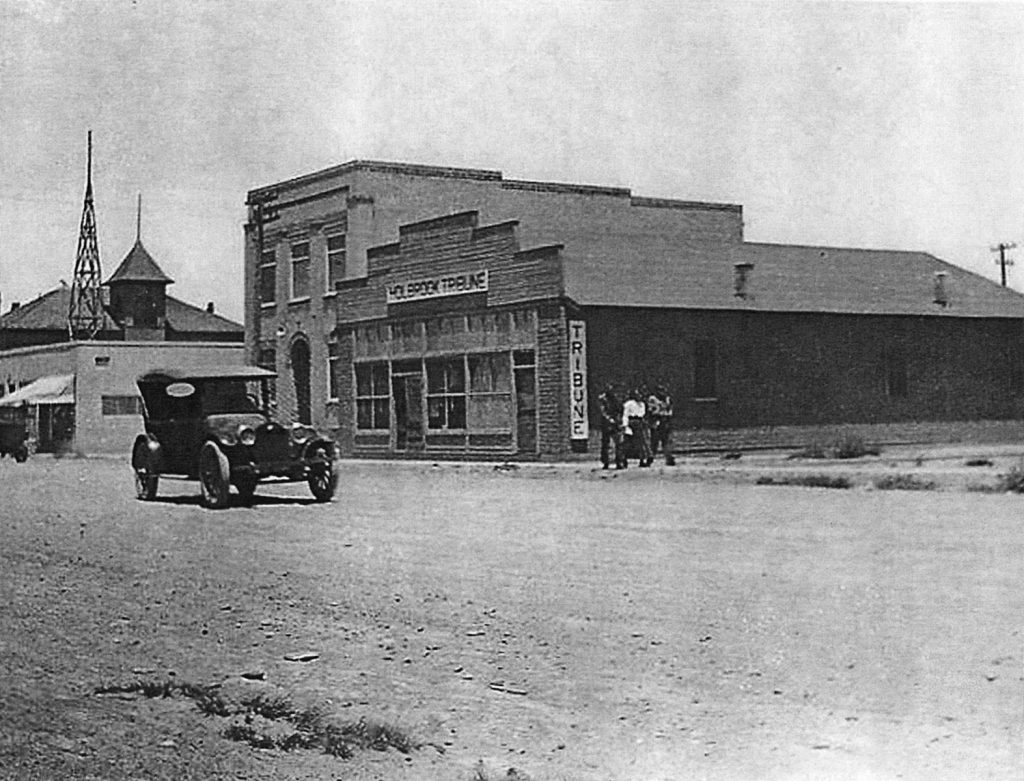
This month Tribune has marked its 115th year of providing the news and serving the communities of Central Navajo County and to commemorate this lengthy legacy, The Tribune will be running an eight-part history of the evolving newspaper industry in the region and the communities that they benefited.
Part 1: When it began
Navajo County’s newspapers have informed the citizens and provided a written history of smalltown life in the West. For well over 100 years, newspapers have reported the news of the area, the county, the state, the nation and in its early days, the world. Now found on microfilm and in bound volumes, what was once news is now the history of a community and its newspapers.
From the founding of Holbrook in 1881 until 1918, the community watched as seven newspapers were founded. Though a time-consuming business and one that required specialized equipment, several men and women believed Holbrook, Snowflake and Winslow were communities that needed a newspaper, and they were willing to make it happen.
Holbrook Times
Holbrook’s first newspaper was called the Holbrook Times. It began publishing on May 17, 1884. The editor and publisher was Henry Reed, who had six months earlier started a newspaper in Flagstaff called The Flag. The small community of Flagstaff had another newspaper called The Champion. Reed recognized that Flagstaff could not support two papers, and so moved his equipment to Holbrook.
“Reed was a perennial starter of weekly newspapers; we know of at least five he launched or had to do with in a period of five years,” wrote Platt Cline.
Cline, who worked at the Holbrook Tribune-News in 1941, wrote a book called, “They Came to the Mountain,” in which he gives an account of the Holbrook Times’ first issue. He said, “Reed moved the equipment of The Flag to Holbrook, and on May 17, 1884, the first issue appeared.
Reed stated, “We refer with more than ordinary pride to our first issue–The Holbrook Times, the successor of the weekly The Flag, which for more than six months was published at Flagstaff.”
It was common practice for other newspapers to report on the launch of endeavors in the newspaper business. The Flagstaff newspaper, The Champion, described the Holbrook Times as “a four-page, five-column paper,” that “dazzles the eye with its sparkling happenings.”
Stories from the May 17 issue included, “A new depot hotel to be erected opposite the present dining cars, will be commenced early this summer.” Another story, which showed the growth that Holbrook was undergoing, was that of survey work about to begin for a location to put a bridge across the Little Colorado River.
Among the ads in the paper were those for a Chinese laundry on Central Avenue East, which was owned by Sing Lee, a bakery owned by Chas. Lindenberger, who sold fresh baked bread, pies, cakes and candy at the bakery on Central Avenue near the railroad water tanks, Wells Fargo & Co., and Santiago Bacca Wholesale Liquor dealer in Albuquerque, N.M.
George H. Crosby Jr., a future editor of the Holbrook Tribune, wrote in an article published on Feb. 16, 1923, that, “Reed was a thorough printer, and a real newspaperman, but while much was hoped for the future of Holbrook, and he got out a good paper, the town grew slowly, and the Times survived between one and two years, as I remember it.”
Holbrook Press
According to Harold Wayte Jr., a Holbrook historian, “The second paper, the Holbrook Press, may have been of even shorter duration. Mrs. Dutton established the Press in 1885, but no issues have been located. The Phoenix Herald of March 20, 1885, commented that Mrs. Dutton of the Holbrook Press proves herself able to run her own office ‘without the assistance of the officious lords of the town.’”
George Crosby may have given us a hint as to who the “officious lords of the town” were. Crosby wrote, “…Mr. Reed (publisher of the Holbrook Times) and his son, Frank, had a falling-out with the cattle kings, notably Henry Smith, Ernest Tee and Henry Huning, who were ‘in the saddle,’ in the affairs of old Apache County.”
These men had not seen the last of Reed, though. He would return with Holbrook’s third paper.
At this time, nothing more is known about Mrs. Dutton or the Holbrook Press. Mrs. Dutton’s attempt to furnish Holbrook with the news in a time when women were not even allowed to vote was quite an accomplishment.
***
Part 2 will be published in the May 29 edition of The Tribune.