

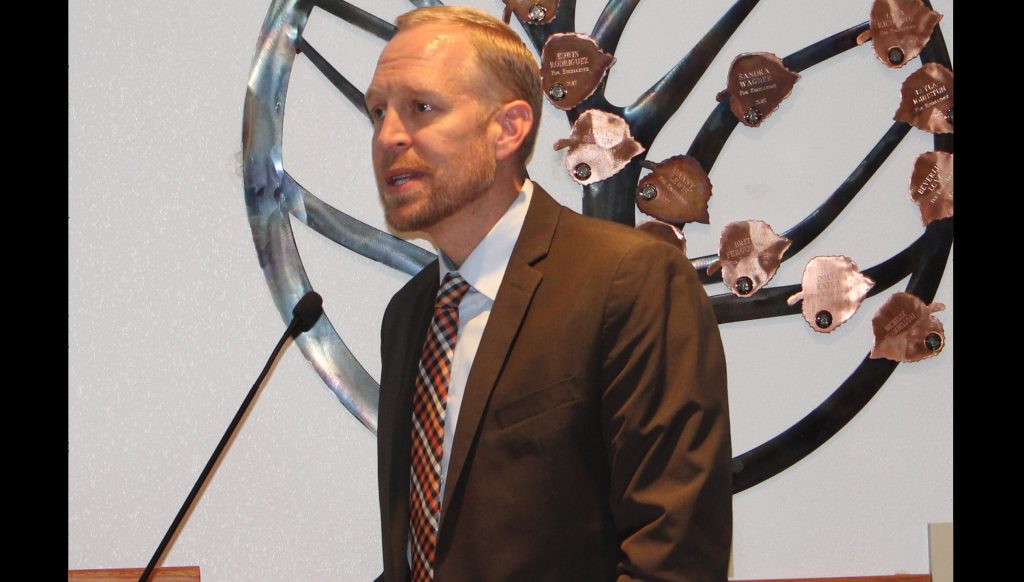
“We all make tough decisions as leaders and this is probably one of the hardest decisions I have had to make to bring this before you,” said Navajo County Sheriff KC Clark at the Navajo County Board of Supervisor meeting on July 10. “I have lived in this county for 38 years and worked here for 31 years. I have seen logging and the paper mill go away, devastating our communities. Coal is a done deal, another devastating blow to this county. We have to do something.”
With that, Clark requested that the board approve a resolution to bring before the voters in November the option of creating a jail district that would be funded by a third of a cent countywide sales tax.
“When the coal plants go off line, we go out of balance by $2.5 million,” said Assistant County Manager Bryan Layton “A jail district is a special district created by the voters for the operation of the jail. It doesn’t build a new jail or even renovate the existing ones; the sales tax would go for daily operation.”
With the Navajo Generating Station (NGS) slated for closure at the end of 2019, the county is anticipating an estimated loss of $1.6 million in sales tax from the coal sold from the Kayenta Mine whose primary customer is NGS. There would also be an additional property tax valuation loss on Kayenta of $125,000 and when the Cholla Power Plant closes, that property tax loss will be $800,000.
Layton noted that the NGS owners along with supervisors Jesse Thompson and Lee Jack Sr., and himself have been attending meetings to find a solution for the aging power plant. “Jack is working with the Navajo Nation to find a new buyer or new opportunity for that property,” said Layton. “But the opportunities that are out there appear as though if they did take over operations, they would generate a fraction of the power, which means less sales tax.”
Layton further noted that there could still be opportunities for the Cholla Power Plant as it has access to the interstate and railroad as well as additional land, but that too is in the future.
Without the jail district, when the coal goes, the county is facing an estimated staff reduction of 20 to 25 percent in every general fund department, which includes the sheriff’s office, jail, administration, courts, attorneys, records, planning and zoning, assessors, and human resources. As Layton noted, “Everything streamlines down. The cuts will not be contained within public safety, they will have to go across the board as well, which means we are concerned with the impact on planning and zoning, recorder, treasurer and assessor. What we typically do now in same day or next day service, could stretch out to a week or month. All services will slow down.”
In a later meeting, Clark said there was another option besides the jail district. “It’s a bad, bad option, but we could charge each city and town 100 percent of the cost of the jail and the medical for their inmates that we house.”
Currently, the county charges each city and town a first day cost per inmate of $128, which includes the booking fee; each additional day after that is $78 per day plus $10 a day for medical and $10 a day per prescription. “The amount of money we spend on medical is incredible, because most of the people who come in are not healthy. It costs between $30,000 to 40,000 every time I fly someone to Phoenix and we do that quite often. But at this time, the cities and towns are not paying those full costs,” added Clark.
In contrast, under the guidelines of the jail district, the cities and towns would no longer have to pay any jail fees, including booking, housing or medical. In 2017, that was a total of $425,000, with Holbrook paying the most at $131,019; followed by Winslow at $114,512; Show Low, $113,093; Pinetop-Lakeside, $48,386; and Snowflake at $18,513. Those are funds that will no longer be paid to the county, but rather can be invested in the cities and towns.
As Layton summarized, “In a 20 year period that is $8.5 million that stays with the cities and towns.
“In order to understand where we are today, we need to be cognizant of what has happened over the last decade, starting with the recession in 2008,” Layton said. During that time the State of Arizona saw its revenues beginning to drop and turned to the counties for support.
“Before 2008, the county didn’t pay anything to state for cost shifts,” continued Layton. “Since that time we have paid just under $5 million just to support state programs and state costs. We have also gleaned down our general fund. We have 16 percent fewer positions than we did in 2008. We dramatically cut back on vehicles, tools, networks, etc.”
But even though the county has fewer positions today, more money is paid out in health care and salary costs, primarily due to increases in health care and state retirement. “During the recession, the county adapted,” said Layton. “Having to tighten your belt is not always a bad thing. You become more efficient, you reduce overhead. You challenge all of your decisions. We reduced positions and changed how we operated and for the most part, the public didn’t see the changes that went on in the county and county staff can be very proud of that.”
That changed this year when the county had to cut $2.5 million from the general fund, taking out the Juvenile Detention Facility and the County Attorney Child Support program. “This was the first time we had to actually reduce entire services, and the public has felt it,” noted Layton.
With the establishment of the district, the sales tax would provide a stable funding source for the daily jail operation, freeing up much needed money in the general fund that would be used to preserve current services and jobs.
In the process of considering the jail district, the county staff also looked other revenue options, including the possibility of increasing property, sales and secondary property tax rates, but none proved to generate the needed revenue.
Regarding an increase in property tax rates Layton stated, “We did not ask for (an increase) this coming year, as the two percent would have only generated $140,000, not nearly the volume needed to replace the $2.5 million.”
The sales tax rate is set by the state and cannot be adjusted and the county is already using the allowed $1.2 million from other fund sources in the secondary property tax. “So even if those rates were increased, it could not benefit the general fund any further,” Layton explained.
Increasing court fines and fees, recording fees and even planning and zoning fees, did not prove to be viable options either as any increase in court fees cause a surcharge to be added by the state at a rate of 88.3 percent, dramatically increasing costs for those who cannot always pay. Recording fees are standardized by the state and Layton said there were concerns that if planning and zoning put the fees too high, it would discourage folks from getting the necessary permits and receiving inspections for their building and homes.
From seizures to public fiduciary auctions to more grants, Layton said the only positive solution was the jail district as it would not only spread the cost of the jail more equitably among the county residents, but it would also be supported by all the visitors who purchase anything in the county.
“There are some revenue sources that might provide more but we don’t have the authority to change the rates. And those we could change would not provide the money needed,” said Layton as he put the one-third cent sales tax into perspective, saying it would increase a $3 cup of coffee or dessert by one penny; a $120 hotel room by 40 cents; and a $30,000 car by $100.
Clark said, “The jail cost is just over $5 million, a big part of our public safety. The jail district as written would fill the gap. It is not a financial windfall. It doesn’t allow us to expand what we are doing; it just fills in what we lose from coal power plants and rebalances us. It is an existing tool used by eight other counties.”
Supervisor Jason Whiting added his agreement when he said, “Those municipalities could add that money back into their funds. I imagine that will be pretty important to them. I also know that since I have been on the board it has been a constant cut here and there. We are looking into future years and realizing we have some problems facing us. We have moved from cutting staff and assets to cutting services. We exist to provide those services to our citizens. It makes sense what is being presented here today.”
The board unanimously approved the resolution to which Layton said that a public hearing will be held in August with the date yet to be determined. “We will be very diligent about engaging the public in this; to have a discussion and answer their questions.”




