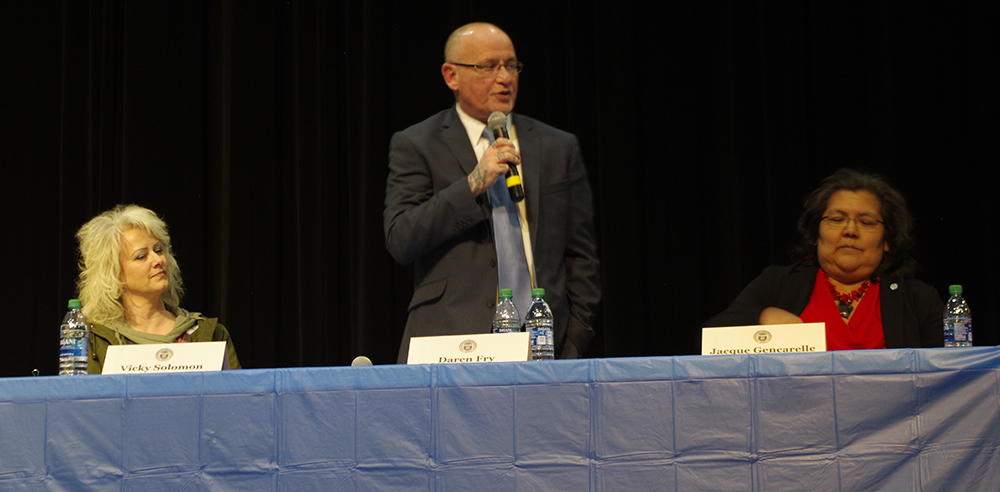
The Winslow Police Department hosted a Dangers of Opioid Usage Town Hall in Winslow on March 3, with nine panel members, each an expert in their field. The event brought together hundreds of residents with questions regarding the current opioid crisis that has impacted communities throughout the region.
Panel members included Randy Moffitt, drug intelligence officer for HIDTA (High Intensity Drug Trafficking Area); Sydney Fox, Center for Disease Control; Brock Bevell, with Blue Vase Recovery Center; Winslow Police Chief Dan Brown; Dr. Steven Dudley, director of the Arizona Poison and Drug Information Center; Dr. Nate Velez, Equality Care Center; Jacque Genearelle with the U.S. Drug Enforcement Agency; Daren Fry, director of northern operations for Community Bridges; and Vicky Solomon, executive director of the Nexus Coalition for Drug Prevention.
In defining opioids, Fox explained that there are both legal and illegal opioids that people have access to and one of the most dangerous illegal drugs currently available is fentanyl, with new versions of the drug being discovered every day. “Opioids react in your brain, in your GI tract even, to send messages that our body produces naturally, so it mimics that response in a much stronger way. So, when you have too many opioid receptors being engaged at one time, the biggest thing that happens is that it depresses your breathing center and you stop breathing and then you die.”
Solomon gave examples of legal opioids that may be found in the home to include hydrocodone, oxycodone, morphine and codeine, which may be legally prescribed but used illegally. Dr. Dudley explained, “We primarily take opioids to decrease pain. One of the side effects at the receptor to relieve pain is that it causes pleasure and happiness and that’s the kicker. That leads people to take opioids much longer than they are intended to. That’s how the process starts.”
Fox noted that another piece of the problem is that opioids are highly addictive. “When you take a certain number yes it reduces pain but ultimately you create a dependency and dependency cause pain. So, when you start to back off your body is saying ‘I have to have more, I have to have more’ and that dependency is physically causing you pain. So just to get well, not to get high, but to get well, you have to take more. So that’s the issue with chronic use. It’s a very simple step.”
Dr. Dudley clarified the difference between physical dependence and addiction. “You think of caffeine. You don’t have your coffee in the morning and you get cranky, you get a headache; that’s physical dependence that’s not addiction. Addiction is taking that a step further and saying, okay, I don’t have my caffeine so I’m going to break into Circle K and rob it. Dependence and addiction do tend to go hand-in-hand but there is an extreme difference.”
Bevell who has been a recovering addict for 11 years, explained that addiction knows no socio-economic boundaries. He recalled that he grew up in a good home and had what he called, “a perfect childhood.”
His addiction began after he sustained a severe injury to his foot and knees after being run over in the line of duty as a police officer. “I took it (pain killers) for a time and didn’t realize I was addicted to it until I tried to stop. There was this chemical that took over me and I couldn’t stop it myself. There was a mental change, there was a physical change. If I went too long without it, I’d start to sweat, I could taste it in my mouth. It was a very difficult process for me.”
Fry, who has been a recovering addict for nine years, added a story regarding a dinner he attended with his sister. “We had a gathering years ago and she made a comment about how much I drank through dinner. I explained to her that it didn’t make sense to me how someone over there could leave a half a glass of wine sitting on the table and go home. For me there was just never enough. If I felt great from this, how much better am I going to feel if I do this much more? Then you get addicted to it and your body gets very sick as it tries to remove itself from the narcotic.”
Fry went on to explain the difficulty in breaking away from the grips of an opioid. “Imagine it’s the worst case of flu that you ever had. Then you start talking about people who do this in treatment centers. You’re in a strange building with a bunch of people that you don’t know and you’re lying in a room that’s probably got 16 other beds and other people as sick as you are. That is what it’s going to be like for someone to go get help. So, when people say, ‘why don’t you just go get help’ or ‘why don’t you just stop,’ ‘why don’t you go do,’ it’s absolutely horrible and then in the meantime you’re trying to convince yourself to go get high again.”
He said that change came for him when he began to understand that his brain is wired differently than people that are not addicted. “The day I became okay with that, the day that I accepted that, was the day that I learned actually how to accept help and I went on to lead a clean and sober life.”
Dr. Dudley noted that symptoms of addiction can cause people to do things differently. Experience emotions that are up and down, depression, anxiety and the potential to lapse into suicidal language. He also noted it can include physical and cognitive withdrawal that can compromise judgement and decision making. “The higher function of the brain just isn’t working and that’s why people can’t just quit,” he added.
Fox noted, “When you are a young adult your brain is not fully developed until you’re around 25, in a best-case scenario. If you’re constantly using substances, you’re creating a change in your brain. So, we can’t expect that when someone would want to stop, that would be an easy thing to do.”
Solomon said, “Once you disrupt that process of your brain developing, some of those things are never going to connect back together. You’ve lost that. So, if you used drugs as a teenager, when you get old you can feel those effects. The sad thing of it is, is that they (kids) can’t understand what we’re telling them because their brain hasn’t fully developed to know and comprehend that. It’s so important for us parents to know that we are talking to our youth every single day. If we are not talking to our youth at least 15 minutes a day, then start. If you start when they’re younger, then they feel comfortable talking to you and whenever they have these hard times and challenges coming in their lives, they will come to you instead of going to their buddy. They need you and it’s okay to say no to them. They want you to say no to them most of the time.”
Genearelle stated, “If you alter your path, you’re no longer going to be that person you were supposed to be. You’re not going to be the next Kobe Bryant, you’re not going to be the president of the tribe. You’re not going to go off and discover some new area because you’ve altered yourself. We’re not just harping on you; we’re trying to help you make those wise choices.”
Solomon stated that the biggest misconception by parents is believing that it couldn’t happen to their child. “I do everything right, I talk to my kids everyday, they get straight A’s; not my kid. Another (issue) is not getting involved and finding out what’s going on in a community. We do have drugs and alcohol and fentanyl and opioids. We do have that in our communities.”
She referenced the Arizona Youth Survey, which shows the results of surveys with eighth, 10th and 12th graders indicating that 56.8 percent of that age group in Navajo County are using alcohol. It also shows that 46.5 percent are using marijuana and e-cigarettes use is to 45.5 percent. Solomon added, “Our parents think their kids are not involved in drugs and alcohol, but they are.”
Fox encouraged parents to get actively involved, “Check their snapchats, check their payment apps. You need to be involved to know what they’re into. Ninety percent of adults who abuse substances started their use in middle or high school.”
When asked how opioids are getting into the communities, Chief Brown responded, “Some of it is prescription, some of that is over the counter.”
Brown explained, “Addiction shouldn’t be a life sentence. We can’t arrest our way out of a problem. We have to get it on the front end. Unfortunately, by the time we get involved there’s sometimes a serious problem. What is really bothering me in Winslow is that in the last two months we have now had five opioid overdoses in our community. And now we have to use the Narcan we got two years ago that we hadn’t had to use. Most recently a death of an 18-year-old boy who had promise.” Narcan is a nasal spray used to treat narcotic overdose in an emergency situation.
“It’s not just Winslow. It’s every community in our state and in every state. It’s just that a lot of communities aren’t discussing it,” Brown pointed out, adding that one of his officers, Corporal Adam Reeves, saved two lives as recent as two weeks ago where three doses of Narcan had to be used to bring one individual out of the overdose.
When asked how to identify fentanyl, the drug leading to the most recent overdoses, Brown explained that what is being seen a lot are little blue pills with M-30 written on them. “Don’t touch them,” he cautioned. “There used to be a day when we could field test to see if it’s cocaine or methamphetamine. We don’t do that anymore. This stuff secretes into your skin and could be deadly; a small trace amount. This is here. This is in our community. Yes, it’s in Holbrook; yes, it’s in Flagstaff; yes, it’s in New Mexico; and yes, it’s on the tribe. It knows no boundaries and it knows no regions.
“What are we doing, we’re arresting people but we’re locking people up for addiction. We need to get in front of this. This is more a public health issue than anything else,” continued Brown.
Moffitt said his job is to look for trends and for fentanyl the quantities are increasing. “We’re looking at seizures: 30,000, 50,000, 75,000. That’s a lot of pills and prices are dropping tremendously.” He noted that Fox once commented on the price, stating that it was the cost of lunch money for any kid in the U.S. “It’s coming and it’s going to impact your communities.”
Dr. Dudley stated that being based in Tucson, he’s not specifically familiar with this region but in the southern portion of the state the changes he’s seen have been drugs that were once being transported in small ziplock baggies are now in much greater quantities. “We had the fentanyl pre-cursers coming from Mexico, up across the border and being distributed. But now we’re seeing houses, manufacturing labs here in the states who are now producing this in-house.”
In explaining the appearance of fentanyl, Dr. Dudley explained, “The M-30s are pressed pills so if you look on a drug identifier that’s oxycodone 30 mm. That’s what that image is linked to. But what’s happening is that these are counterfeit pills being pressed with fentanyl and the users really have no idea what’s real and what’s fake.”
Dudley noted that although M-30s are the most common, but fentanyl laced pills can also be benzodiazapines “benzos” such as Valium, Zanax and Klonpin among others. Marijuana and cocaine can also be laced with fentanyl.
Fry explained that symptoms of addiction include being tired all the time, symptoms similar to the flu, okay for a time then violently ill. He noted that Community Bridges provides treatment, with the only treatment not available in Winslow being methadone treatment. There is also outpatient and integrated services at Change Point. He noted that treatment is completely funded so there’s no gap in treatment.
Medication-based treatment is the most common treatment for opioid addiction. Dr. Velez explained, “The gold standard is medication treatment. We know that those addicted to opioid use have a tremendous propensity to have a risk for disease (and) employment issues. Medication is used to reduce the amount of harm to the addict and stabilizes the brain. This is also coupled with health and wellness, as well as addressing family relations.” He noted that if all complexities of addiction are not addressed, then navigating a drug-free life is very difficult.
Velez continued, “When we talk about treatment, the fleeting moment someone says ‘I need treatment and I’m willing to do it now’ we have to be able to readily respond to that from a law enforcement side, from a jail side, from a treatment side, from a community side, from a family member side.”
Bevell spoke up and stated that at his treatment facility in Show Low the approach is different. “Our program is a recreational therapy program. So, our clients come into our program and the bulk of our time is used outdoors; we’re repelling, we’re hiking, we’re going on adventure races. What we are trying to do is re-acclimate us to society. So, a lot of our usage and a lot of our time we spend developing a team of people that can surround us when we’re done using and when we come out. What’s working in Show Low is that we’re a community and all of the hundreds of recovering addicts that have come into our program have people that they have gone through the program with them that they can reach out to.”
He added that there are many ways to recover. “For us, because of who I am, my past, I feel that when I recover it’s when I’m getting outdoors, it’s becoming physically fit and clearing my mind out.”
Bevell noted that at his treatment center they do not prescribe medications. “I know there’s a lot of pros and cons about medications but my feeling is that I’m a recovering addict. If I add opiates to my recovery I’m not recovered. Our goal is to be completely sober from all medication.”
Brown closed by stating, “It’s so easy to sit back and say ‘they should do something.’ Let me ask you, who is ‘they’? ‘They’ is you. This affects every single one of us. Be involved.”
To obtain Narcan free of cost, visit a local police station or health provider. Drug tests are available at local pharmacies but many drugs are not detected with these tests so the label should be read carefully.
Community Bridges in Winslow can be reached by calling (928) 289-1222 and in Holbrook at (844) 238-3074. Change Point can be reached in Holbrook at 524-6126, in Snowflake at (928) 536-6869 and Winslow at (928) 289-4658. Blue Vase Recovery Center in Show Low can be reached by calling (480) 826-3833.