/wp:paragraph
wp:paragraph
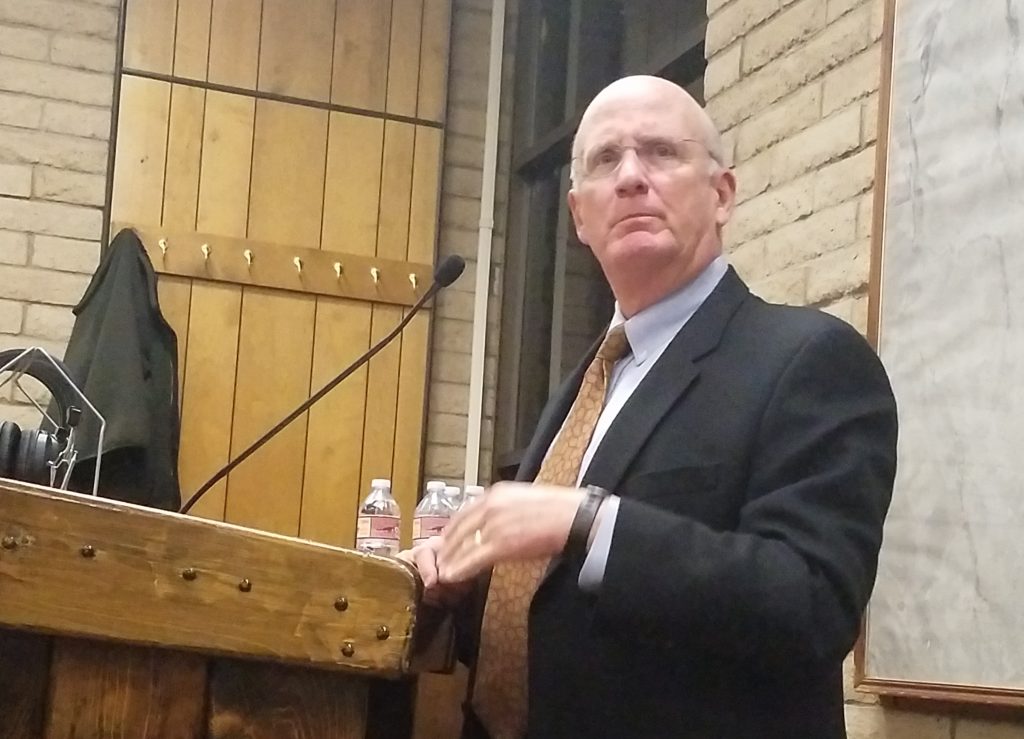
The Winslow City Council heard their first quarterly report in over a year from the Little Colorado Medical Center (LCMC) at the Jan. 8 council meeting.
/wp:paragraph
wp:paragraph
Chief Executive Officer Jack Dempsey stated, “About five years ago, when I arrived at LCMC, it was facing some real serious challenges. Including several million dollars in loss, following a roll out of an electronic medical record system. We had very limited reserves and had bankruptcy council. Over the last five years, we have made genuine progress.”
/wp:paragraph
wp:paragraph
Dempsey reported that LCMC, “delivers about 20 babies a month, has 12,000 emergency visits a year, about 100 surgeries a month, about 3,800 impatient days and employs about 250 people.” The statistics cited were provided by the Arizona Hospital Association, Dempsey explained. “It is estimated that we are between $48 and $50 million a year in economic impact to the City of Winslow and $1.4 to $1.5 million in uncompensated care.”
/wp:paragraph
wp:paragraph
Dempsey explained that uncompensated care is the amount of money not reimbursed to the facility for patient care. Be that by private payers, insurance companies or the Arizona Health Care Cost Containment System (AHCCCS). “As a non-profit hospital, we are obliged to give care regardless of the ability to pay. That leads to unique challenges that face critical access hospitals such as LCMC. An example I have used before is about 15 years ago I learned that in the context of a cardiac catheterization, the full reimbursement from AHCCCS just paid for the cost of the catheter; nothing for the nursing care, medication (or) respiratory care. AHCCCS is a real difficult proposition. If we are well run, we break even on those patients. The rest is commercial private pay and some cannot pay anything. Much of the cost is borne by the insurance companies.”
/wp:paragraph
wp:paragraph
He went on to explain that though the facility loses money on about one-third of its patients and breaks even on one-third, they continue to be in good financial favor. However, he said, “LCMC is only open by virtue of a few supplemental revenue sources. They are most often a blend of federal and state funds associated with serving a disproportionate amount of poor patients. Last year we did have modest losses relative to the previous few years.”
/wp:paragraph
wp:paragraph
Mayor Tom McCauley pointed out that Winslow taxpayers also help fund the hospital with their one-fourth of a percent sales tax. “That portion goes through the city and is matched by AHCCCS, again, federal/state money and roughly $300,000 to $500,000 is brought to LCMC. Without that, without any of those revenue streams, LCMC would not be the same and may well close,” said Dempsey.
/wp:paragraph
wp:paragraph
McCauley continued, “The reason we wanted you to come and speak to us is to ask you, as a taxpayer, are your board meetings open to the public?”
/wp:paragraph
wp:paragraph
Dempsey replied, “They take place monthly and are historically not open to the public. I am familiar with open meeting laws and fully respect them. Everything we do is open but all non-profit hospitals are not public with their meetings. Aside from patient confidentiality, there are federal mandates concerning patients, physicians, quality of care, etc.”
/wp:paragraph
wp:paragraph
“My next question,” said McCauley “is how is our tax money invested for the benefit of the community?”
/wp:paragraph
wp:paragraph
“It keeps the doors open,” said Dempsey. “Further, we invest in our people and in our facilities. Unlike for-profit hospitals with shareholders, every nickel we have goes back in to the facility.”
/wp:paragraph
wp:paragraph
McCauley continued, “How many people are served by the taxpayer investment?”
/wp:paragraph
wp:paragraph
“There are certain things that LCMC doesn’t do. But the notion of critical access is things we need to do. We need to have good emergency care, we need to support women and families. Everything that is of a critical nature, we do.”
/wp:paragraph
wp:paragraph
He explained that if McCauley would like he could follow up with a meeting to discuss more precise numbers.
/wp:paragraph
wp:paragraph
Dempsey added, “First off, Dr. (John) Sears is retiring. He has been a great asset to our staff and we appreciate his years of service. In his place, we have hired Julie Williams. She starts Feb. 20. Her historic background is a bit different from the traditional primary care model, but she is committed to really work hard to support her colleagues and Winslow. Additionally, last time that I was here, I had been hearing from neighbors in the community that our emergency department was poor. We have recruited and were able to attain a very accomplished group of very strong physicians since that time.”
/wp:paragraph
wp:paragraph
Dempsey went on, “The emergency department tracks a statistic titled ‘left without being seen.’ It is when patients grow tired of waiting and decide it would be faster to drive to Flagstaff or Show Low. That percentage used to be in excess of seven percent, above the national norms. Now, we are at about 1.1 percent, well under the national norms. Our door to doctor time is about 20 minutes and our door to discharge time is about four hours. All of these in relation to national benchmarks are favorable.”
/wp:paragraph
wp:paragraph
LCMC has goals to do more community outreach in the coming year with a plan to hold outreach meetings with community leaders, according to Dempsey. “Just to plug into a broader section of the community and to hear from you all about what we could be doing a better job on. We also plan to reach out to the high school and encourage those students to explore and follow careers at LCMC. The majority of our nurses come from NPC (Northland Pioneer College) and we actively support their continued education.” The council will hear a presentation from Dempsey on a more regular basis from this point forward. “We will be on the agenda moving ahead.”
/wp:paragraph