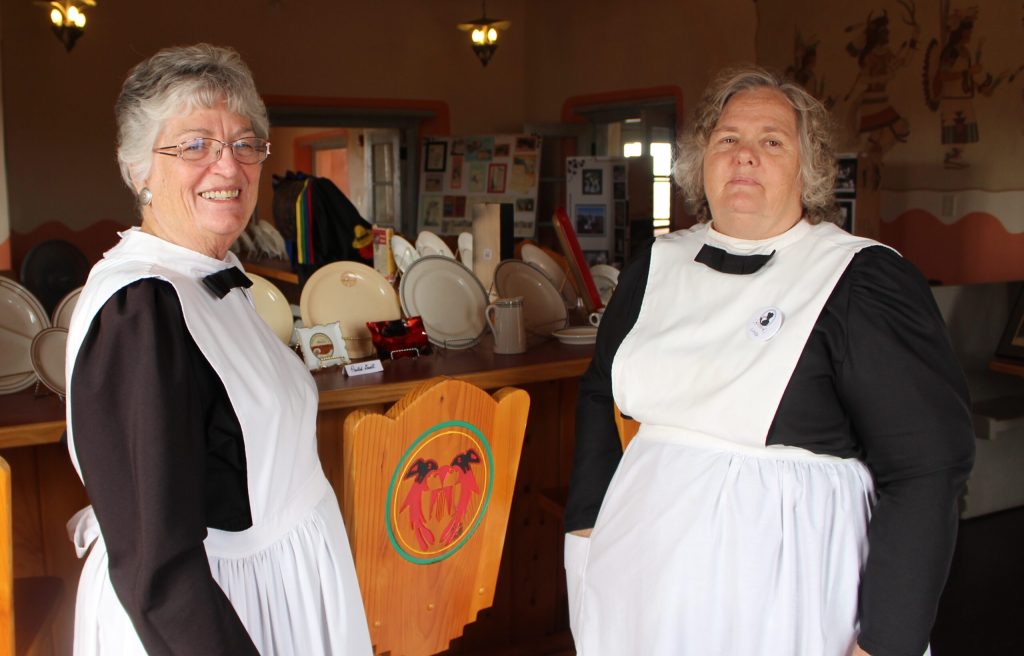
Dressed in long black dresses covered by pristine white aprons, Peggy Nelson and Linda Hallman, cultural demonstrators at the Painted Desert Inn on Aug. 25, and members of the Winslow Harvey Girls, shared the story of the young women who ventured West in a time when women were not often employed to become Harvey Girls at the Harvey House restaurants that dotted the Santa Fe railroad in the late 1800s.
Long before women’s movements of the 1900s, these girls brought their own spirit of independence to the West; breaking barriers in the male-dominated work place while providing an element of grace and good food to the weary passengers who traveled the rails of the Santa Fe. But there would be no Harvey Girls if it had not been for the resolute foresight of Fred Harvey.
Emigrating from England at the age of 17 in 1853, Harvey landed his first job in the new world as a pot scrubber at a popular New York City restaurant. A little over 20 years later, in 1876 Harvey started a line of restaurants along the Santa Fe Railroad. The first 10 years, Harvey managed to keep all the profits, but when the railroad began to realize how profitable the restaurants were, they renegotiated the deal, giving Harvey an exclusive contract for 50 percent of the profits.
While the food was good, Harvey was constantly faced with the problem of finding good help to serve the food. Nelson said that most of the cowboys he hired were Confederate soldiers and fights continually broke out, until Harvey decided it was time to hire women.
He put out a nationwide ad, promising $17.50 a month, with a first class rail ticket. In exchange the women must have an eighth grade education, be between the ages of 18 and 30, sign a one-year contract and remain unmarried during that time.
According to Nelson, “The preachers preached against Harvey, saying, ‘Mamas keep your daughters safe.’” But the thought of making $17.50 a month and having a first class train pass, enticed more than one girl to join the ranks and over 80 years, Nelson estimates that nearly 100,000 women worked as Harvey girls.
“They had to be of good moral character, could not wear make-up or jewelry and could not be married,” continued Nelson. “If a girl was fired, she would lose half her wages and the first class railroad ticket. While serving guests, they could not talk with each other, which helped prevent fighting among them.”
The efficiency of the service set up by Harvey was ahead of its time and he was often known as the Civilizer of the West. The girls went through an intensive six-week training course before being shipped out to their assignment.
The railroads quickly realized the value of the service Harvey provided. Nelson said the conductor would take orders from the passengers while the train traveled from Gallup, N.M., to Holbrook. “At Holbrook the orders would be telegraphed to the La Posada in Winslow, where preparation of the food began.”
With only an hour to spare, the guests would be seated in the dining room of the La Posada, where the girls would confirm the orders and take drink orders.
“Ice water was always on the table,” noted Nelson. “And there was a cup code used to easily indicate which of the four drink options had been chosen: hot coffee, hot tea, iced tea or milk.”
“The Harvey Girls were the Pan Am stewardesses of the railroad company,” said Jacob Smith, one of the Navajo Cultural Demonstrators who was also working at the Painted Desert Inn that day. To which, Nelson agreed. The Harvey Houses with the Harvey Girls remained on the landscape until 1968 when it was bought out by Amfac, Incorporated, a Hawaii based hospitality company.
As railroad travel gave way to air travel, the grace and service of the Harvey girls became the pattern used to create the modern-day stewardesses.
The Winslow Harvey Girls began on Dec. 5, 1997, by co-founders Marie LaMar and Christine Pane. Today the group is preparing to celebrate its 21st anniversary. There are a total of eight members, of which Nelson is the president and head waitress. For a small fee, the Girls offer a two-hour walking tour of the La Posada Hotel in Winslow, a former Harvey House, which can be booked upon request. For information, call (928) 289-4160.