The Winslow Unified School District is currently in the process choosing a new superintendent as current Superintendent Cyndie Mattox is set to resign from her position at the end of the school year. So far in the process, the WUSD Governing Board has formed an advisory committee and brought on Steve Highlen from the Arizona School Boards Association as a consultant.
Last week the advisory board, as well as the governing board, conducted interviews of four possible candidates to fill the position. A community forum was also held to garner community input as well as from staff and students.
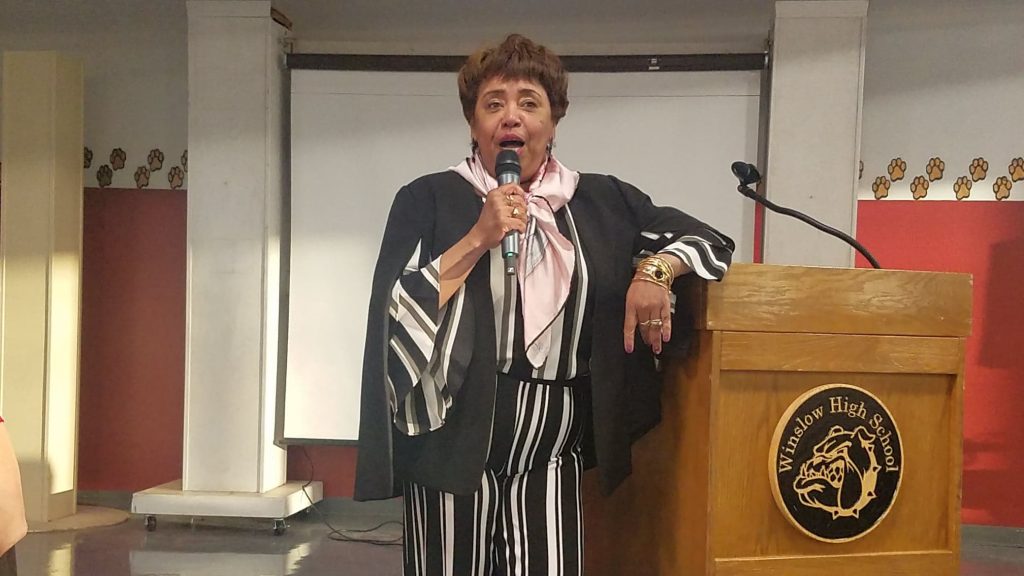
The four candidates are Denise Lynch of Chicago, Ill., Darlene McCauley of Beaver Dam, Connie Gover of Winslow and Katheryn Zanin of Tucson. The four participated in the question and answer forum moderated by Highlen at the Winslow High School Student Union.
Gover was the first to introduce herself and listed a long career in education. “Currently, I am the special education director for our district. Prior to that I worked for the Arizona Department of Education. I have worked at the Winslow Residential Hall, have been an adjunct professor for Northland Pioneer College and the Arizona Department of Corrections.”
Zanin was a teacher for 21 of her 32 years in education. She is currently the principal of a K-12 school in the Tucson area. “I have taught fourth through eighth grade, (was a) STEM coordinator, transportation director and administrator. I have also had experience as a math specialist and coached soccer and boys’ baseball, so I have a well-rounded background.”
Former Winslow Junior High School principal Darlene McCauley started her career in education in Dilkon. She said, “I taught sixth grade, English language arts and developed their arts program. While working out there, I noticed children having difficulties and that prompted me to enter the field of counseling and social work.” She spent time as a program coordinator for the Department of Child Services before returning to education as a teacher for 10 years. She spent five years as the junior high principal and is currently serving as the superintendent, high school and junior high school principal for the Littlefield School District in Northwestern Arizona. “I am in the middle of my dissertation on rural education and have a Master’s Degree in Educational Counseling.”
Denise Lynch, who is originally from South America, is currently an administrator in the Chicago area. “I have been a principal for the last seven years. Prior to that I was a bilingual teacher. I work with urban students, students that need the most help. My expertise is in working with marginalized students who do not have mom and dad, those are my priorities. I work with diverse learners and I turn schools around. I take schools that are on probation and take them off in a matter of a year or two. I believe in data-based decisions and my dissertation is on comparing students in the United States with those in third world countries. My inquiry is why students in the third world are so hungry for an education and I have to create incentives to get students to want to come to school in the United States.”
Questions were submitted anonymously by community members as well as staff and students, and candidates were each given a reasonable amount of time to answer, each answering every question.
A recurring question was on the issue of bullying. For example, one student asked, “What can be done about bullying and why has there historically been little to no repercussions for those who bully?”
Gover answered first. “What we need to do is make sure that we are listening to children and that we are following up on it. We also need to get parents involved. Both the parents of the students who are doing the bullying and who are being bullied.”
Zanin added, “We need to define what bullying is but I do agree, we need to listen. We need to teach young people that there is a better way to treat people and develop a culture of compassion and to work with others, and support them in kind, loving ways. Yes, there will be consequences associated with this behavior, and work with the child who has been hurt.”
“The only thing I would add to that,” said McCauley, “is helping students to identify who they can talk to as administrators. Each bullying report has to be absolutely investigated. What I would like to do is to find some sort of a resolution, sometimes that means getting all of the people involved in a room and decide that we don’t have to like each other but we have to figure out how to co-exist and work together. Resolving the conflict is what we need to work on.”
Lynch expressed her plan for dealing with bullying by saying, “I fully believe that the district needs to allocate a behavioral health team. A team that is dedicated to addressing what I call social emotional learning. A lot of students who are bullying others are coming from homes where there is a lot of trauma, they bring it to school and act out. If you have a behavioral health team in your buildings, chances are you will create preventative methods so you will not have a school that has consistent bullying.”
The topic of a four-day school week was also discussed, as was the issue of academic performance. Each candidate was apprehensive about the four-day school week and did not give absolute answers. The general consensus was that it would be considered by each one if they were to take on the superintendent’s role.
A question submitted by a staff member asked, “What plans do you have that can be quickly implemented within our school district that can improve education levels of our students?”
To begin, Zanin expressed her belief in data driven assessment. “We also need to look at instruction and find out if students are engaged in purposeful meaningful work, or are they expected to sit like robots in chairs and just regurgitate what they are being told? We need to develop lessen plans that are highly engaging and make sure that our students are reading, are able to write academically and do mathematics.”
The continuation of teacher learning and professional development is important to McCauley. “The process that we used with Winslow Junior High School was taking a look at our instructional process and our interventions. We collaborated and evaluated and found out what was and was not working. We embarked on an improvement plan and began designing interventions that have been proven to work. Students that are struggling often also have behavioral and emotional issues, not just academic ones. We need to look at our assessment data and make sure that no children are falling through the cracks.”
Lynch answered, “First and foremost, students must feel appreciated and welcomed in the classroom. Teachers must make them their business partners. Students must want to come to school. We need to make sure that within the first 10 minutes of being in class know what their day is going to consist of and why. We need to have grading systems that do not dehumanize students. We need to change the learning environment.”
Gover agreed with the need to consult data derived from testing. She explained, “What we need to do is disaggregate their data. We are learning to take the data and finding out which areas we are low on and set smart goals. What we are doing at the high school is looking at data and realizing that test scores are just a snapshot of that day when the student took the test. I don’t think that can define our schools but it does give us an idea of where to go.”
The conversation was spirited and very well attended by WUSD faculty and staff as well as concerned parents and community members. Following the forum, the governing board met with the intention of choosing one of the candidates for the position. However, the governing board chose instead to conduct another round of interviews in a special meeting to be held this Friday, March 6.