The Citizen Liaison Committee in Winslow held a public forum last month on the topic of drug use. An expert panel made up of officials from law enforcement, treatment facilities, social workers and emergency medical services led the discussion as citizens asked pertinent questions on the subject.
The forum was mediated by Dr. Greg Hackler, the Citizen Liaison Committee (CLC) chairperson. Hackler said, “We developed the CLC because there was a need for communication between our citizens and the police department. We want everyone to be heard.”
Detective Adam Reeves of the Major Crimes Apprehension Team (MCAT) presented an overview of pervasive drug use in Navajo County. “What we see the most of is marijuana and methamphetamine,” he said. “Methamphetamine is the biggest problem that we see here in Winslow.” However, he continued, “We are starting to see more and more heroin come in to the area.”
According to Reeves, in an effort to prevent deaths from opioid overdose law enforcement officers have been trained in the use of Narcan and are carrying it on them at all times. Narcan is a brand name of naloxone, a medication used to stop the effects of opioids, especially in the event of an overdose.
Due to Arizona state statutes handed down last year, law enforcement officers are required to carry the drug on them as well as make it available to the public at no charge and with no questions asked. Governor Doug Ducey declared a state of emergency in 2017 regarding the opioid epidemic.
Tiffany Hardman, the Director of Social Services at Little Colorado Medical Center (LCMC) explained, “Winslow is identified in the top five in the state for our drug abuse. That’s not good. The University of Arizona collected data from all of the mandatory reporting that is done through emergency departments on overdoses.”
Because of that ranking, LCMC was given a grant that Hardman used to purchase products to help address the opioid issue. “We did that in two ways,” she said, “One was giving people pill lock boxes that allow pain patients to lock up their medications. We also gave out hundreds of disposal bags that deactivate medications.
“The opioid epidemic is not just children, it is not just adults, it is the grandmas and grandpas that have been generously supplied with narcotics through their doctors,” said Hardman. “With new regulations telling doctors what they can and cannot do, we are seeing grandmas go into crisis. They are buying heroin and shooting up, they are buying anything to keep going. We are seeing overdoses from little old ladies.”
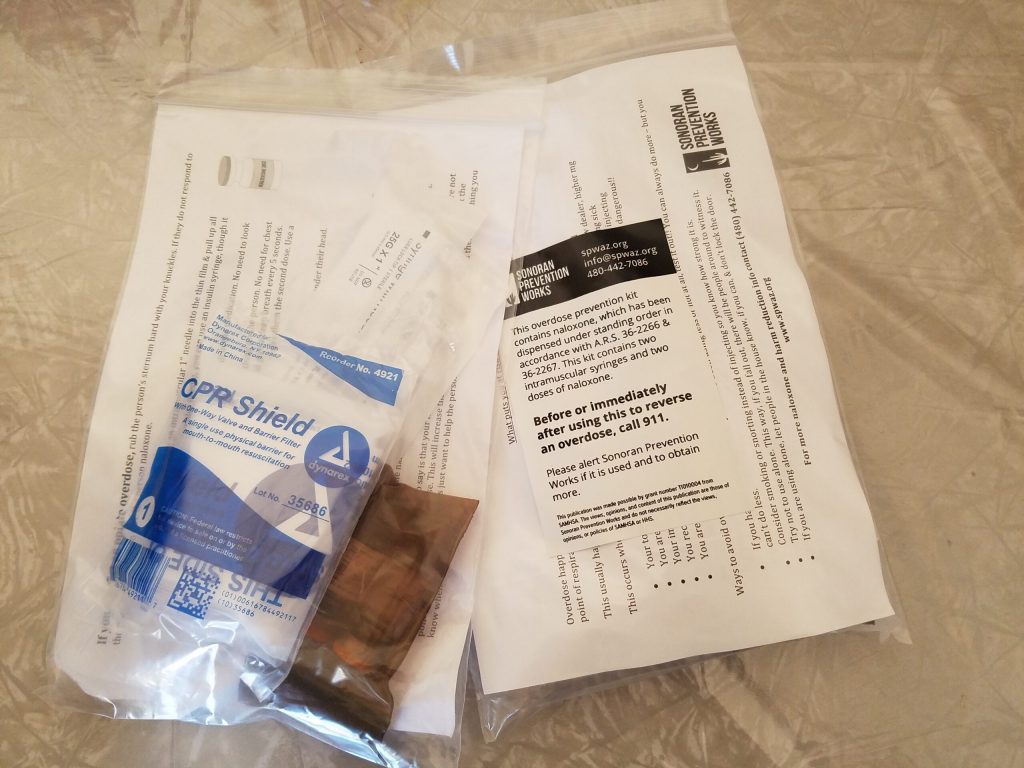
Hardman passed out overdose kits to those in attendance. Each kit containing naloxone and intramuscular syringes. “These are the same medications given to overdose victims on the ambulance. These are for anybody and everybody who has access to opioids. I have hundreds and they are all absolutely free.”
Detective Reeves added, “Our diversion programs have been successful in educating people on locking up their medications, or say, if there is a death in the family, the right way to get rid of those medications, especially the opioids.
Frequently prescribed opioid medications include morphine, hydrocodone, oxycodone, heroin and fentanyl. They are often recognized by brand names such as Oxycontin, Percocet, Vicodin, Percodan and Demorol. According to the Center for Disease Control (CDC), opioids are prescribed for moderate to severe pain and certain health conditions including cancer.
According to the CDC website, anyone who takes prescription opioids can become addicted to them. In fact, as many as one in four patients receiving long-term opioid therapy in a primary care setting struggles with opioid addiction.
One of the major components of the discussion was treatment options. CLC member Ben Sandoval said, “It seems that the trends the last several years have been less on punishment and more about treatment. Is that true?”
Detective Reeves answered, “Most of the people we arrest as just users are seeing probation or drug court as their options.” Darren Frye, Director of Operations at Community Bridges added, “We have statewide what we call ‘law enforcement drop off programs.’ That allows the law enforcement community to drop someone off at our door without question. We also have a long-term treatment program that can include probation or drug court orders.”
Winslow resident Denni O’Quinn asked, “When you talk about rehab, is this court ordered or can people just leave?” Frye answered, “Well, those are two different things. The courts can order treatment but in substance abuse, treatment is voluntary.”
Those who are seeking treatment or know someone in need may contact Community Bridges, located at 993 E. Hermosa in Holbrook or by phone at (844) 238-3074 or in Winslow at 105 N. Cottonwood Ave. or by phone at (928) 289-3154. Changepoint Integrated Health Services also offers treatment options and counseling and can be contacted by calling (928) 289-4658 in Winslow, (928) 524-6126 in Holbrook or (928) 536-6869 in Snowflake. The Navajo County Health Department is available as well to direct citizens to treatment locations and plans. For information on County services call (928) 524-4750.