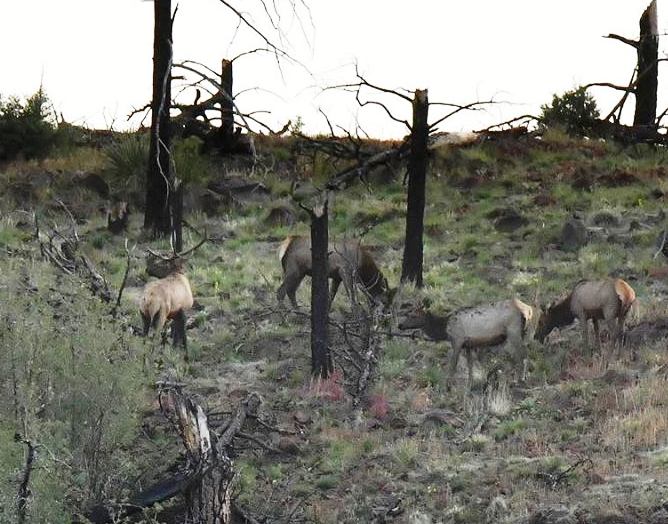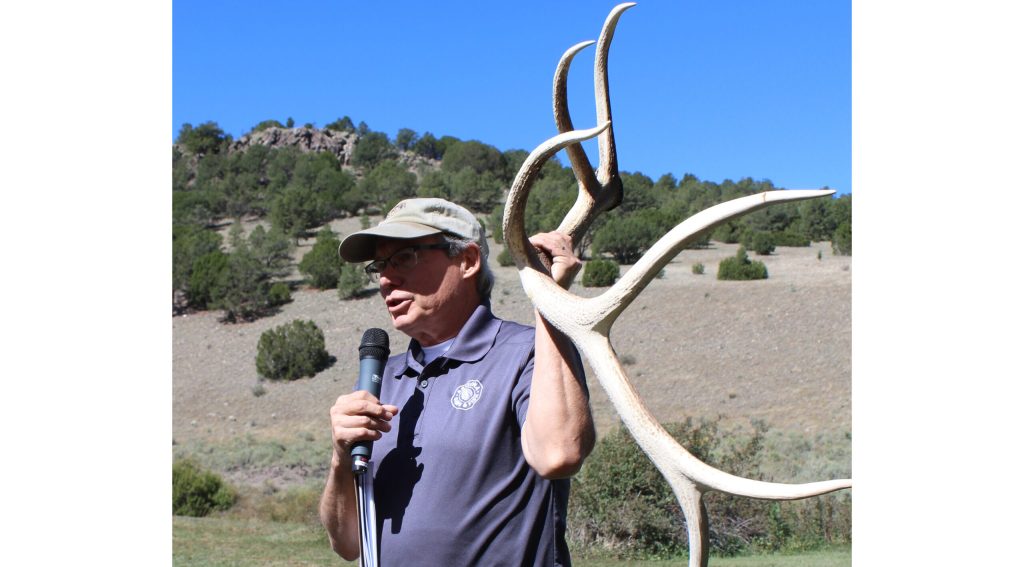
Amid the changing leaves and windy weather that heralded the end of summer, people from Arizona, California and beyond came to the White Mountain Elk Viewing Workshop hosted by the Arizona Elk Society and Arizona Game and Fish Department (AZGFD) at the Sipes Wildlife Area (SWA) a few miles outside of Eager.
Until 1993, the SWA was known as the White Mountain Hereford Ranch, a nationally renowned working cattle ranch owned by Dennis Sipe. But it was the impact of hundreds of elk on his land that caused Sipe to offer the land for sale.
In 1993, the ranch was purchased through a partnership of public and private funds (primarily Arizona Heritage Fund monies) and now the 1,362-acre wildlife area reflects Arizona’s ongoing concern for wildlife of all kinds.
AZGFD manages 800 different species of wildlife in Arizona, and is mostly funded through hunting and fishing licenses. The elk that live in the White Mountains are from a herd in Yellowstone National Park, which were brought to the area in 1912.
Dave Cagle, AZGFD terrestrial wildlife program manager, said the Merriam’s elk, the largest of the subspecies, that once inhabited Arizona, went extinct in the early 1900s. “All that is left are three skulls in different museums.”
In 1912, Yellowstone donated an elk herd of 14 bulls and 72 cows to Arizona that was the seed of the herds that can be seen today. Known as the Rocky Mountain Elk, they are one of four subspecies that survived the changing tides of civilization.
The other three subspecies that live on the North American continent are the Tule elk, a smaller animal that typically lives in California; the Roosevelt elk, the largest of subspecies, which lives in the rainforests of the Pacific Northwest; and the Manitoban elk, which can be found in Canada.
Today one of the primary responsibilities of the AZGFD is to manage the big game in the area. “We have Rocky Mountain big horn sheep, deer, elk, antelope, bear, lions, just about everything except bison,” said Rick Langley, AZGFD game specialist.
Langley went on to say that elk are a large animal that can live in a lot of different habitats. “One of the things we see, in drought years when there might not be as many groceries on the ground, elk tend to do better than deer. Elk are a larger animal and they can take in a lot more forage of a lesser quality than deer or antelope. So they tend to persist better over lean times than other species in the deer family.”
The balancing act that Langley and the other game specialist find themselves in is too many elk and too many hunters.
Arizona is a desert state, with a herd of approximately 30,000 elk versus a state like Colorado where there are 350,000 elk. “In Arizona it has been shown that we can easily end up with too many elk,” said Langley.
One of the issues that impact the farmers in Round Valley is the elk on their hay fields. “For farmers who are trying to grow groceries to feed their livestock or sell hay; having 50 elk every morning on the hay fields is a problem,” noted Langley.
Another challenge is the vehicle accidents involving elk. “It is amazing to me how many elk get killed on the roads here in Arizona,” Langley shared.
Between the competing interest of hunters, landowners and vehicles, AZGFD also has to take into consideration how tough elk can be on the natural habitat.
From destroying aspen stands and creating browse lines on trees, the elk can also overeat the native grasses allowing non-native plants to thrive. “In the early 1990s the elk were converting the habitat,” said Langley, as he added, “It’s important to keep the balance between the hunting public and non-consumptive public that like to see the elk. There are two sides to this; we are trying to keep good elk populations at a healthy level.”
Another difficulty that AZGFD faces is the elk movement across the Apache reservations boundaries, as the tribe manages their elk differently. “We have a good working relationship with the biologists on the reservation,” said Langley, “Which is not always the case in every situation. Elk, deer, bear and other animals cross tribal and state boundaries, which creates an interesting dynamic on how we handle that and collect the information needed.”
The final speaker of the day was AZGFD photographer George Andrejko who described himself as the “sole photographer of the department. Every facet of photography starts and ends with me.”
From his list of tips for photographing wildlife, Andrejko shared, “We have to be there when the animals are there. The more you study the animal, the more you will know how to find them.”
Andrejko also suggested getting to know your camera. “Take it off of the auto setting, and try a different setting, like a cloudy setting for outdoor as this gives a warming effect to the photo.”
One of his final suggestions was to focus on the eyes of the subject. “The life is in the eyes,” said Andrejko. “Our eyes are drawn to their eyes. If you can capture the glint or the light in the eyes, then you have caught something amazing.”
Today, SWA is open year round for recreational opportunities that include a visitor center, which is generally open from May-Oct., four hiking trails and a day-use picnic area. A 50 room, prehistoric ruin that was occupied by ancestral Pueblo people can be seen on the Rudd Creek Trail.
To see upcoming events and hunts with AZGFD in Pinetop, visit their Facebook page @AZGFDPinetop.