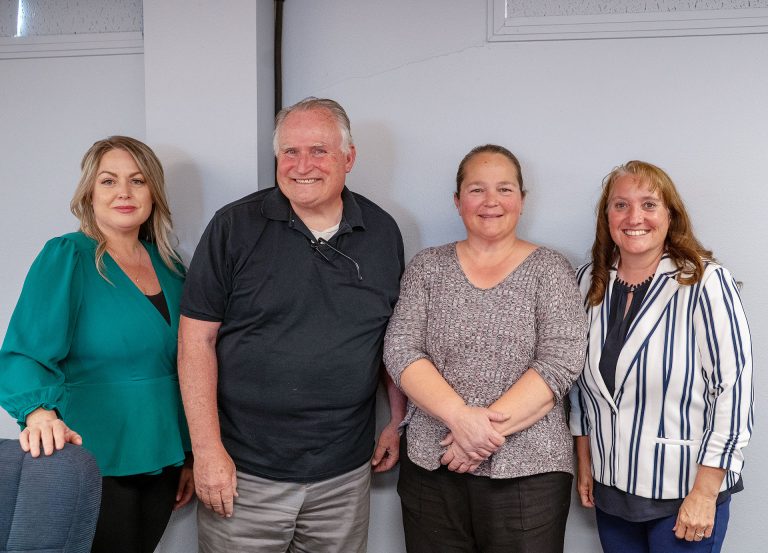
The City of Holbrook is moving ahead rapidly to address economic development, code enforcement and blight in the city. Interim City Manager Randy Sullivan has taken strides in addressing residential concerns with Barbara Blythe tackling residential code enforcement and recently hiring Joe Jarvis as a contractor to address related matters on the commercial side.
Jarvis comes from an extensive background in city government and has many tools to use in addressing issues that the city is facing. His background includes a Master’s Degree in Public Administration from Arizona State University that he earned in 2008. He then interned in Winslow and has been working for cities, towns and counties ever since, focusing his career specifically in public service. In 2022, Jarvis formed his own company in 2022. He currently resides in Eagar but intents to be in Holbrook while addressing the needs of the city.
Jarvis stated, “One of the things I see in municipalities, especially in rural ones, is that people like to wear lots of hats. That’s why I like to work for them. They’re all allocating all of their available resources to really good things but there are gaps or there are opportunities that they are not able to capture because they can’t afford a whole employee, or they can’t afford someone with expertise, or they don’t have enough work for a full-time employee so I’m trying to fill that gap. For my clients I’ve secured federal funds and state funds and I’ve helped them process applications and get rid of assets, manage the day-to-day operations, and manage public meetings. I’m perfect at nothing, but do a lot of work,” joked Jarvis.
Jarvis said he’s excited to be working with the Holbrook team and has been asked to focus on planning and zoning administrative duties, and support on code enforcement. As planning and zoning administrator, he will also be the floodplain manager.
“When it comes to planning and zoning, any time someone wants to consider development within city limits, they’re likely going to have to talk to me. And if they want to submit a request for a conditional use permit, a variance or rezoning, they’ll talk with me. I see it as very important that I keep the planning and zoning commission well informed about what’s going on,” stated Jarvis. To that point, the commission has already held its first meeting with Jarvis and moving forward meetings will be held once a month at 5:15 p.m. on the third Thursday of each month at the council chambers. In the past, the commission only met a handful of times each year, as needed.
According to Jarvis the commissioners, who include Michael Sample, Trent Larson, Buddy Dupee, Aaron Colon and David Smith, are all very excited about helping Holbrook stop the direction it’s heading and shift back into helping Holbrook be what it should be. “I suspect with P&Z that some months nothing will be on the agenda but we will have discussion such as to how we want to handle things, what do we want to focus on. They recognize that they are an advisory board, they don’t make final decisions but they do make recommendations.” In reviewing city code, Jarvis noted that there is an entire section of city code that talks about historic preservation but no historic preservation committee exists. “This section is longer than the planning and zoning commission’s regarding responsibilities, so my suggestion to the city council will be to request they allow P&Z to operate at the historic preservation committee.”
Jarvis stated that there is supposed to be an overlay on the zoning map of the historic downtown area but he was not able to find that overlay and the commissioners are not aware of where that is. What is suspected is that the overlay is the same as the historic commercial area, which is south of the railroad tracks right along Bucket of Blood. “We want to preserve the history of this beautiful community. But we recognize that some of the structures that represent this beautiful community are past their useful life and we may not be able to convince a wealthy donor to fix them. For some, it may be time for them to be razed. The city doesn’t have the resources to do that.”
The buildings being discussed included the Star Inn on Hopi Drive. The structure sustained critical damage due to fire in the past and, according to Jarvis, the property owner has not been very responsive to the communication from the city. That situation is different than the Bucket of Blood Saloon, which has its roof caved in. “We can’t do a one size fits all. The Star Inn has a place in our community, the Bucket of Blood Saloon has a place in our community, somebody spent money building those buildings. But in my perspective the Star Inn has less historic value than the Bucket of Blood building.”
When asked how the city will address other blighted buildings such as the old bus depot at the intersection of Hopi Drive and Navajo Blvd. and how city code will be implemented to ensure that property owner, and others in the city are held accountable for the condition of their properties, Jarvis said that he has no problem implementing and being firm regarding city code if that is what he is asked to do by administration.
“What makes that challenging is if there is political will to support it because you get sob stories, and you get connections, and if those sob stories and those connections undermine the decision to enforce the code, then you’re not going to be able to enforce the code,” explained Jarvis, adding that the other aspect is that just because it is written in code, that doesn’t mean it’s enforceable. “If it’s enforceable that’s great, but are you going to follow through with enforcement next year and the year after.”
One of the other things Jarvis has been asked to do is review the code, as many times the code is outdated or unable to be enforced. Former city administrators have touted the cost of enforcement with lawyers and court fees as a barrier to enforcing city code, but Jarvis said that is not necessarily true. “We present to the property owner, you need to fix X, Y and Z. We set a date for them to accomplish it and then we go back and inspect. If they haven’t, then we escalate it based on our city code. If they ignore all those transactions then we should be able to present it to our prosecutor to say, please present this to our local magistrate so that they can enforce this code. That should be able to be easily presented to the magistrate.” Jarvis explained that the city presents its documented evidence, the defendant (property owner) presents theirs and the magistrate will make a decision. If the magistrate sides with the city, which the evidence should strongly support, the process continues. “The magistrate will say ‘you have X number of days to get it done. If you don’t, you’re fined and it will still need to get it done.’ That’s how simple it should be. And, if there is still no response by the property owner and the city code allows you to enforce a lien on the property that can also be done.”
Although he said he has no problem taking that route he has also used other solutions. “There’s been times (in past administrative positions) when I’ve provided dumpsters to a property owner because they were going to demolish their property. It was much more efficient. That way we were helping them save thousands of dollars, we were getting rid of a dilapidated building. I don’t like the easy answer of ‘we can’t afford to do that.’ That means you’re not being creative and you’re not heading somewhere.”
Regarding costs, Jarvis says it comes down to how the city wants to allocate their funding. “If you want something different, you’re going to have to allocate your funding a little differently. If you want to remodel properties, and take over properties and demolish properties, that’s great. What are you going to cut? Or who in your community can you collaborate with to raise those funds so that it will work. Or who are you going to apply to for grant funds to get a little bit of money to do that.” He added that if the city takes a crew off of their duties to demolish a building, that’s great but then you’ve also taken them from the job that was supposed to be done that day. “A city has to decide what it’s minimum expectations are or what it wants to provide and then it needs to allocate its resources for that purpose.”
When Mayor Kathleen Smith was asked if addressing code enforcement now is part of an overarching plan that has been laid out or if it’s still a process that is being worked out, stated that in her opinion, it’s still something being worked out. “That’s what the work sessions that we’re doing with the general plan are going to focus on. As we prepare for next year’s budget, that’s what we’re going to be talking about, how much money are we going to allocate for code enforcement. There are so many issues that I think as a council, we need to prioritize those issues for this year and phase the others in but we can’t fix everything all at once. We need our top priorities and not to be distracted by the other, although still important, issues,” stated Smith.
In conclusion, Jarvis stated, “I’m excited to be here. I’m excited to know that Holbrook is looking at their serious issues and trying to address them. I think it takes leadership at the political level. I think it takes skill at the staff level and I’m seeing both of those things here. It’s not easy, but I think being able to put together a plan is a major step that many municipalities lack.”