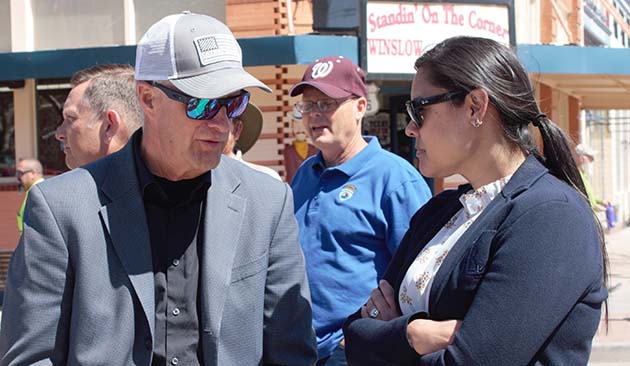
Last week, the Army Corps of Engineers, Navajo County and Winslow officials, civilian contractors and consultants toured the city and the site of the Winslow Levee. The reason for their visit was to begin the design phase of the reconstruction of the Winslow Levee on the Little Colorado River.
The project was recently awarded $65 million from the federal government as part of the Infrastructure Investment and Jobs Act of 2020. That money funds the Army Corps portion of the estimated $100 million project. The City of Winslow will be responsible for funding the remaining $35 million.
According to County Government Relations Director Rochelle Lacapa, “That is where partnerships with the county and other stakeholders will come to play. We will have to explore our options including investigating our bond capacity and things like that. We will have to see what we can offer in-kind and how much money will need to be ultimately spent.”
Lacapa also spoke about the conversations that have been happening that have had a hand in securing the $65 in funding. In addition to the efforts by Congressman Tom O’Halleran and senators Mark Kelly and Kyrsten Sinema, county and city lobby groups have also been instrumental in this process. Robert Holmes, of the Nexxus Consulting Group said, “We came on with the City of Winslow last year and within the year, we were able to get the entire congressional delegation on board with this project.”
Lacapa explained that the levee has been on the list of federal projects for a long time. However, as she said, “It wasn’t really a priority. Part of what finally showed Congress that it should be prioritized were the social factors of the area.”
One of those factors, she said, is the Navajo-Hopi Relocation Act of 1974. Thousands of Native Americans were relocated to Winslow and the surrounding areas during that time, most directly into flood zones. The deterioration of the levee puts their homes and businesses at risk.
In fact, decertification of the levee placed nearly two-thirds of Winslow residents, most of which live below the federal poverty line, into the position of needing to carry flood insurance they cannot afford.
The redesign and reconstruction of nearly 23,000 feet of the levee will reduce those costs and risks. It will also alleviate restrictions set forth by FEMA (Federal Emergency Management Agency) on improvements and renovations of properties in the flood zone, which includes every emergency service provider, the hospital, four of five schools, multiple businesses and nearly every home in Winslow.
Economic development has also been stifled in Winslow due to flood zone restrictions. Winslow’s Economic Development Director Una Wirkebau said, “This visit from the Army Corps of Engineers is so important because, even though we have made the announcement that we have received funding to fix our levee, having them come here to visit offers them a perspective on the project. Having their buy in is massive. Having them understand the community dynamics and how this has affected us and the businesses and how it plays into developers have chosen to not come here is a big factor. We have a number of manufacturers that have been watching Winslow for decades waiting for the levee situation to be fixed. We have huge potential and even more now that there is movement on the project.”
She continued, “FEMA has requirements for developers building in a flood zone. Those perimeters are very costly. They add a lot of expense and a lot of time to building so those are deterrents. For home builders and home buyers, additional cost due to the mandatory flood insurance may price some of them out of owning or building.”
The Winslow levee has been the topic of discussion since its decommission in 2008. However, as Wirkebau pointed out, “We now have an actual timeline for when this could be finished. We were looking at 2031 for completion, but we are now seeing that because its not as bad as originally thought, and after the Army Corps has come through here and funding is secured, we are looking to get this done sooner. We are really pushing them to do what is called a design/build. That means that we won’t have to come to the table with our financial match right away and the process will move much more quickly because it will be a simultaneous project.”
Primary engineer and civilian contractor David Van Dorpe explained, “A traditional contract delivery model in civil works is you 100% design it, then you solicit a construction contract, then you build it. In a design/build, we only bring it to about the 35% level of design and then we award the contract, and that contractor finishes the design and builds at the same time. There can be a lot of efficiencies in design and cost.”
Program manager and engineer Priyanka Wadhawan explained, “This is not as involved as we originally thought. The plan is to rebuild the levee downstream to north of North Road with no levee improvements necessary downstream. We will need to improve the conveyance under the BNSF Railroad Bridge by removing saltceder (also known as tamarisk) and river channelization. We will also need to set the levee back from the Homolovi State Park and ruins.”
Colonel Balten added, “I really think getting on the ground and understanding how this will benefit the community here is a home run. This is why we are public servants and why we are in this Corps, to do community service.”
Civilian engineer Cheree Peterson also offered her positive outlook on the levee project. She said, “I have been on this project since it was just a study and seeing it in person today and seeing the kind of real improvement its going to make for this community is not something you see often. We are very optimistic for the future and see that it will go well.”
Van Dorpe concluded, “Right now, as we understand this to be, we are looking at a two-year design phase and a three-to-four-year build. That is a timeline that is much better than we originally planned for, and we cannot wait to get started for the fine town of Winslow.”