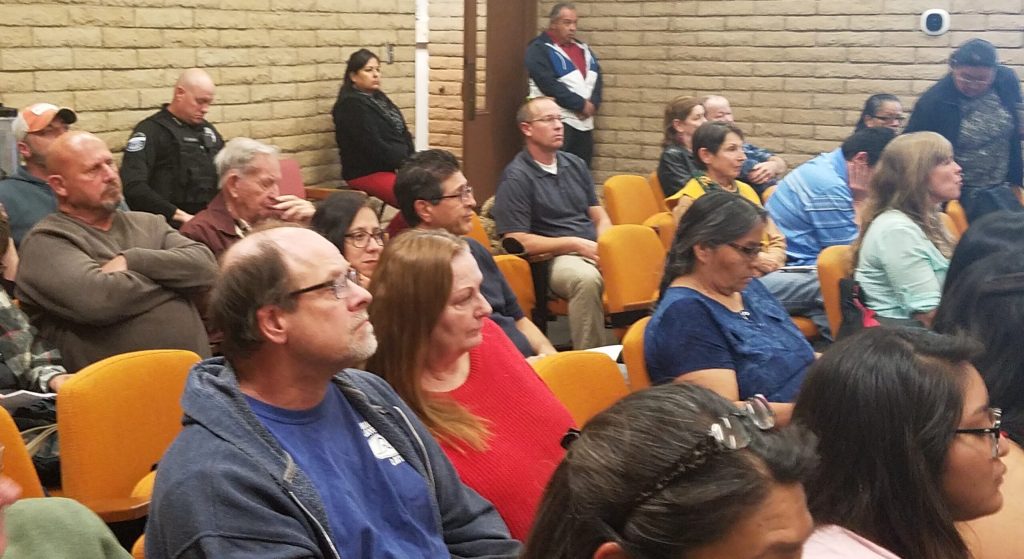
By L. Parsons During the Winslow City Council meeting last week, a group of concerned citizens addressed a possible ordinance that would protect members of the LGBTQ (lesbian, gay, bisexual, transgender, queer) community from discrimination in terms of employment and other public accommodations. Ten speakers addressed the issue that was proposed by Mayor Tom McCauley in a council meeting last month but has yet to be written by city staff for the council to consider. Winslow resident Kathy Contreras addressed the council noting that since 2013, five cities have an ordinance similar to the one McCauley proposed including Tempe, Flagstaff, Tucson, Mesa and Sedona. “Scottsdale twice held meetings about putting in this and it failed to pass. The reasons being that businesses with 15 or less employees would be negatively impacted, also citing that a patchwork of different ordinances varying from city to city does more harm than good.” She also noted that Tempe has LGBTQ non-discrimination protections that businesses must adhere to or face a fine. Contreras stated that she investigated the claims on the One Community website as to the 225 cities in the country who have an ordinance of this nature and was unable to verify their sources. “The most independent economic articles focused only on boycotting costs and several lists of companies to avoid buying from and major companies that they endorse due to funding. But none showed an increase in tourism, even in Sedona, by having this ordinance.” Dave Conaster, a retired Winslow schoolteacher asked, “Who is a non-privileged person in Winslow? Well right now, we are saying that if you are homosexual, you are. So, we pinpoint people. We are saying that if you pass this ordinance, if you get a job and you goof off on the job and don’t do it well, you can’t be fired.” Community members continued to take the podium, speaking for the allotted five minutes each. Fred Garza, “I’m going to point out as a community per the city, they have had zero complaints against lesbian, gay, bisexual and transgender people, so I think it’s incumbent upon all of us to look at any special interest group based on the facts and statistics of such groups and the desire to get Winslow to grant special privileges.” Garza went on to cite statistics on the number of people who identify as LGBTQ who suffer from AIDS, suicide and depression. “If I did that litmus test (as to) whether or not I thought this was a good idea coming to my home I’m afraid that would fail.” While the issue being addressed was inclusion, some of the individuals addressing the council instead took the opportunity to speak out against the LGBTQ community in general. Lou Slonczewski, a long time Winslow resident cited the Bible, “In Leviticus 18:32, (it states) one shall not lie with a male as one lies with a female, it is an abomination. Some folks might call that hate speech. Well I have to disagree with that.” Pastor Fred Harris of the First Baptist Church of Winslow equated homosexuality with being a thief saying, “I don’t view being born with a certain nature as a license to sin. If a person manifests their sinful propensities as LGBTQ preferences, that’s no more defensible than my child’s propensity to take something that doesn’t belong to them.” Harris labeled members of the LGBTQ community as a “completely different category than something like race.” He explained, “I’ve never seen Jesus bring someone out of being black or brown or white. Warning someone who identifies as LGBTQ about any dangers inherent in the lifestyle or considering the lifestyle as immoral because of religious views is considered to be on the same level of intolerance as telling a black man that it is immoral for him to be black, or white man that it is physically dangerous to continue living the life of being white.” Harris spoke about the ordinance from his point of view saying, “Ironically all the name of equality, inclusion and religious freedom. This ordinance, if accepted, in its very nature would insist that a photographer would have to photograph a homosexual wedding that is against his religious values. The Christian that wants to start a daycare would be forced to hire a man who prefers wearing dresses simply because he’s good with kids despite whether it’s an offense to Christian parents who might not want him around their children.” Citizens spoke against the proposal but also against the council. Elizabeth Petreman said that if the ordinance is passed, “You’re saying that the people of Winslow no longer believe in God and that Satan is alive and well and flourishing in this town.” Others pointed out that they were afraid they would lose their ministries or businesses if such an ordinance were to pass. Dr. Lula Stago spoke regarding the Native American standpoint on the issue. She stated that she has been discriminated against all of her life because of the color of her skin. “I don’t go around and file lawsuits because I’m discriminated from a job or from whatever. That’s a normal experience. This has nothing to do with discrimination, it is making a stand for what is right.” Dr. Stago added, “This group we are talking about made a choice. Because it’s a choice, they can always change it…. Everybody has a right to be happy. But not at the expense of somebody.” There were those that addressed the council in support of protecting citizens from discrimination. One of those was Lavetta Penrod, a long time Winslow resident who said, “It’s always edifying to the spirit to go to church. However, tonight I would like to address this government issue. I support and encourage the city council and mayor for their forward thinking in considering an inclusive ordinance. I and many others applaud the active role that you are taking in bringing in more business and income to Winslow. “Because of the visceral reaction from a few in this town I felt the need to counter their uninformed attacks. In fact, the attacks and misinformation give substance to the fact that the LGBTQ community do need support and sometimes protections. But this ordinance does not do that. It simply says, ‘open for business to everyone.’ Somehow that is threatening to some.” Carly Murray also came forward in support of an ordinance. She said, “I voted for you for what you would do with my government not what your Christian beliefs are. History will look back on this moment, it is just like the civil rights movement whether you realize it or not.” In response to the statements made in the meeting, ONE Community Arizona President Angela Hughey responded to The Tribune by email saying, “ONE Community proudly partners with churches across Arizona, and over 450 faith leaders have signed our ‘open for worship to everyone’ unity pledge. We agree that freedom of religion is important; that’s why it is protected by the First Amendment in the U.S. Constitution and in Arizona law. But religious beliefs ought not be used to harm people. Businesses open to the public should be open to everyone on the same terms. Businesses are not houses of worship; they should serve everyone equally. “In Arizona, people are protected based on a multitude of characteristics like religion, race, gender, national origin and disability. When they are discriminated against based on these characteristics they can seek legal recourse. Because sexual orientation and gender identity are not included among these characteristics, when LGBTQ people face discrimination there are no legal channels for them to pursue. We are committed to equal protections, not special protections.” Per the rules of the City Charter the council may not address or discuss comments made during the call to the public. However, McCauley later stated, “I would just encourage everyone to read the full draft of the ordinance once it is available.” A decision will be made by the council at its next regular meeting scheduled for 6:30 p.m. on Tuesday, Nov. 13, in the council chambers, located at 115 E. Second St. The agenda along with supporting documents will be available on the city website, www.winslowaz.gov at least one week ahead of that date.