

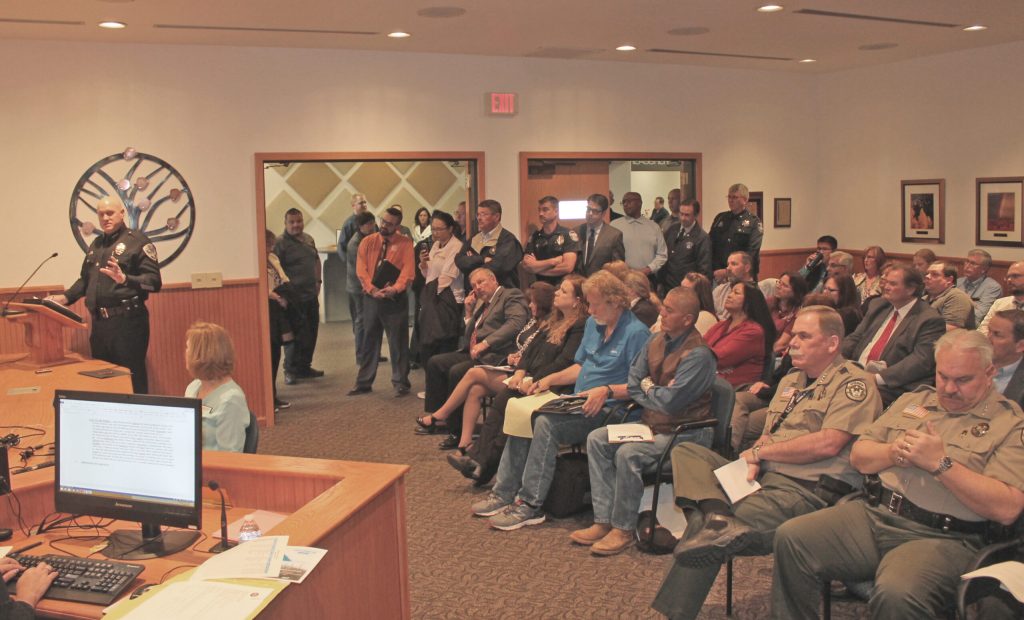
During last week’s meeting of the Navajo County Board of Supervisors, the majority of the board voted to close the Child Support Division and the Navajo County Juvenile Detention facility.
The closures will impact local services and cause the loss of 31 jobs effective June 30, but is anticipated to provide $800,000 to help offset an anticipated $1.2 million deficit in the county’s 2017-18 budget. Those in attendance to discuss the matter included citizens, county employees and representatives from law enforcement agencies throughout the county.
County administrators estimate a $1.2 million shortfall in property taxes due to the partial closure of Cholla Power Plant in Joseph City and the Peabody Mine in Kayenta. Added to that is a continuing loss in sales tax revenues, which Assistant County Manager Bryan Layton noted were already down $130,000 for this year.
Layton also explained that the costs for the Elected Officials Retirement Plan increased by $558,000 for this year, with additional cost increases expected for Microsoft contracts, the increased minimum wage and health insurance.
In addition to the increased costs and loss of funds, the county is faced with an aging fleet and equipment. “The average age of our vehicle fleet is 11 to 13 years old, and for heavy equipment, the average age is 19 years,” noted Layton.
The proposal by administrative staff was to move the juveniles in the 40-bed facility in Navajo County to either the Graham or Pinal county facilities for an annual anticipated savings of $600,000. The detention facility holds an average of 7.1 juveniles daily from Navajo and Apache counties, with Juvenile Director Arno Hall noting that 332 juveniles were detained in the facility last year.
Navajo County Superior Court Judge Michaela Ruechel addressed the board with a number of questions regarding the closure of the juvenile detention facility, asking if the savings noted included the loss of revenue from Bureau of Indian Affairs and Apache County contracts, medical expenses related to juveniles and transportation. “What happens if a new facility raises rates, either because our numbers are higher than expected, or because their numbers increase and they have to bring in more staff than originally anticipated?” she asked.
Regarding the employees who will lose their jobs, she said, “You will be taking jobs that, as a group, have devoted more than 100 years to this county, and then turn around and give that money to another county.”
St. Johns Police Chief Dan Brown addressed the board as president of the Northeast Arizona Police Association, representing law enforcement agencies in Navajo and Apache counties. He advised the board that 90 percent of the NAPA membership is opposed to the closure of the detention center.
“Apache County pays just under $100,000 contracting with Navajo County. If you close this facility, you will be closing the last (juvenile) detention center in northeastern Arizona. If this is inevitable action, if this is the low hanging fruit, then law enforcement needs a say so. We need to be able to sit down and discuss what is going to happen when our kids cannot see their families because they’re four or five hours away. We live in a very poor area. These are children, and if these children go down to Florence or somewhere else, how much of an inconvenience will it be for these families to go down there?” Brown asked.
“It is devastating this whole area because of the lack of industry, lack of tax, lack of voting measures; something needs to change. Give us a little more time to research. See what we can do between our two counties and all of our agencies to help solve this problem before you vote on it.”
Navajo County Sheriff KC Clark stated that in his opinion, this is an issue that has been addressed with cities and towns for months. “This is still a long ways off, so due diligence has been done. We are committed to working with cities on transporting these juveniles,” he said.
“As a taxpayer I think this is a wise decision. When the power plant closes, and we all know it’s going to close, it’s going to be very devastating to this region.”
Juvenile Diversion Coordinator Lynda Wilson noted, “Every probation department in the state with the exception of two has had some conversation about the closing of our facility. The two departments that have not been included are Apache and Navajo County probation, the two primary stakeholders. This begs the question why? Why have we been excluded? We are the subject matter experts.”
Wilson explained how those in juvenile detention serve beyond their time in the facility. “We go and see them at home, school and work, in the community or in detention,” she noted.
She also disagreed with the amount listed as savings, saying that would be a “best case scenario” and that associated costs will build up within the year.
“Studies show that the juveniles who are incarcerated away from home are 21 percent more likely to reoffend. Their arrest rate increases nearly 33 percent. In 2007, the number of juveniles who committed violent offenses in Navajo County was 43 and in 2015 it was 15. This represents a 31 percent decline. Our current model shows a cost saving of between $12 and $24 for every dollar spent on delinquent youth. How naïve it is to think that by incarcerating our juveniles 200 miles away we will have better results than statistical models have shown,” she said.
Wilson also noted that a closure places an undue burden on law enforcement agencies, as they would be expected to send officers on a 400-mile round trip with a juvenile in custody.
Following the meeting, Holbrook Police Chief Mark Jackson said that he agrees with Wilson’s comments. He noted that he had only heard of the agenda item the day prior to the meeting and that other small law enforcement agencies in the area such as Snowflake/Taylor and Pinetop were also not informed until just prior to the meeting. Jackson heads a department that is already down three officers and is struggling to find replacements.
“I understand it’s difficult with the county shortfall, but you’re impacting the smaller communities and public safety. This takes an officer off the road for at least eight hours in order to transport a juvenile, plus fuel and per diem,” said Jackson, who added that his officers are already working 12-hour shifts with eight hours overtime each week.
During the meeting District III Supervisor Jason Whiting questioned whether removing the juveniles would be violating mandated services required by county government.
Navajo County Attorney Brad Carlyon stated that it was somewhat of a gray area, because the county was allowed to partner with other agencies to provide services, but it did not state that those partnerships had to be within the same county.
During the discussion regarding Child Support Services administered by the county attorney’s office, Carlyon said that he understands the circumstances the county is in, but that he also understands the services being provided for single parent families in the county.
“It’s not the Attorney General’s responsibility to provide these services, they just had a co-existing ability to do so just as they do to charge criminal cases. I understand the finances. The toughest part is that we’ve gotten to this point where it’s on the agenda. I’ve failed my child support people,” he said.
The decision was to have the Attorney General’s Office provide the service as it already does for most Arizona counties. It’s anticipated the closure of that office will produce an annual savings of $200,000.
In making the decision, District IV Supervisor Steve Williams stated, “I’m with you that local control is good. Sometimes you have to make the tough decisions, but still have the service provided for our citizens. I think sometimes you have to step up and square your shoulders to make the best decision for the county as a whole.”
Following the decision to close both offices, District V Supervisor Dawnafe Whitesinger noted, “We are responsible for protecting, overseeing and championing, and supporting the taxpayers and the dollars that come to us. We are in a crisis position and we don’t want to be, but if we look away when we have to make tough decisions then that crisis position tends to grow.”
Each of the supervisors expressed regret at having to make the decisions presented to them, with the motion to close Child Support Services passing unanimously and the decision to close the Navajo County Juvenile Detention facility approved by Whiting, Williams, Whitesinger and Chairman Jesse Thompson, but opposed by Supervisor Lee Jack. Both closures will go into effect at the end of June, with the county to work with either Graham or Pinal county to create a partnership agreement to house juvenile offenders.




