Rising from the desert scrublands of chaparral and sage, 55 miles west of downtown Phoenix near the town of Tonopah, are the three gray reactor domes of the Palo Verde Generating Station.
Set against the arid backdrop of the desert, and with the defeat of Proposition 127, Palo Verde and the 100-percent carbon-free energy produced there continues to be “the anchor of Arizona’s clean-energy future”.
As the largest nuclear generating plant in the United States, powering an estimated four million homes and businesses in the states of Arizona, California, New Mexico and Texas, and being the only nuclear plant in the world that was not built near a large body of water, Palo Verde is on the cutting edge of the new world of nuclear technology.
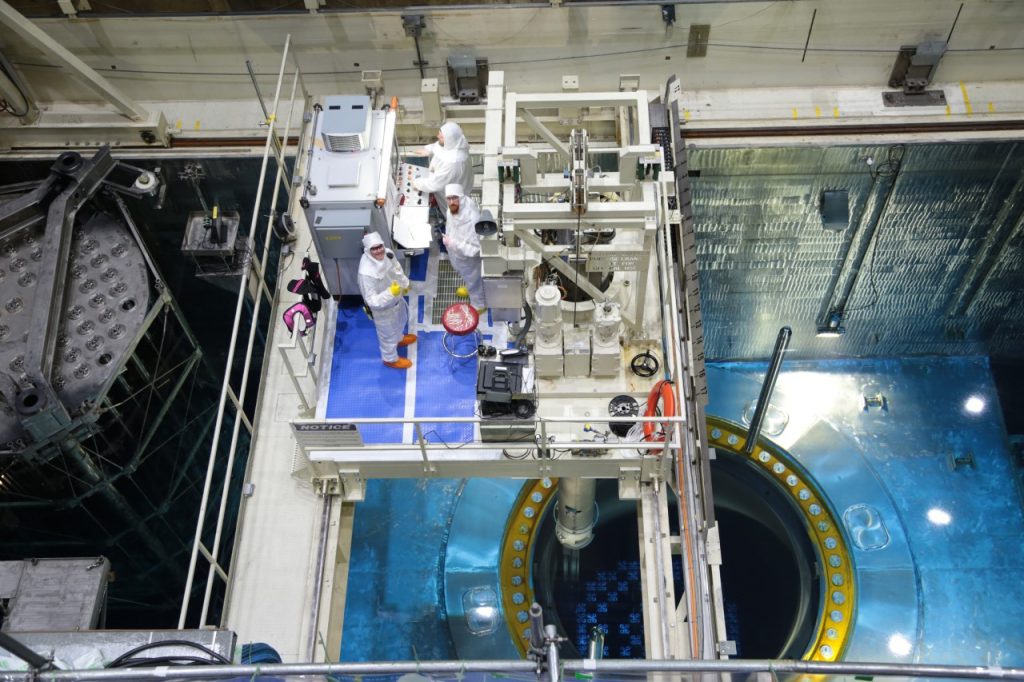
Arizona Public Service (APS), the operators and one of seven owners of Palo Verde, opens the plant to media tours twice a year to view the inside of one of the reactors during the refueling and maintenance of the core, providing an opportunity to tour Reactor Two during the October shutdown.
Palo Verde was the dream child of the Arizona Nuclear Power Project, which was a joint endeavor between Arizona Public Service (APS) and Salt River Project (SRP). The plant took 12 years to build at a cost of nearly $6 billion.
In full operation by 1988, today Palo Verde stands as a tribute to the Arizona ingenuity and fortitude and as a model throughout the world as the nation’s top energy producer of any kind since 1992, creating safe, clean energy while reusing treated wastewater.
Unlike most multi-unit nuclear power plants that share common control rooms, turbine buildings, spent fuel pools, etc., each of Palo Verde’s three units is independent of one another.
The reactor containment buildings are some of the largest in the world. The facility’s design incorporates many features to enhance safety by addressing issues identified in the early years of commercial reactors. The design is also one of the most spacious internally, allowing for exceptional room for conducting operations and maintenance by staff and media tours when the reactor is shut down.
Those taking the tour were dressed in the white, crinkly suits that are designed to keep low-level radioactive dust inside the containment buildings and not carried out on clothing.
Also worn are on the feet are inner booties and outer booties, then two sets of gloves, followed by a full-body zip up suit, head gear and safety glasses; a process that takes nearly 20 minutes to complete.
Some on the tour joked about no longer needing night lights and glowing in the dark, but in reality, no one was sure of what to expect standing before the massive metal door that took the group through an airlock and into the bowels of the reactor.
Safety was the number one component of not only the tour but also the entire plant. From radiation dosimetry meters tucked into the front pocket of the suits and hard hat clips worn on collars and safety glasses, to the strict warning not to touch their faces for any reason due to possible contamination, the group began the core tour by climbing a series of steep metal steps that led to the catwalk above. All around was a mass of concrete and steel with pipes and tanks covering nearly every available space.
To those who lead the tour, Plant Manager of Water Resources Rick Lange and Director of Strategic Business Services Don Naughton, this was home. Every twist and turn carried a story of how the system worked. Among the things that stood out most was the absolute adherence to safety; there was never a need to hurry. In a quiet, almost zen approach to care, every movement was a process and had meaning.
While in the reactor, the men explained how the system worked. Built with the similar concept of the coal and gas-fired plants, only using uranium for the fuel, the nuclear fission heats the water, which creates steam and turns the giant turbines that produce the electricity.
Palo Verde operates three Pressurized Water Reactors (PWRs), which is the most common type of reactor. Originally utilized as a way to operate the nation’s submarines, PWRs use ordinary water for both cooling the fuel and moderating the temperature throughout the process. The name PWR comes from a primary cooling circuit that flows through the core at high pressure, while a secondary circuit in which the steam is generated, drives the turbine.
Every six months, one of the three reactors is cycled for shut down for maintenance and refueling, which means each reactor is online for 18 months at a time.
During the shutdown, Naughton explained, “We off-load the entire core into the spent fuel pool which allows us to do maintenance. Then we refuel the core, putting roughly two-thirds of the old fuel back in along with one-third fresh fuel.”
The fuel is generally used three times before it is moved to the fuel pool for up to seven years before it is cool enough to put into dry cask storage. With a little more than 30 years of operation, the canisters of spent fuel are stored in an area less than half the size of a football field.
The uranium for the plant is bought from sources all around the world, with the fuel being fabricated on the east coast where it is made into small 0.3 gram pellets – about the size of a gummy bear.
Naughton said, “We have even used demilitarized uranium. But it is important to know that our uranium cannot be turned into anything ugly because it is only enriched at about five percent.”
After leaving the reactor, the group was able to remove their suits, which were put into barrels where they are disposed of properly. Those in the group had their hands, the bottoms of shoes and their street clothes all checked for any detection of radiation.
Over and over throughout the tour, the group was scanned in several different ways. Never once was there a whiff of extra radiation. As APS Executive Vice President and Chief Nuclear Officer Bob Bement shared in the first briefing, “I believe this is the safest place to work in the state. We take great pride in doing our task right the first time.”
At one point in the tour, one of the massive turbines turned by the steam power produced by the reactor was started. “Each unit’s turbine spins the generator at a force of 1.9 million horse power,” said Lange.
Stepping into the breezeway between buildings, Lange pointed out the two on-site reservoirs for use in the nine cooling towers, which require between 40,000 and 50,000 gallons of water a minute when all three reactors are at peak performance.
Palo Verde is the only nuclear plant in the world not built near a body of water. Instead the plant uses 20 billion gallons of treated wastewater annually from the nearby cities for its water use. The wastewater travels through 36 miles of underground pipe before it reaches the storage reservoirs, where it is cleaned.
“We take 100 tons of impurities daily out of the water we receive,” said Lange. Preventing the build-up of minerals in the water allows the turbine generator to operate at the most efficient levels.
“We need to make the water as clean as possible. If we keep the water clean, the condensers stay cleaner which prevents extra maintenance, allowing for cheaper electricity for customers. Palo Verde is a steam plant on steroids,” Kory Raftery, department leader of communications, had noted in an earlier presentation.
The two storage reservoirs have a combined capacity of one billion gallons and can provide up to 14 days storage of makeup water to cool the condensers in the three nuclear units operating at full capacity during peak conditions in the hot summertime weather. “Every drop of water is literally used 25 times before it evaporates into the air,” shared Lange.
At the lunch presentation with Vice President of Operations Support Mike McLaughlin, Senior Vice President of Operations Jack Cadogan and Director of Communications Greg Cameron, Cadogan shared that Palo Verde was originally licensed to 2027. “We are now renewed to 2047 and believe that we will easily be licensed up to 2067 as the plant is in great shape.
“The people who built this plant were visionaries,” said Cadogan. “And they had guts to believe used waste water would be feasible. We have run the plant successfully since the beginning. In a world without nuclear power, we would not be able to meet the federal goals for clean energy. A lot of environmental scientists have concluded that the only way to seriously stop the impact of carbon-based energy on the planet is to increase the amount of nuclear power, not decrease it.”
The big three energy generators of the world are natural gas at 32 percent; coal generation at 30 percent and nuclear plants at 20 percent. “That 20 percent from nuclear plants produces nearly 60 percent of all the carbon-free, clean-energy in our country,” noted Cadogan. “If Palo Verde ceased operations, the impact of fossil fuel generated plants is estimated to be like adding the carbon emissions of 118 million vehicles to our state.”
Not only does Palo Verde produce more than 70 percent of Arizona’s clean air energy, it also attracts a workforce of environmentally-minded young people.
Bement said, “As good as the leading technology of the plant and nuclear generation are, the people are even better. The security team is made up of approximately 33 percent from the military, many coming from the nuclear operations of the navy. We have a legacy class of engineers from our local universities, with a 95 percent retention rate among the engineers.”
Lange added, “It takes 24 months of training at the cost of about $500,000 per student before an employee is allowed to touch a piece of equipment or implement a calculation as a licensed operator.”
In the final moments of the tour, the group was taken into the training simulation rooms. Stepping through the doorway of the largest room was like stepping on board a starship from a science fiction movie. The two trainers stepped those in the tour through the dials and buttons, showing how the plant runs from behind the circuitry.
At one point, a simulated emergency scenario core melt down was done, with muted lights and sounds, under the guidance of the staff and the computer, the emergency “melt down” was quickly stopped and the system went into recovery mode.
On Nov. 6, Arizona voters overwhelming rejected Proposition 127, keeping Palo Verde safe for now.
“We’ve said throughout this campaign there is a better way to create a clean-energy future for Arizona that is also affordable and reliable,” said APS Chairman, President and CEO Don Brandt. “Any serious plan to reduce carbon emissions has to include nuclear energy and Palo Verde. Our energy mix is already 50 percent clean, and the addition of battery storage technology on our existing solar facilities together with other initiatives, like increased infrastructure investment to support electric vehicles, will continue to advance our clean-energy vision.”