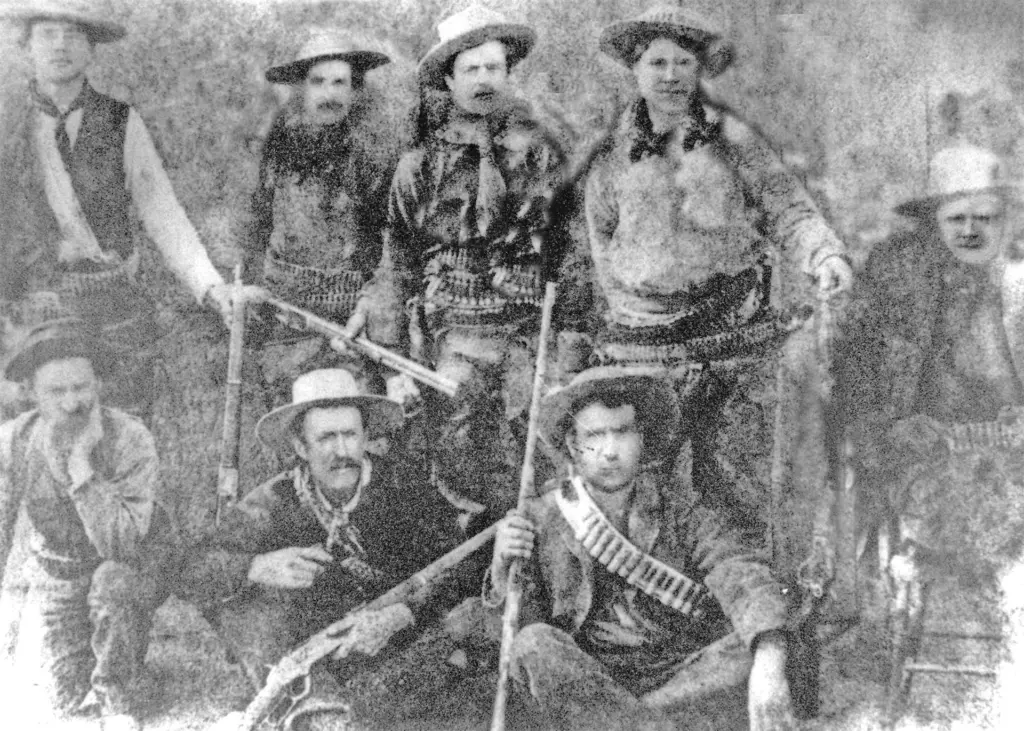
This 1880s photo of Hashknife cowboys shows some of the rough, hard-working men who rode for Aztec Land & Cattle Company. The outfit managed thousands of head of cattle spread over two million acres between New Mexico and Flagstaff. The main office for Aztec Land & Cattle was in Holbrook. Today the company owns approximately 239,000 acres in Navajo County between Holbrook, Joseph City, Snowflake and Heber.
Shares of Aztec Land & Cattle Company, the 142-year-old firm that owns approximately 239,000 acres in Navajo County between Holbrook, Joseph City, Snowflake and Heber, closed Friday at $2,700, more than double the price of a year ago and about two-thirds higher than at the start of 2026. The stock touched $2,800 earlier this month, the highest price in its history. At Friday's close the company's roughly 141,800 outstanding shares were worth about $380 million.
The climb has happened with almost nobody trading. Aztec's shares change hands over the counter under the symbol AZLCZ and on most days fewer than two dozen trade; three shares traded Friday. Prices set on that little volume can move sharply on a single order and for much of the run-up the company itself was the biggest buyer.
Aztec bought back and retired 8,066 of its own shares in 2025 and 278 in 2024, about 5.6% of what had been outstanding, at a total cost of about $7.7 million, according to the company's summary of its annual stockholders meeting held March 3 in New York. It paid for the purchases with corporate cash and $3.24 million borrowed from two of its directors at 6.5% and 7% interest and told shareholders it does not currently have the cash to buy more.
How quickly the price has moved shows up in the company's own paperwork. When Aztec issued 133 restricted shares to directors and consultants on Jan. 5, it valued them at $1,328 apiece, a figure its equity plan sets from the average of bids and asks over the prior three months, according to the company's audited 2025 financial statements. Friday's close was more than double that.
What investors are paying for is rent. Aztec and its affiliate, Aztec Land Company LLC, which holds part of the acreage and whose units are stapled to each share of the corporation's stock, reported combined revenue of about $8 million in 2025, including a $1.2 million transaction between the two entities, according to the meeting summary. The corporation collected $3.66 million in rentals last year and reported $2.34 million left after expenses and income taxes. The company collected $2.33 million and its auditors reported that 96% of that came from renewable energy leases and that three leases alone produced 93% of its revenue. Grazing leases, the company's original business, were projected to bring in about $222,000 across all its land in 2026.
Those leases are the wind and solar plants rising south of Joseph City and Holbrook. The 504-megawatt West Camp Wind Farm, built by AES on Aztec land roughly 10 miles south of Joseph City with 112 turbines, began delivering power in April, according to U.S. Energy Information Administration generator data and Aztec told shareholders it collects a per-turbine fee during construction and lease payments once turbines run. AES says the project will employ 14 to 18 full-time staff. Invenergy's Hashknife Energy Center, a 475-megawatt solar and battery project in two phases that broke ground in December 2024 and connects to the Cholla substation, is under construction and expected to reach commercial operation in 2027; Invenergy says it will support up to 450 construction jobs, as many as 16 permanent positions and more than $49 million in payments to the county over its life. On March 11, Aztec told investors that another lessee had signed a 20-year power purchase agreement with an Arizona utility for 400 megawatts of solar and battery storage on about 2,200 acres of Aztec land, with construction expected to start later this year and last up to two years. Aztec said it has not seen the agreement and does not know its terms and that its own lease runs 25 years but can be ended by the developer for a fee.
For Navajo County, the distinction between what the land earns and who collects it matters. Most of the money that flows from the projects to the county comes from the developers rather than the landowner. The wind turbines, solar panels and batteries are the developers' property and are taxed as such, which is where Invenergy's $49 million figure comes from and the construction payrolls are theirs as well. Aztec itself paid $9,093 in real estate and mineral taxes in 2025, according to its audited statements, a figure consistent with Arizona's practice of valuing grazing land on its agricultural use rather than its market price. The lease income goes to a company headquartered in Phoenix whose stockholders met this year in Manhattan and the LLC paid them $8 per unit, or about $1.13 million, from its 2025 earnings.
The company's filings also describe several things in the county that have not happened yet. Aztec told shareholders it is trying to entitle a manufactured housing development on a section of its land inside the Town of Taylor, granted a gravel operator an option to buy 640 acres and sold about 16 acres to a renewable developer for an electrical substation. On data centers, director Clare Brophy Bellendir told in the March meeting that attracting them to the area is unlikely without new gas or nuclear generation. A 2020 agreement with an outside company to explore for oil, gas and helium under Aztec's 318,000 acres of mineral rights has expired and the company reported nothing new beyond lease payments.
Water runs under all of it. Aztec and its affiliate own most of the land served by the Little Colorado Water Conservation District, which holds a 100-year lease on the company's well field near Holbrook and state approval to pump up to 10,184 acre-feet a year from it through 2035. The district delivered about 95 acre-feet from that field in 2025 and none the year before. The company also holds rights to 13,490 acre-feet a year from a second well field it bought in 2017. All of those claims remain subject to the Little Colorado River general stream adjudication, a case pending for more than 40 years and the 2024 settlement among the Hopi Tribe, the Navajo Nation and the state parties still await an act of Congress to fund it. Aztec told shareholders it expects litigation costs to be significant for years regardless.
Aztec was formed in 1884 to buy a million acres of railroad grant land across northern Arizona and ran the Hashknife outfit, the cattle operation that gave Holbrook its early reputation. It spent most of the following century as a grazing landlord and since the 1960s has worked to consolidate its scattered sections into contiguous blocks. Navajo County adopted the company's Aztec Area Plan into the county comprehensive plan in 2011 and the company bought the Apache Railway out of bankruptcy in 2015. The land has not changed. What has changed is what buyers of the stock expect it to earn and by the company's own accounting that expectation currently rests on a handful of energy leases.