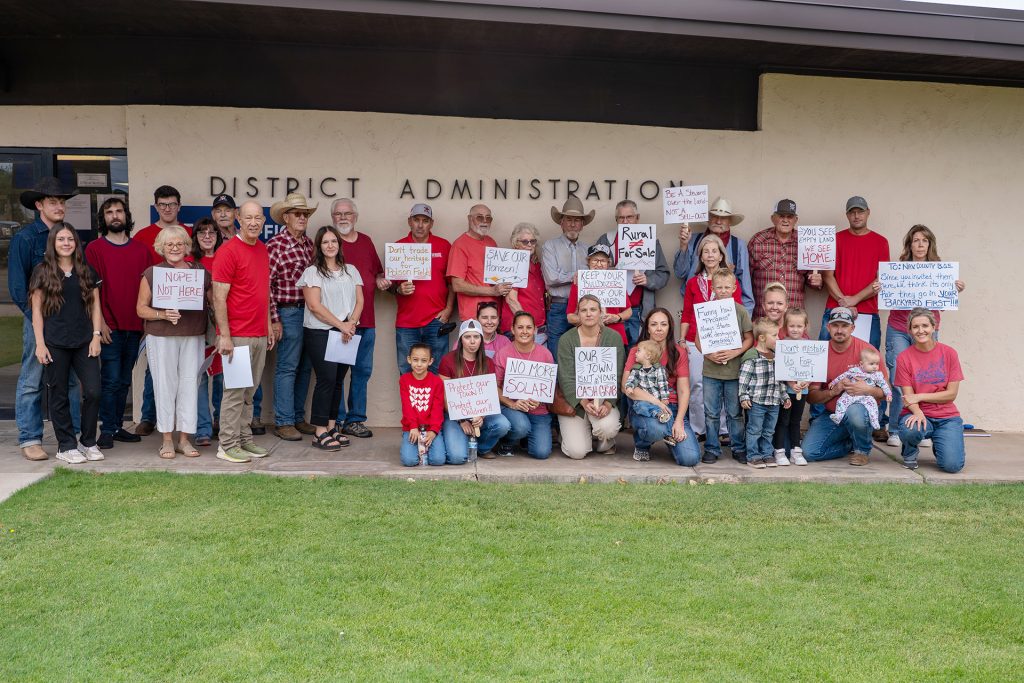
More than 35 residents turned out to an Invenergy open house at Joseph City Elementary School last week to oppose a proposed solar and battery storage project north of town, the second and considerably larger of two facilities the company behind the Hashknife solar projects wants to build in the area. They pressed company representatives on local hiring, road damage from construction traffic and who would ultimately buy the power. Several in attendance said they left without answers.
Invenergy’s Honeymoon Trail Energy Center would pair 600 megawatts of solar generation with 600 megawatts of battery storage capable of holding 3,600 megawatt-hours, according to the project’s website. The company says it would generate enough electricity to power about 179,000 homes. Hashknife, by comparison, is a 475-megawatt project on roughly 3,960 acres. The question of the acreage that the Honeymoon Trail project would encompass was not answered by Invenergy as of press time.
Holbrook City Council member Robert Black, who attended the open house, said the region has moved past the point where residents will absorb new projects quietly and that the number of developments now proposed or underway around Holbrook, Winslow and Joseph City has outstripped what anyone anticipated.
“I think all of us were okay when one or two of these projects come in,” Black said. “And we thought, well, if we need them, we need them. But none of us understood the magnitude of what’s going on around here.”
Black said the objections run deeper than aesthetics, and that county officials have misjudged how much more residents will tolerate. “I don’t know how much patience the (Navajo County) board of supervisors thinks that these people have, but they’re out of it,” he said. “These people don’t get upset too easy over little things. This is huge to them. This is their way of life. This is rural communities that they thought they’d retire in, that they laid back communities, and this is all taking it away from them.”
He said residents have raised questions about property values, dust from construction and whether they will end up leaving. “They’re upset, and it’s not going to go away so it’d be a good idea for people to start listening. If people start listening, I think things will calm down and be all right, but the more of these projects you start throwing out here, the more upset people are going to be.”
Jeffrey Strong, a Joseph City resident, said he asked about local hiring and about where the electricity would go and was not satisfied with the response to either.
“There’s not really a lot of opportunities,” Strong said. “That’s pretty concerning to me.” He said no one at the meeting could tell him who would buy the power, beyond one company representative saying it would go to the grid.
Strong also said road conditions and construction traffic drew significant concern, and that local roads have been torn up by project vehicles. This referencing reckless driving by drivers for Blatner Energy, a contractor for Invenergy. Driving that Sheriff David Clouse said commanded special attention from his department and resulted in a dozen arrests and numerous citations.
Among those with the most at stake are ranchers whose operations border the proposed site. Curren Murph, whose family runs cattle on the land immediately west of it, said the project would sit on sections checkerboarded between federal and private ownership and would occupy two or three sections along his family’s entire eastern border.
“They have different sections of land checkerboarded in between BLM and then the private land,” Murph said. “And they go right up against our eastern border all the way up.”
Murph said the family already looks at solar panels to the west, and that the new project would close in the other side. “It’s going to be right up against our border, and it’s kind of almost the same as being on our ranch, even if it’s not,” he said. “We’re going to have to look at it every day, and it sucks, and nobody wants to see it.”
Murph added that he believes there are steps Invenergy could take to make the project less damaging to the community and to ranchers who do not yet have solar development on their operations.
Casey Murph, Curren’s father has fought a public battle and attracted federal attention with a separate solar company’s potential move onto state trust land his family uses for winter pasture, said he came looking for specifics about how this project would affect his operation and left without them. “I got to ask some questions, but I haven’t got very good answers,” he said.
The project is in what Invenergy calls its “site characterization and permitting phase,” meaning the company is conducting environmental surveys and preparing permit applications. A display panel at the open house put construction beginning in 2028, with the facility delivering power in 2030.
Invenergy says the project would support about 500 construction jobs, for the construction duration about 18-24 months, at peak and create six to eight permanent full-time positions once operating. The company’s project website lists “$34 million-plus total economic investment” without specifying whether that figure represents construction cost, local spending or lifetime tax revenue. Requests for clarification were not provided before going to print.
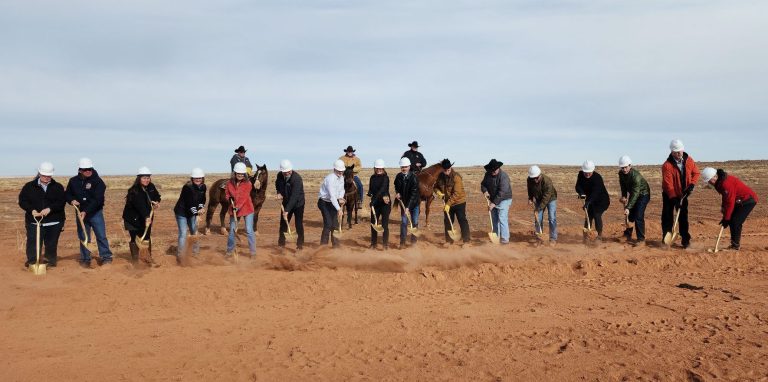
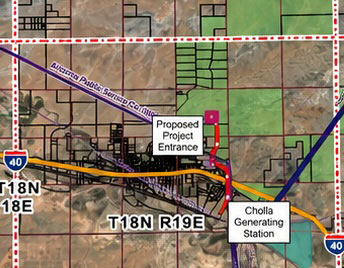
Hashknife broke ground in December 2024 and connects to Arizona Public Service’s Cholla substation by way of a 500-kilovolt transmission line. That substation is a large part of why northern Navajo County has drawn developer interest, because as the Cholla Power Plant winds down, its switchyard and transmission capacity remain, infrastructure that new generation can plug into without building long new lines.
Honeymoon Trail would be the third utility-scale solar project to move through Navajo County’s permitting process in roughly two years. In January, county supervisors unanimously executed a development agreement for Cygnus Solar, a 650-megawatt project on about 3,700 acres north of Snowflake, with construction expected to begin in 2027.
The project would be reviewed under zoning rules the Navajo County Board of Supervisors adopted in June 2025, which set scaled distance buffers for power generation facilities, minimum separation between battery storage systems and nearby homes, wildlife and environmental review requirements and reclamation bonding that must be updated every five years.
The county’s leverage over a project like Honeymoon Trail is narrower than it appears. Once a development satisfies the standards written into the zoning ordinance, supervisors are weighing a permit application rather than deciding whether the industry belongs in the county at all and they have limited grounds to turn down a use the ordinance otherwise allows. In fact, illegally turning down lawful uses could open the county up to paying costly legal settlements.
Solar plants are also exempt from the state siting review that applies to conventional power plants of comparable size, so no Arizona Corporation Commission hearing stands between a developer and construction, although the transmission line serving a project can trigger one. The decisions that would slow the buildout, including how the state leases trust land to developers and whether the Legislature restricts where these projects can go, are made in Phoenix, roughly 200 miles for the residents most wanting their voices heard for this.
Much of the open country north of Joseph City is a mix of Arizona State Trust land, federal land and private holdings, and grazing leases on the state and federal parcels have become the sharpest point of friction around solar development in Navajo County. Governor Katie Hobbs signed an executive order in September 2025 directing state agencies to speed energy development, including on state lands.
Invenergy has set up a project phone line at 928-494-3899 and an email address, HoneymoonTrail@Invenergy.com, for public questions.