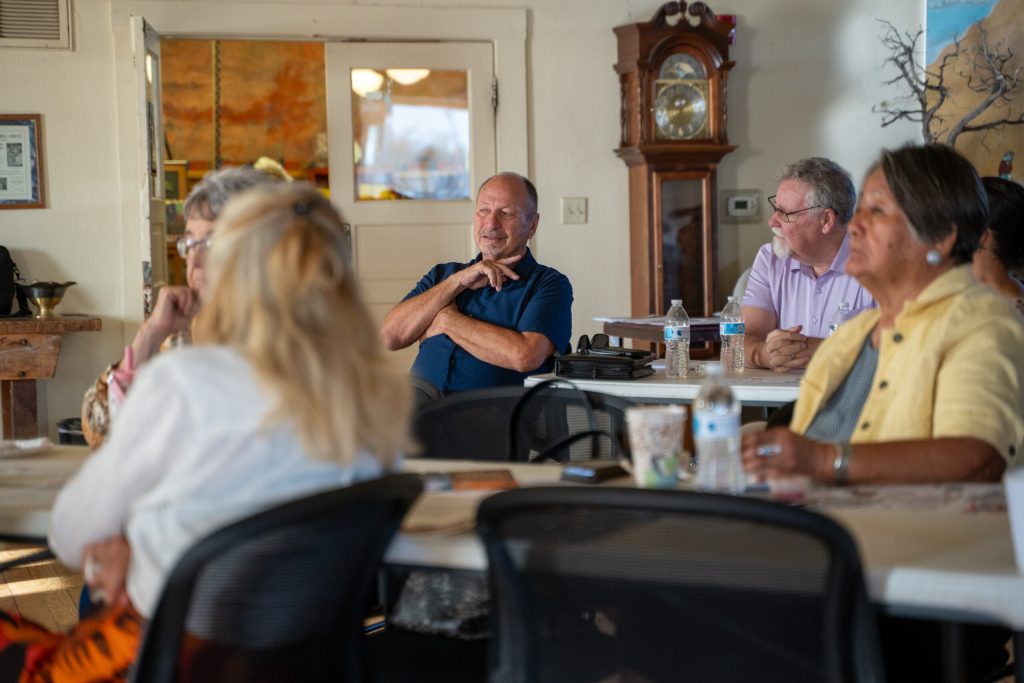
City Manager David Coolidge told a Winslow Chamber of Commerce audience Wednesday that Winslow is operating without a penny of sales tax it has collected for decades. If voters don’t restore it in November, he said, the city will have to cut services and reduce staff. Coolidge laid out the city’s finances at Good Morning Winslow, the Winslow Chamber of Commerce’s monthly business meeting.
The 1% city sales tax expired July 15, not by any council vote but because a scheduling quirk left the city no legal window to put a renewal before voters in time. Proposition 449 on the November ballot asks residents to reinstate it, this time for a decade, running February 2027 through February 2037. “It’s not a new tax,” Coolidge said. “It’s basically, we’re redoing a tax that existed here prior, that we lost for a few months.” State law requires the city to present it to voters as a new tax regardless, he said.
Winslow shoppers pay a combined 9.43% sales tax, with 5.6% going to the state, 0.83% to Navajo County and 3% to the city, though the city’s share is 2% at the moment. That 3% is split three ways. A quarter of a percent funds Little Colorado Medical Center, another 1.75% goes to the general fund that pays for police, fire, parks, the library, the courts and city administration and the final 1% is restricted by the voters who approved it to capital projects only. The expired levy took 0.75% from the general fund and the full quarter-percent hospital share with it.
Coolidge said capital funds are a common point of confusion, with residents asking why the city can’t spend it on payroll when it is buying trucks or renovating buildings. “I can only use it for capital,” he said. “I cannot use it to pay employees. I cannot use it for general overhead costs.” Because when that tax was approved by voters it was only approved for capital projects so excess funds can’t change hands and fund things like operating the public library.
Winslow businesses generated $264 million in gross taxable sales in fiscal 2025 and an estimated $277 million in fiscal 2026 and the city projects $291 million this year, an increase Coolidge attributed partly to inflation. At the full 3%, that would have produced roughly $5.1 million for the general fund, $2.9 million for capital projects and $728,000 for the hospital.
Instead, the city is planning for two outcomes. If Proposition 449 passes, the tax resumes Feb. 1, leaving seven months of collections lost, or about $3.8 million in the general fund, down $1.3 million from projections, plus roughly $303,000 for the hospital over the final five months of the fiscal year. Coolidge credited a state appropriation secured last year with building a surplus that covers most of that gap. If the measure fails, the general fund drops to about $2.9 million in sales tax revenue and the hospital receives nothing.
Sales tax is not the city’s only revenue, but it is the largest local piece. Winslow expects about $3.9 million in intergovernmental revenue, the city’s share of state sales and income taxes and vehicle license fees distributed by population, along with roughly $512,000 in property tax, $350,000 in franchise fees from utilities operating in the right of way, about $150,000 in licenses and permits, administrative charges billed to the city’s water, wastewater and sanitation enterprise funds and a couple hundred thousand dollars in interest.
Total general fund spending is budgeted at $11.5 million, with police accounting for $5.2 million and fire for $1.3 million. Utilities, carried under non-departmental costs, make up most of the rest of what Coolidge described as roughly 70% of the budget consumed by three line items.
State statute requires the city to provide police and fire protection and the utility bills have to be paid, which leaves about $2 million in discretion. “That’s what I get to figure out,” Coolidge said.
Pressed on what reductions would look like, Coolidge said parks, recreation, the library and administration would face severe cuts or elimination and that police and fire, while they cannot be eliminated, would be reduced. A reduction in force would follow. “Not a threat,” he said. “Just reality. If you don’t have enough money to provide it, you cannot do it.” He acknowledged residents would disagree about priorities, saying that if he asked each person in the room what they would cut, everyone would give a different answer.
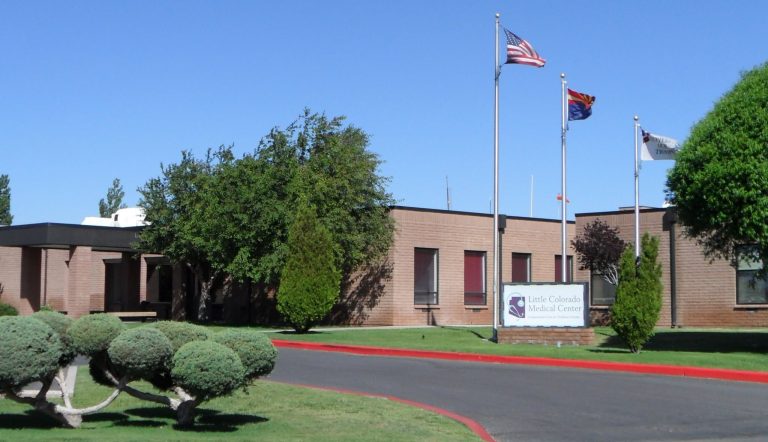
The hospital piece carries an added consequence. The quarter-percent, established in 1985 when the hospital was struggling, draws a matching contribution from state and federal sources, meaning the loss compounds. One attendee, noting the region’s nearest alternatives run from Flagstaff to Gallup, said the cut could threaten services at what is the area’s only hospital.
The lapse itself traces back to a decade-old fight over election calendars. When the Legislature pushed cities onto a consolidated even-year election schedule around 2015, Winslow, a charter city that set its own election dates, joined Tucson and other charter cities in court and initially prevailed, Coolidge said. The challenge returned year after year until Winslow conceded rather than keep paying to litigate. The last renewal ran five years and expired in an even year, and under normal practice the city would have gone to voters the year before, but 2025 was an odd year and no election was available. “We technically should have gone in ’24,” Coolidge said, “but no one looks 24 months out.” The 10-year term proposed in Proposition 449 is designed to keep future renewals on the even-year cycle.
Coolidge said Winslow’s 3% city rate sits in the middle of the state’s range, below Chino Valley at 4% and below Verde Valley communities such as Sedona and Camp Verde at 3.5% to 3.7%, and above cities at 2% that typically have more diverse retail bases. Winslow’s largest sales tax generators are its two grocery stores. The practical effect on shoppers, he said, is a dollar on a $100 taxable purchase, the difference between paying $2 and $3 to the city on that sale.
Separately, the city levies a 2% tax on restaurants and bars that flows to the capital fund and a 2% bed tax on hotel stays inside city limits that goes to the Chamber of Commerce for tourism advertising. City officials cannot campaign for the ballot measure, Coolidge said, and his role is limited to presenting the facts. The hospital however is not bound by such restrictions and LCMC’s CEO has called upon his neighbors multiple times to keep the hospital tax when they go to the polls this November.