

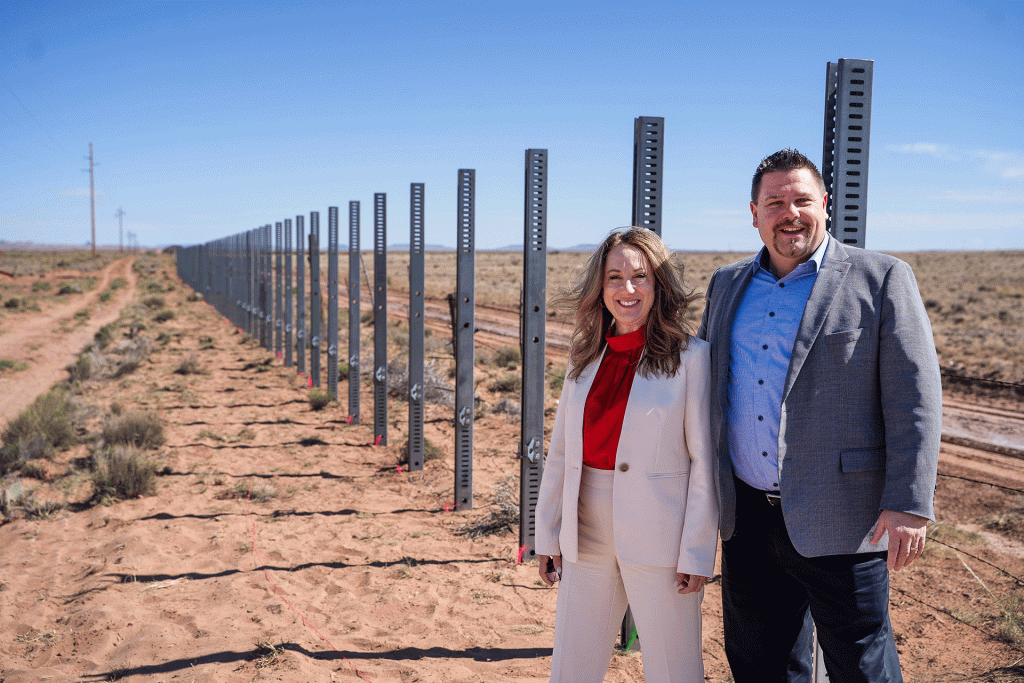
GoSolar.US is moving forward with a solar fence demonstration between two ranch properties northwest of Holbrook, part of the company’s broader effort to show how renewable energy infrastructure could be integrated with working ranchland.
GoSolar.US Ceo Gordon Baier invited the Painted Desert Tribune to the site, where a crew is currently installing fence poles that are expected to later be fitted with double-sided solar panels. Baier said the system is designed to produce power while continuing to function as a fence between ranch properties. He said the fence is expected to generate around one megawatt-hour per mile and around 40 miles of fencing is planned.
Cindy Baier, president of GoSolar.US, said the design is intended to keep cattle in more securely but also leave room for wildlife movement through the area. The fence will include a large break for wildlife migration and the panels will be installed with about three feet of clearance from the ground, allowing smaller animals to pass underneath while keeping cattle separated.
Gordon said that it will also be more secure from trespassing. “That is something we’re hearing from a lot of ranchers is they have issues with trespassing,” Gordon said. The fence will include a camera system so ranchers can view any potential people trespassing on their property with Gordon adding, “We will be the ones maintaining the fence.”
The solar fence is one piece of a larger approach the company is promoting for ranching properties. They described raised solar panels with six to eight feet of clearance, allowing cattle to graze beneath and between solar arrays. The company says the land can remain in ranching use while solar infrastructure adds shade, water access and potential long-term income for landowners.
The company’s materials also list possible ranching-related benefits, including shade for cattle, reduced evaporation, improved soil moisture, pasture growth, water pipelines, retention ponds, cow brushes and free GPS ear tags for tracking animals.
Cindy said the company believes solar panels can improve some land conditions by reducing harsh sun exposure and allowing plants to retain more moisture after rainfall. She said the company also wants the installations to be reversible.
“Whatever we do with the solar panels can be undone,” Cindy Baier said. “These fence posts can be taken out of the ground and it will look exactly like it did before.”
The demonstration comes as GoSolar and GigaWatt.Land continue discussing a much larger energy and industrial development north and northwest of Holbrook. Gordon has previously described that proposal as a co-located system involving solar generation, long-duration energy storage, data centers and other industrial uses, while saying the company wants to work with local ranching families rather than displace existing land uses. He noted at that time that, in order to qualify for certain federal tax credits, he would need to have a shovel in the ground before July. He reaffirmed that timeline last week.
Before the larger project can move forward, it must go through a series of public meetings. Property owners within a quarter mile of the project area must be notified of the meetings and public comments from those meetings must be submitted with the project’s technical application. That application would then go before the Navajo County Planning and Zoning Commission. The project must also show connectivity agreements with the larger power grid so that the energy being generated isn’t wasted.
If the project clears that stage, the developers would then be permitted to apply for a development agreement, which would also go through planning and zoning before being sent to the Navajo County Board of Supervisors for final approval. With those steps still ahead, Baier’s stated goal of beginning work before July leaves a narrow timeline for the project to complete the required review processes.



