

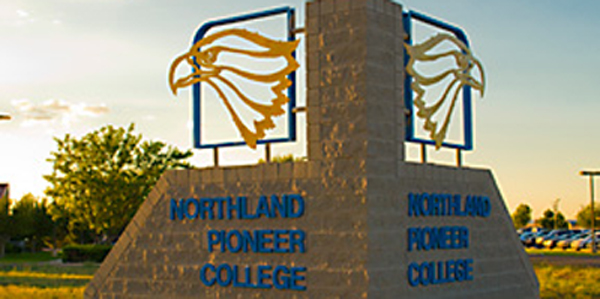
Northland Pioneer College has a lot going on in the coming year that includes new facilities, additional programming and collaboration with state universities.
The college has two construction projects taking place at this time. One is the Skills Center at the White Mountain Campus in Show Low and the other is the Head Start facility on Winslow’s Little Colorado Campus. It was planned to have both facilities complete by this time but according to NPC President Dr. Chato Hazelbaker, the delays in construction will make for a solid opening for both facilities in the fall.
The offerings in the Skills Center will include the industrial energy program that will be removed from the Painted Desert Campus in Holbrook. The automotive programs that are taught at other locations on the Show Low Campus will also move to the center. “It will also provide space for things like Skills USA, which all those students will participate in, it just provides a lot more space,” stated Hazelbaker.
He noted that the Skills Facility in Holbrook is still relatively new and offers a great deal of space for new programs that will serve the northern part of the district best. “We’re looking hard at automotive. We probably could start a second automotive location there.”
Hazelbaker also noted the potential opportunities coming from the City of Winslow’s economic development planning. “There are positive things coming out of Winslow, with lots of opportunities for Joseph City or Winslow with those kinds of economic development changes. We’ve already had conversations about if there is going to be any light manufacturing coming into Winslow, then we will be able to retool or create a different type of advance manufacturing program,” he stated.
The new Head Start facility in Winslow will be operated by NACOG (Northern Arizona Council of Governments) and it will operate as a regular Head Start facility. “Students who want to take classes can take advantage of the facility to put their children in while they are in class. The other opportunity is that we already work really close with Head Start, both in terms of training their employees and using it as an internship and practicum opportunities for our students.”
He explained that Head Start has a tremendous hiring need so it creates the opportunity for what Hazelbaker calls a “living and learning lab” on the campus while providing a service to the students. The public will also be able to utilize the facility. Head Start as a federal program requires a degree for most of their staff but NPC does provide the opportunity for a two-year degree in Early Childhood Studies. In addition, there is state and federal funding that may help a student pay for their education. “If a student has even the littlest bit of interest in that area, cost should definitely not be a barrier,” he said, adding that such programs could even provide additional funding for expenses such as rent.
In addition to the new Head Start facility, the Winslow campus has two existing buildings that will be remodeled to include a welcome center at the current library location at the front of the campus. The cosmetology and some nursing programs will also be moved to another building on campus.
Regarding community outreach, Katie Matott is the new director of marketing and will be looking at ways to market the opportunities provided by the college to the public. The college has also recently hired Frank Orona as the director of enrollment services. “They’ve created the Strategic Enrollment Management Committee that pulls together all the people that are supposed to be doing outreach so that we actually know who is doing what, where. What the role of traditional media is, what’s the role of traditional media, what’s the role of people going out to high schools and talking to people. We’re further along than we were a year ago because we have all the right people in the room talking about it,” said Hazelbaker.
He noted an upcoming event in March where all high school counselors from the region will be invited to what is being called Early College Convocation to learn about what NPC will have available for students in the fall. The college is also ensuring that each high school will have a representative from the college that is a specific point of contact person.
On the adult education side, Hazelbaker, stated that he knows that adults sometimes need a different schedule than traditional college students and NPC is considering ways to offer shorter eight-week programs.
Regarding programming, Hazelbaker anticipates that NPC will be offering four new programs in the fall, although some may not start until spring. They include a bachelor’s degree in Early Childhood Education, which would be the college’s first offering of a four-year degree. The college is currently waiting on their accrediting body to do an onsite visit to determine when they can move forward. The next program would be for law enforcement. “This would be for students who graduate from the police academy training to go ahead and finish their associate degree. They do the police academy and a lot of times they don’t have the opportunity to finish their degree because they go right to work. So, what happens is they work for a couple of years and then their agency wants them to go and finish their degree, or they move up in the organization or do something different.” He also noted that this would also lead the way into a bachelor’s degree in criminology at a university.
Another program planned is Physical Health and Performance. “That’s really more of a general pathway starting for high school students so that they can explore health care professions.” Local physical therapist Lynn Johnson is heading up the creation of that program that will be in several high schools.
The fourth program will be Behavioral Health Technician. “This is probably the program I’m most excited about. It’s a two-year program in some cases to get a behavioral health technician degree. But you’ll also have short term training opportunities.” As an example, he cited Arizona Western College, which provides short term training for teachers and firemen and all the professions that may want a short-term program to help them understand people with behavioral health and substance abuse issues. The full degree is now a degree that is recognized and those with the degree can be hired and be billed to Medicaid for payment. “This opens the door for additional substance abuse counselors, additional suicide prevention counselors because they can work and be reimbursed through insurance.”
Hazelbaker explained that the program became available through a grant from the State of Arizona so there is no Navajo or Apache county money going to fund this program for the next three years, with the expectation that the college will be able to maintain the degree after that time period. “Part of the funding on that states if individuals will commit to working in the State of Arizona for a couple of years after they graduate, this will be a tuition-free program for them. This is where we are looking at potentially doing paid internships,” said Hazelbaker. It’s been a number of years since the college has been able to offer up new programming and Hazelbaker expects this trend to continue moving forward.
As the college looks towards providing bachelor’s degrees, Hazelbaker explained that there are processes to be gone through. The bachelor’s in education is well into planning and the other is a bachelor’s in applied science in a management area. “There’s so much that goes into a bachelor’s program that is really boring but really important. Like, does your IT system recognize four-year programs versus two-year programs. There are things with financial aid, accreditation issues. But then with future degrees, some of those requirements go away because we’ve met the standard and know what to do.”
The bachelor’s degree in education is well along in the planning, the second that is being considered a bachelor’s of applied science in a management area. “It’s really more for people with technical degrees that want to finish out that bachelor’s degree. Maybe you came through and got an associate of arts degree in automotive but you really want the skills to be able to do more management types of things. It’s really a pathway for that and there’s lots of other areas,” said Hazelbaker, noting that program is probably at least a year out before being implemented.
NPC is also looking for ways to collaborate with the state universities. “The four-year colleges in Arizona all need enrollment and recognize the importance of degree completion in the state, so they’re really willing to work with the two-year colleges in a way that didn’t exist in the past.”
He noted that he is having conversations with universities in the state, particularly Northern Arizona University. “NAU has been really aggressive in a positive way wanting to see how we can work together to provide these degree programs on our campuses, in our communities, to our students and not just online.”
The region is ranked the lowest in the state for four-year degree attainment, and the goal is to make improvements. “I think we have a real opportunity where ASU (Arizona State University) and NAU are really coming to the table and want to figure out how to help us move those numbers in this area.”
Overall, NPC is making strides to ensure opportunities for anyone seeking certifications or degrees in a wide variety of fields. To learn more about NPC visit www.npc.edu. Summer registration begins on March 27 and fall enrollment begins April 24.



