The Holbrook Unified School District No. 3 Governing Board convened last Tuesday, Sept. 13,
during which the board received a presentation on the budget increase through a Maintenance and Operations (M & O) Override.
If a proposed budget of a school district exceeds the aggregate budget limit for the budget year, at least 90 days before the proposed election, the governing board shall order an override election to be held on the first Tuesday following the first Monday in November for the purpose of presenting the proposed budget to the qualified electors of the school district who by a majority of those voting either shall affirm or reject the budget. “So we will be going out to an override in November of 2023,” stated Superintendent Dr. Rob Koerperich.
The M & O override will be brought to the board most likely around May to be approved, which will then be sent out to the public for review. “Last time, we approved it was in November of 2018,” he added.
Koerperich provided the board with a history of the override. “So, we’ve added over 35 years of support through our override and our community just has been excellent.” Beginning in 1984, the override started at 5% of people’s tax rate, then escalated to 8% in 1986, then finally to 10% in 1989 where it has remained since. In 2018 the override was re-approved for five years until 2023.
“The override is actually contingent upon taxes,” stated Koerperich, “So we’re asking the community to tax themselves through their property taxes to approve about $1.5 million.”
An approximate $1.5 million for the approximate 1,700 students in the district equals to $894 per student, per year. “It’s used for smaller class sizes (and) competitive salaries. This has really helped us to stay competitive with our salary ranges, music and physical education.” Koerperich stated, adding that it helps with extracurricular activities, meals during school trips and advanced classes as well.
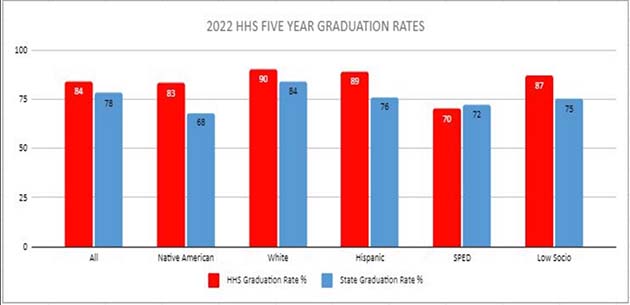
Koerperich believes this override also helps with graduation rates, which have most often been higher than the state average. The benefits go beyond as well, helping students achieve college education and higher paying jobs.
“Some closing thoughts is we have a 10% override and we could go out for 15% override. We haven’t done that because we feel like the 10% has served us well, we don’t anticipate going out to 15% but we will ask the voters in November of next year to approve a 10% override again.”
The board accepted public comment on the matter, which there was none.