For a deeply broken teenage girl to grow up in a cycle of poverty and abuse, and still be able to build a stable family of her own, says a lot. To be able to love again–to have hope and a future–when everything around you seem to suggest the opposite, this is the tale of story-book dreams. For Jovannah Poor Bear-Adams, she would tell you, “Breaking the cycle isn’t a clean cut. It is a process.”
Poor Bear-Adams’ process involved the help of others. Teachers and staff, who became like family, helped her find her healing and thus her potential. Now Poor Bear-Adams is doing the helping, sharing her story of dark to light with students so they too can rewrite their story.
Thanks to divine intervention through the faithful support of one little school in the Arizona desert, Poor Bear-Adams can celebrate a life healed with the school that helped in her healing.
Poor Bear-Adams’ story is one of many. For 75 years, Holbrook Indian School (HIS) has had stories like this. On March 6, Poor Bear-Adams joined other alumni and past staff in celebration of the school’s 75 years of service.
Alumni, former staff, and representatives from the Pacific Union Conference and the North American Division of Seventh-day Adventists were invited to celebrate God’s hand in the school’s 75 years of service.
Current students watched digitally archived reel-to-reel pictures of some familiar experiences that they enjoy today. Past students, now years into their adulthood, saw new and innovative programs that post-dated their time at HIS. Together, with other visiting guests and friends, all were truly blessed in recounting stories of hope, overcoming, and God’s provision throughout various eras.
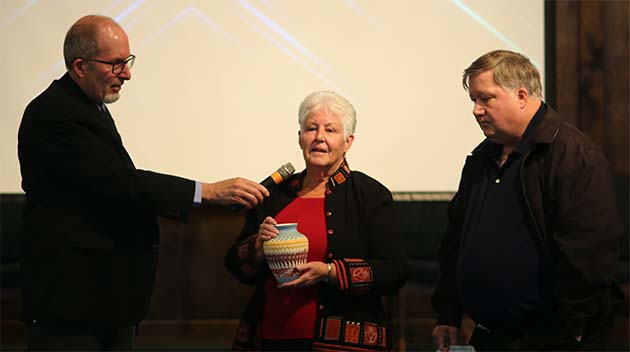
For Poor Bear-Adams, coming back was truly like “coming home.” Poor Bear-Adams graduated from HIS in 2006. She then returned to serve in many roles, with dean of students and vice principal being her most recent positions. At the celebration ceremony, Poor Bear-Adams and fellow alumni shared HIS’s impact on their lives. Union President Brad Newton, talked about the importance of the school’s ministry to Native Americans and the greater relationship with the Adventist Church.
Holbrook Indian School, like many ministries, started with very humble beginnings. Marvin Walter was a missionary working for the Arizona Conference, and he set out to learn about the needs of the Navajo. As Walter talked with the people, he discovered their desire for their children to receive an education.
With his wife Gwendolyn and funding from the Pacific Union Conference, they set out to build a school. In 1945 the missionary couple moved to Holbrook where a new school was built.
With 320 acres of land in Holbrook, the first mission school term started in 1946. That fall, 30 children sat on sheepskin rugs reciting their first lessons in a foreign language—English. This became the first class of students of the Seventh-day Adventist Mission School, now known as Holbrook Indian School.
Through the years, many people have come to work at HIS. The school has grown to serve more than 100 children and youth who annually enroll at HIS and Chinle Adventist Elementary, a day school on the Navajo Nation in Chinle.
Throughout the past 75 years, students from many nations have come to Holbrook. Students from HIS have become nurses, teachers, pastors, accountants, dentists, welders, private business owners and have served in the US military.
One student, Charlotte Beyal, became the first woman and Navajo judge magistrate in Flagstaff. “My father had a dream for his children to receive an education. That is why he brought us to the SDA mission school,” stated Beyal.
Much of what the school does today continues from the past, celebrating and uplifting Native American heritage, as well as practical whole-person learning. Classes such as welding, auto mechanics, indigenous arts and woodworking have been conducted throughout the years. More recently, the school has also included supplementary programs like Outdoor School, Equestrian Facilitated Learning, College Transition, Summer Experience and licensed clinical counseling.
The wholistic approach to learning that HIS has always taken over the years recently became a more formal and systematic program with a name–MAPS. The program has four pillars – Mental, Academic/Artistic, Physical, and Spiritual. It is through this framework that administrators formulate the objectives for all general and advanced classes, educational opportunities, and programs. To view the video of 75th celebration program, visit https://www.holbrookindianschool.org/hisnation/75-years.