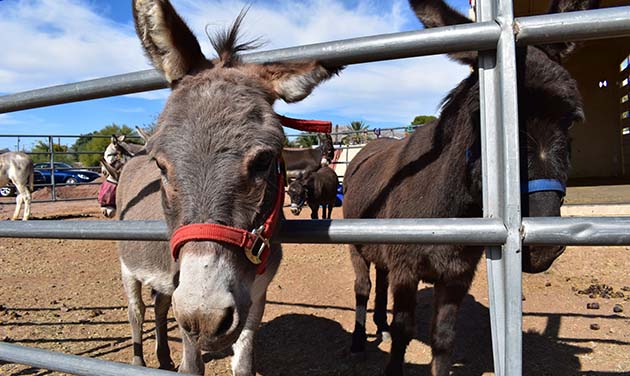
SUPERIOR – A few hours before high noon, about 80 competitors – in this case, donkeys – strolled through Main Street before wandering over to nearby old mining trails. Around 1,000 human fans lined up along the dusty avenue, cheering the animals as they went hoof-to-hoof in either 3-, 6- or 12-mile races.
And once again, the Superior Burro Run was off. Nearly all the competitors walked alongside their donkeys through the historic Arizona town while also learning about the ancient ways of mining.
It’s a tradition that has been around for decades. More than 3,000 years ago, burros made their way into the Southwestern United States. Commonly known as donkeys, the hard-working animals played a huge role in mining and exploring. They carried the miners’ tools, hauled resources collected from the mines and much more.
However, by the late 1940s, following World Wars I and II, the demand for ore was low and mining communities were dying. With the towns on the brink of disappearing, the remaining residents looked to find a niche way to breathe life back into the mining burgs that were sprinkled across America’s West.
In 1949, Leadville and Fairplay, two towns in Colorado, introduced a new professional sport: pack burro racing. Bill Lee, a 72-year-old racer from Colorado, said it helped lure tourists from major cities and boosted the local economy.
Some 70 years later, Arizona jumped on the idea. In the last few years, burro racing has taken place in Superior, Black Canyon City and Tombstone. In the Arizona races, tourists are not the only source of income. At the Superior Burro Run, the event featured competitors from California to Georgia.
Although every human competitor comes with different experience levels, they share the same passion for keeping the tradition alive.
“The history of burro racing is one of the coolest aspects because we run through old mining camps,” said Jon Roberts, a racer from Colorado who competed in the 12-mile Superior race Oct. 23. “It is a part of our history and you get to be a part of that because these animals were a part of it.”
Joe Polonsky and Roland Brodeur joined Roberts as the competitive Colorado crew. After experiencing Colorado’s history with the sport, they wanted to expand their burro racing horizon into new mining towns.
“I did the Superior race two years ago because I’ve never competed in Arizona before and wanted to,” Polonsky said. “We wanted to come down and see the new race course and meet the new race director and compete.”
Brodeur, who also competed in the 12-mile race in Superior, was impressed with the setup in Arizona.
“Everyone seems very excited to have such a new event here,” Brodeur said. “Some of the Colorado races have been going on for 70 years and are very established. But, with the sport being so new in Arizona, it seems to excite the community.”
Since the sport has a small following, many communities and organizations work together to keep the excitement flowing.