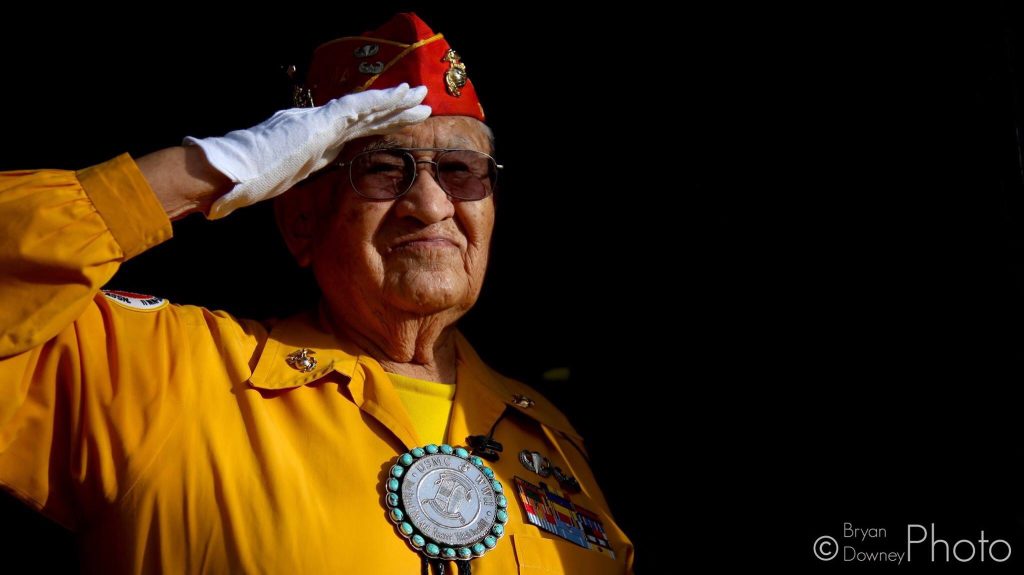
On Saturday, Feb. 8, Native American Music Award winner and Holbrook alumni Michelle Thomas and award-winning producer from Bulldog Studios in New York Bryan Downey recently paid a visit to Winslow to film the second episode of Downey’s docuseries titled “1,000 Years A Witness.”
Michelle Thomas, who recently received the Empowered Indigenous Women’s Award said that Downey, who is also the photographer for the photo used to promote her award, contacted her about co-producing the second installment for his documentary series and he wanted to do it on the Diné community, also known as Navajo in Arizona. Native to the area, Thomas was more than happy to hop on board and assist the producer on his mission. “I thought it was amazing. Especially to be able to do it on our Navajo people. It was empowering,” said Thomas.
Downey, whose professional record includes working with celebrities like rapper Jay-Z and singer Jennifer Lopez, as well as larger entertainment companies such as HBO, NBC, Disney, AMC, CBS and more, explained how he captures the history of each culture through their memories. “What we do is interview 13 to 14 elders so that their ages combined come to exactly 1,000 years. If we’re a few years out, we interview a child,” said Downey.
Downey explained further, “It’s very easy to understand the premise of the documentary. We interview elders of the Native American communities. We do one community at a time; we don’t mix it up. Then they just tell stories of when they were children, that’s it. So, we’re documenting their stories so we can pass them down to their youth who are a little distracted,” said Downy, pointing to his own mobile device as his example of distraction. Downey said he believes that cell phones are a major reason for the lack of interest the youth are taking in their history. “They’re not building memories,” added Downey.
Having received so much positive feedback for the first installment of his docuseries on the Shinnecock people, which has won four awards in the six short weeks since its release and has been entered in 29 film festivals globally, Downey told Thomas his plan was to focus now on the Diné culture for part two and she immediately got to work making arrangements for Downey to shoot the film in Arizona.
They first stopped in New Mexico where they met up with one of the last living Navajo code talkers from World War II, Thomas H. Begay. During their visit with Begay, he sang them songs in Navajo and recounted his time serving in the Marines.
Downey, who said he is drawn to the Native American communities for their “natural elegance,” said it was quite an experience and recounted the visit.
“Thomas H. Begay, a Navajo code talker (one of only four left) was a true gentleman and was upset when the interview was over. ‘I’m not finished yet,’ he kept saying. He sang the Marines anthem in both English and Navajo. As a vet myself, from the British army, I connected with him and we shared a mutual respect. He did mention he remembers every second. Climbing down a rope to scrambling into the landing craft of sand as he landed in Iwo Jima, ‘like it was yesterday.’ He mentioned all his fallen brothers in Navajo and American alike. I was so emotional filming him and still am. Beyond honored.”
After wrapping up their interview with Begay, Downey and Thomas headed to Winslow to interview Diné elder Ned Morris from the Dilcon area. Morris performed the song “Take it Easy” in his native tongue and recounted his own memories for Downey right in the middle of Standing on the Corner Park in Winslow.
After completing the interview with Morris, Thomas and Downey headed over to Dilcon for more interviews, where they were greeted by a crowd of people who showed up to welcome Thomas back after nearly four years away from her home. While it was planned as a surprise, Thomas said there was no way to keep it a secret as many people from Colorado and Utah were anxious to be there for her welcome and experience their elders talk of their history.
Because he only had a two-day window to film and take photos, Downey said he will be returning to shoot the second half sometime in the coming months. When asked when the documentary is expected to debut Downey explained, “It’s impossible to get all I need from one weekend’s shooting. We only got about 600-650 years of elders’ combined ages interviewed and I had limited time photographing. So, I’ll be back to do more portraits at sunset and sun-up plus do four to five more interviews in the daytime. I have a guide and a team of Navajo helpers as they think it is important.”
Downey provided an old African proverb, which represents why he feels the work he is doing on his documentary is so precious, “’When an elder dies a library burns with them’ it is important that we pass on their memories to the younger generations.”
“Hopefully these stories of struggle, success, death and spirituality, hopefully they can pass it on to their kids and keep it alive,” said Downey.
Because of its pending completion, there is no set release date, but Downey assures he will be inform The Tribune as the film progresses.