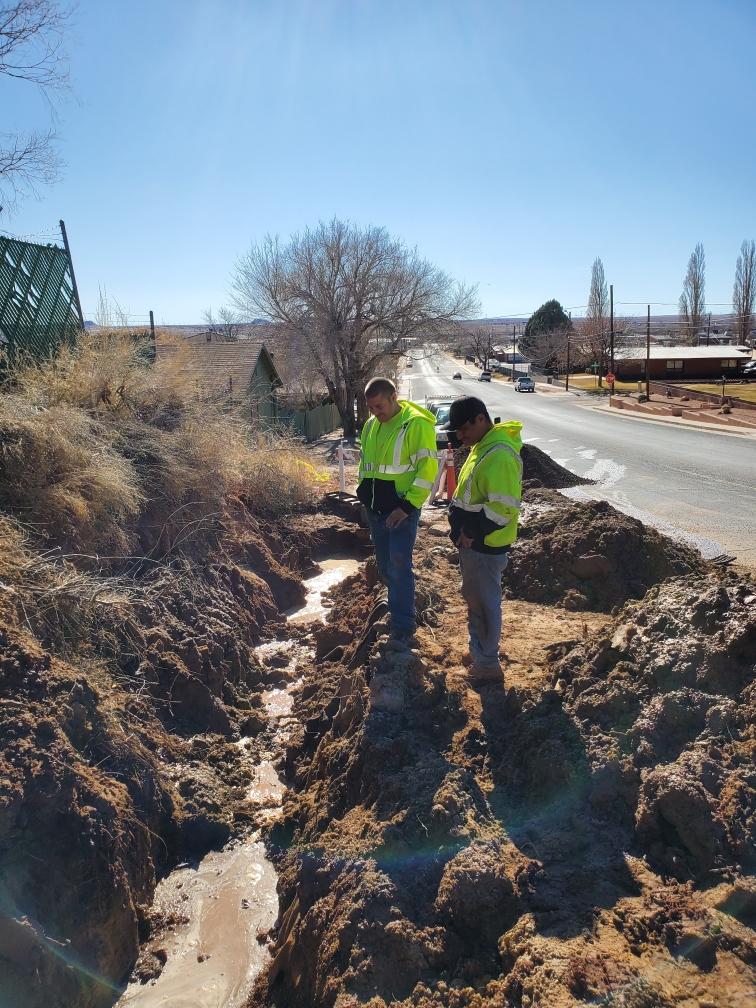
At the Holbrook City Council meeting on Jan. 22, Randy Sullivan, who doubles as the finance director and supervisor for the Holbrook water/wastewater department let the council know how he plans to get ahead of some of the reoccurring long-standing issues that would free the water/wastewater department up to work on other projects needing to be addressed within Holbrook and Sun Valley.
Sullivan explained that he and his water crew, includes himself, Jose Agramont, Daniel Gabaldon, Earl Hollins, Byron Shelendewa and Sean Cassidy are responsible for maintaining all water wells and sewer lift stations in those areas.
Sullivan explained that a well is responsible for pumping the water meant for consumption while the lift station is responsible for pumping raw sewage. The wells are maintained daily by his crew to see that the water’s residual reading, which is basically the amount of chlorine used to treat the water, stays within the parameters set by the Arizona Department of Environmental Quality (ADEQ). “Right now, my guys check it every day and we try to get a .2 residual,” said Sullivan.
He explained how the majority of the wells and lift stations are connected to their telemetry system, which is basically a network of sensors placed in inaccessible areas that communicate whether levels are being maintained and equipment is working sufficiently and if it is not sensors send out, with the system is maintained by a remote operator. He explained that prior to adding the facilities equipment to the system there were a lot of issues. “Without this, every time the pumps would kick on, they would kick on so fast that we had water breaks everywhere.” Although they still encounter water breaks, Sullivan said adding these facilities onto the system has mitigated much of the problem.
Sullivan said that a major priority they must focus on first is getting everything to a safe operating standard. Because everything is hooked to an electrical system, they must take precautions to assure it’s all safe for operation. Part of the overhaul being done is to have all facilities connected to the system the same way to provide a consistent clean system to work from. “A lot of what we’re doing right now is getting rid of old stuff, cleaning it up and putting it on the telemetry system,” said Sullivan.
One of the lift stations that seems to call attention to the crew quite often is the Romero Street lift station. Sullivan said, “I think we’re starting to get ahead of it. Back in 2010 we did a survey on it and what it boils down to is that this lift station was never meant to pump the volume that it is pumping. It was built to just service Lewis subdivision and then we took on the county (the Navajo County Governmental Complex). So, the well’s not deep enough, the trash that we get from the county just clogs our pumps constantly. When it clogs it just burns them up so we’re going through pumps a lot faster.” Sullivan said that they currently only have one working pump and through his research he is finding that the existing ones installed are not meant to be used at that location for the capacity that flows through.
Since he began his research, Sullivan located what he called a “grinder pump,” which appears to be the best solution so far. He said part of his plan is to replace the current broken ones. He noted that he prefers to go with the grinder pumps that will effectively break down the materials allowing them to pass through the system with ease as opposed to the other pumps that would require a basket that collects all the debris that would then become another task for his crew to carry out daily.
“The positive thing about this is once we get it going good, the pumps that are giving us problems are about $10,000 to $11,000 and the Keens are only $5,000. If we’re going to do it, I would like to just get two or three that way we have a back-up already and we’re good to go. ADEQ (Arizona Department of Environmental Quality) actually requires us to have a pump and a backup for each one of the lift stations,” which Sullivan stated would need to be done at Romero.
He went on to explained that although the Keen pump is working well and he believes they are the ones that will get the job done, until he completes further research to see that they will be sufficient in the long run he’ll hold off on finalizing any plans. Sullivan informed the council that once he has all the information and determines whether the solution is viable, he’ll be back to seek financial approval.
He noted that the daily maintenance part of the 500,000-gallon and 750,000-gallon booster tanks on top of the hill is also done by his crew but the larger more in-depth projects like inspecting and maintaining the inside of the tanks has to be outsourced. “Maybe 12-15 years ago we had them recoated and repainted. It’s about time that I need to start researching some scuba divers to inspect those and hopefully they’re still good, but I won’t know that unless I get a professional,” said Sullivan.
According to Sullivan, the boosters have two 100-horsepower pumps and one one-third horsepower booster. He explained that part of the responsibility of the tanks is knowing when to run the pumps. “During the winter we can get away with just using one 100-horsepower pump, usually keeps it good. But during the summer all three of those are running 24 hours.”
The pumps were obtained through an energy efficiency grant and replaced brand new so Sullivan said they should be in good shape for a while.
Sullivan said that they still have the old pumps and hopes to be able to rebuild them to use as a backup. He recounted one incident that happened in 2019 where one of them broke, so as preemptive measure, he suggested that they rebuild the old ones that were replaced and keep them in case anything happens to the current ones. “I really think that’s something my crew and I can take apart and rebuild so that we have backups.” Sullivan said most of it can be done in-house but like the booster tanks, there comes a point where they will have to enlist a professional to complete the process.
The water crew also maintains one well in Sun Valley. There is another well, but it quit producing as much so they outsourced a company who specializes in cleaning out wells but it didn’t help. Sullivan explained that there is an existing pump that can be used in the future to build a new well or evaluate the possibilities of what it would take to drill the existing one deeper. Again, Sullivan said that they will need to consult a hydrologist before executing any major projects.
In response to Mayor Merrill Young’s question of what the water quality was out in Sun Valley, Sullivan replied, “Not good.” Sullivan explained that previously he was told by a hydrologist that any water coming from the south end of the railroad tracks is more salty and lower quality. “It’s suitable because ADEQ passes it but it’s definitely not desirable.” Sullivan said that they are just not in a good spot and hopes to be able to invest in a hydrologist to assist with finding a more permanent solution in the future.
Sullivan explained that the 50,000-gallon water tank on the south side of Sun Valley is also on their priority list of things to get in front of. He explained that the tank is fairly new and has no issues but to his knowledge has never been inspected.
Sullivan showed a photo of the north end tank in Sun Valley, which appeared to be very old. He explained, “We started having samples come back of total solids. We would flush the lines every day trying to get all that stuff out of there, and they were still coming back bad,” said Sullivan. Eventually, Sullivan decided to empty the tank. He explained that he and the crew made an entry space where they were able to see a large quantity of sediment.
“It’s no wonder it was coming back with total solids. We spent the whole day out there tending to it and cleaning it out and it’s been good ever since,” said the supervisor. Sullivan added that during a final inspection he noticed that the physical condition of the tank itself is bad and they need to start planning for repair or replacement, which he said would ultimately be up to an outsourced company who would be able to better direct them to a permanent solution.
Sullivan informed the council that when they hire someone to look at the tanks in Holbrook, they’ll be having them inspect Sun Valley’s as well.
Overall, Sullivan eluded to a brighter future for the water/wastewater systems of Holbrook and Sun Valley. “A lot of the lift stations we’re trying to simplify. Just making them smarter. The more alarms we get the better. In a round-about way, it could save a pump. I’ve got a great crew and it’s been a pleasure working with them.”