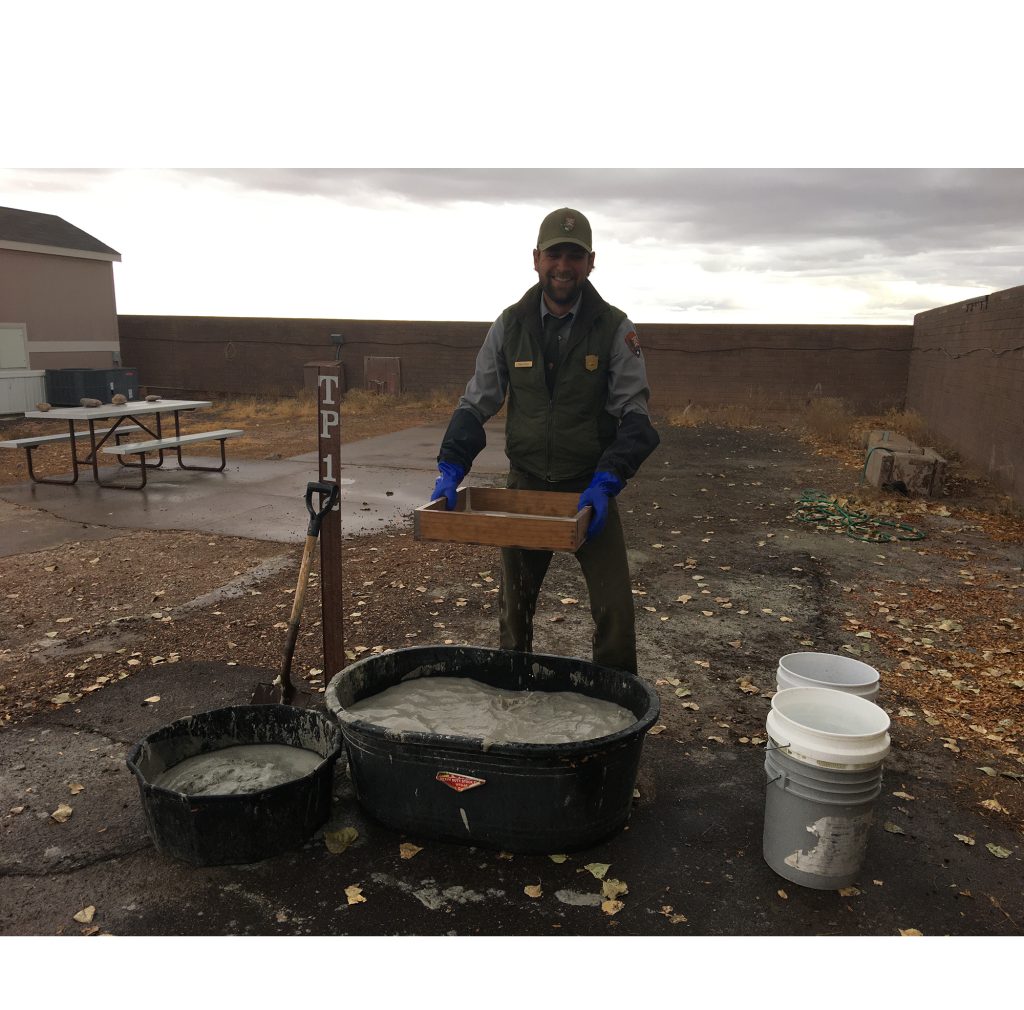
In 1906, citizens of Holbrook came together to find a way of preserving the heavily sought-after rock fossils known as petrified wood. As a result, the Petrified Forest National Park was founded and became home and refuge to thousands, and in some cases millions of years-worth of the earth’s history. During a visit with PFNP’s paleontology team, Ben Kligman PHD, candidate at Virginia Tech, Museum Curator Matt Smith and Paleontologist Adam Marsh it became quite clear how significant the discoveries right in Holbrook’s back yard, old and new, are to understanding the world’s complex evolution.
Inside the park’s paleontology lab there are shelves upon shelves of excavated fossils and nearly 500 bags of sand holding potentially thousands of fossilized bones. PFNP Chief of Interpretation Sarah Herve said, “PFNP is literally where new discoveries get made.” Not only are they making new discoveries but they’re finding new ways to make those discoveries.
Over the years, it’s been common practice to excavate, curate and reconstruct fossils as a part of research into understanding the evolution of earth’s organisms. But not all fossils can be seen with the naked eye. Kligman explained that more common than not, they’ve found micro fossils encased in hard rock-like stones called coprolite, which is fossilized feces. Kligman explained that this discovery has opened the door to much more speculation of how the fossils are being preserved at PFNP.
Smith explained that one area was believed to be a tropical river flood plain in the Triassic and every single animal that was living in that area was getting into this lake deposit, and likely where the smaller animals were being consumed by the larger herbivorous ones. “So, we’re getting really high diversity. We have like at least 55 species at this one sight. So, every one that was living in this eco system we find them in these bags,” said Kligman. He explained how they locate the spots that may contain fossils by the soil characteristics. Thin layers that are different colors than the other rocks that are believed to be where the watering holes were where animals would gather to replenish themselves and that’s where some would meet their fate then put them in the coprolites.
“This is a once in a career kind of site. Throughout the entire geologic record all over the world, this is a unique place in every single aspect of the word,” said Marsh.
Because PFNP is also the only place in the world that duplicates the environment of the Triassic era, which they believe is heavily responsible for the preservation of the fossils, the paleontology crew at PFNP refers to the area as “the sweet spot.” “Our rocks here in Arizona, New Mexico and Texas are the only rocks on earth that preserve the equatorial regions during the Triassic whereas all the other places where people find Triassic fossils are from high latitudes in places like Europe, Asia and China. Right here is the only place where you capture the equatorial tropical settings during the Triassic,” explained Kligman.
Kligman explained that the approach they are taking to locate the fossils is not typical but has proven to be effective in identifying the smaller fossils of animals such as lizards and frogs. “No one was sampling it like this. They were collecting larger fossils because they are easy to find,” said Kligman. Larger fossils like the phytosaur they discovered at PFNP, which resembles the crocodile and whose feces they’ve began to find the smaller animals inside. This is also where they’ve recently discovered animals that have never been seen before, throughout the entire world. The team is just waiting on publication before revealing their finds.
After hours of inspecting only grams of sand at a time under microscopes to find matching pieces of bones, the pieces are glued together using a self-made apparatus because using regular tweezers is too aggressive for the fragile specimens which should be handled as little as possible to prevent breakdown of the existing layers and tissues.
Once pieced together, the small specimens, which are only a few millimeters long are put into a CT scanner for magnified images and then duplicated with a 3D printer. “We’re now noticing different shapes of the teeth and bones that we hadn’t even seen before just because we’re magnifying and printing them. So, it’s allowing us to do better science doing this process,” said Kligman.
“I think what this whole project is showing is that we’ve actually only just scratched the surface. There are so many more sites like this. The park preserves 25 million years of time and this site was only deposited a couple thousand years ago. There is way more than a lifetimes or careers worth of work to be done here,” added Kligman.
When describing the magic that happens at PFNP’s paleontology lab Smith said, “We’ve got this movie called the ‘History of Life, 25 Million Years-Worth,’ and we’re trying to reconstruct a plot from only a few frames of film here and there. Each time we find a new site, we fill in a couple of those frames.”
Marsh said that outsiders are welcome to join the PFNP Paleontology crew on their journeys to new discovery during scheduled visits. “We take people to sites like these for the day digs for the field institute so when they show up, they’re a part of the crew that day. We do the whole thing,” said Marsh. People can visit their field institute website and sign up to be a part of the crew for a day. Marsh shared the one instance where a park visitor who went out on a dig day made a discovery of his own, which became the topic of a published piece by Kligman and also gained the finder media recognition where he was able to recount his experience and his accomplishment.
Although PFNP has a strong economic tie to Holbrook, Sarah Herve explained that the purpose of fostering the relationship between Holbrook and the park is really to remind them of the international treasure that sits right in their backyard. “There is an opportunity for Holbrook to celebrate the fact that they are a gateway to a national park,” said Herve.
To see what the institute has to offer visit petrifiedforestfieldinstitute.org.