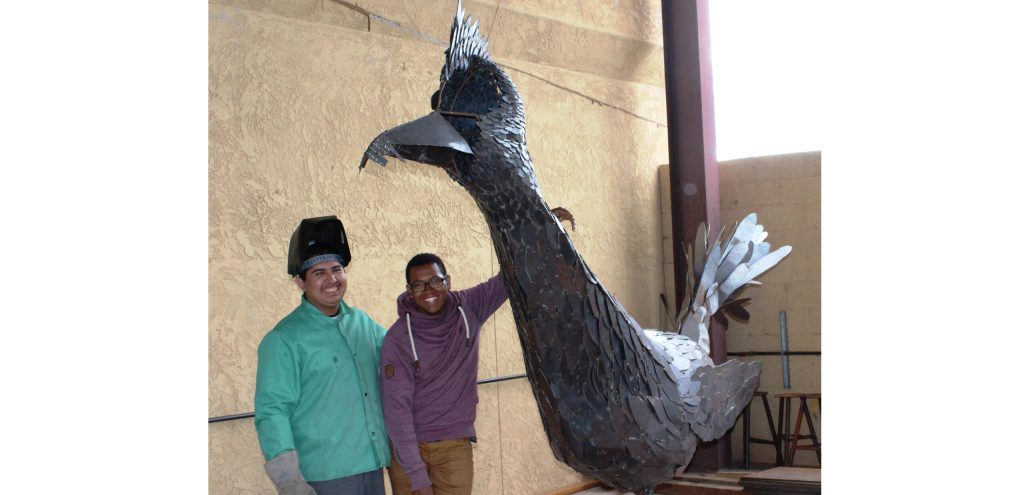
By Toni Gibbons For decades, high school vocational training has been a way to introduce students to hands-on skills outside of the classroom, usually featuring classes in home economics, automotive, construction and welding. Today, those programs, now called Career and Technical Education (CTE), have taken on a whole new dimension, offering students a chance to be industry certified and employable to good jobs right out of high school. At Holbrook High School the CTE program, led by Dr. Charles Haussman, assistant principal and director of CTE, features a range of options that include digital communications, robotic software development, film and television, business, early childhood development, computer aided drafting that stand right along the old standards of construction, welding and automotive technology. With the power of the internet and a partnership with Northland Pioneer College (NPC), Holbrook, like many of the schools in Navajo County, can now access training for their students that decades ago would have been impossible. “The whole goal of CTE is to get our students to an industry standard where they can go to work and/or college,” said Haussman. “There is a labor shortage in some parts of our country. Enabling our students to meet those shortages through CTE is the pathway to a middle class lifestyle without all the debt of college.” Renell Heister, TALON grant project director with NPC, who taught high school for 15 years, shared, “The CTE program is so amazing; it keeps kids in school. Not every kid is a four-year university student. We are all different and have different interests. I had a student tell me, ‘if it wasn’t for welding, I would have dropped out of high school by now.’” For Dale Larsen, instructor of the Holbrook high school welding program, it’s not just the certification that makes the program worthwhile, it’s about teaching the students how to weld. “Even though students strive to get certification, the most important thing is to get work experience that can get them recognized by employers and respective industries,” said Larsen, who is teaching approximately 85 students this year. Holbrook’s welding shop has an impressive array of booths complete with the MIG and TIG welders as well as the arc welder. In the outdoor shop is the famed roadrunner that has been an ongoing project for the last five years. Kamal Yazzie, a senior, is determined to finish feathering the bird before he graduates. “I like to connect the feathers,” Yazzie said, as he pointed to the neck area where approximately 150 small feathers still need to be cut and attached. Another senior, Marco Luna, said his passion is automotive but he is learning welding as a way to further the automotive he is learning. “Mr. Larsen is a great teacher,” he said. Meanwhile, just a few doors down from the welding shop is the construction building where Adrian Tubbs, Holbrook High School construction teacher, trains the 90 students enrolled in his program everything from basic home repairs to working with electrical, plumbing, concrete, roofing and drywall. Tubbs said it is not uncommon for students to go home with their new knowledge and do a repair on the family home. “I teach introductory level home repairs and maintenance, as well as the construction,” shared Tubbs. “It gives the students the initiative and aptitude to be able to fix things. I have parents tell me about a repair issue that their child was able to fix as a result of this class.” Tubbs also noted that last year two students were hired on a construction crew in Flagstaff. “One of them shared with me that what I taught him was relevant to the work.” All the training for welding and construction are completed through modules of industry standard tasks and procedures provided by the National Council for Construction and Education and American Welding Society Entry level welder programs. At the end of the coursework in their senior year the students can take the testing for certification. In welding, concurrent credit is available with NPC for each semester of the class for both the junior and senior years.