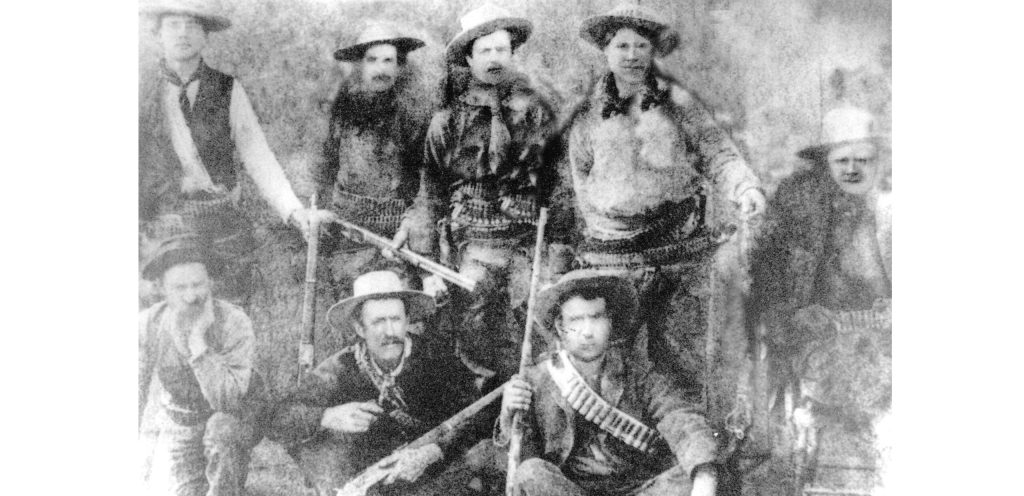
This is Part I of an accounting of Holbrook’s Wild West based on excerpts from the thesis of Harold C. Wayte Jr. and clippings from area newspapers stories of the time.
****
Holbrook was founded in 1881 and had its start as a temporary railroad station for the Atlantic and Pacific Railroad that came through the Southwest. It was decided to name the station after Henry Randolph Holbrook who was chief engineer of the division for this region. It wasn’t long before Holbrook became the epitome of the Wild West. Surrounded by the Navajo, Hopi, Zuni and Apache tribes, the town was neither inviting nor safe for families and was dubbed the “town too tough for women and churches.”
When the railway created a shipping and distribution location for cattle and sheep ranchers in the region, Holbrook quickly became a booming western town. By 1884 the town had a population of about 200 people and the business district included a jewelry store, a gunsmith shop, grocery and drug store, a blacksmith shop, meat market livery stable, two general markets, two hotels and three saloons.
In the spring and summer of 1885, the Aztec Land and Cattle Company brought 40,000 head of cattle from Texas and purchased one million acres of land between Holbrook and Flagstaff for the herd to graze upon. The Aztec was also known as the Hashknife Outfit because the brand looked like a knife that was used to cut hash by the chuck wagon cooks. The company made Holbrook a major cattle shipping center for 15 years but it also invited a lot of crime. There was plenty of open land for cattle rustling and it was well known that the stolen cattle was illegally shipped out by the trainload from Holbrook but the law never interfered and for 14 years no one was ever convicted of cattle rustling.
The cowboys hired by the Aztec company were of a rough and rowdy nature. According to the memoirs of Lloyd C. Henning, a well-know businessman and local newspaper editor who also served as an Arizona State Senator, the cowboys “…would race their horses through the town, brandishing their six-shooters and shouting ‘Hide out kids, the cowboys are in town.’ They would shoot out lights at dances and otherwise justify the wildest western traditions. Several Hashknife men were known to be killers. Holbrook had now become a tough little cow town.”
Throughout the 1880s and 1890s despite having a population of just 200 people, Holbrook became one of the most lawless towns in the country. According to one news source, in a period of one year, gun battles left 26 dead. Shooting brawls brought an abrupt end to dances and public gatherings and at least several times each week cowboys would race through the town on their horses, shooting out windows and wounding bystanders not quick enough to get out of the way.
That lawlessness extended to the area outside of Holbrook where a feud had begun between the Tewksberry and Graham factions in Pleasant Valley southwest of Holbrook where a wholesale rustler’s campaign was in full swing on the cattle range near Holbrook.
This lawlessness brought to Holbrook its most famous lawman, Apache County Sheriff Commodore Perry Owens. Owens had run away from his home in Indiana at the age of 13, making his way west by working as a farmhand. He came to Arizona in 1881 at the age of 29 and was hired as a foreman at a ranch in Apache County. He was also employed to guard cavalry horses at Navajo Springs from the Indians. It was reported that Owens killed so many Indians that the Navajos called him the ‘Iron Man’, they also believed Owens had supernatural powers and that he was not human but of the devil. Owens was reportedly never wounded and killed as many as 50 Indians.
Owens made a striking figure with steel gray eyes and flowing blond hair that fell to his waist. He carried twin .45s at his hips and two rifles in his saddle scabbards. He used an old single-shot Sharps and it was said he was a dead shot at a mile. He also had a Winchester repeater for closer work. He shot from the hip with both hands and never missed a shot.
One story of his shooting prowess was when he confronted a band of Navajos. It was said he frightened them away by shooting a squirrel at a distance of about a mile off a rock near the top of Keams Canyon. Another story tells of when a group of 100 or more Indians besieged him in the old stage station at Navajo Spring. For three days they cornered him in the station but every time an Indian showed his head he would kill him. They eventually gave up and went away.
With news of his skills spreading and with lawlessness on the rise, the county officials voted to hire Owens as the first sheriff. In Holbrook’s newspaper, The Argus, Owens was described as a “quiet, unassuming man, strictly honorable and upright in his dealing with all men, he is immensely popular and enjoys the respect of all who know him.” Another account of Owens stated that he never drank alcohol, smoked, gambled and had a wonderful respect for women.
Sheriff Owens is best known for the infamous Blevins Shootout that occurred on Sept. 4, 1887. It came about when Owens went to the Blevins home to serve three warrants that had been issued for Andy Cooper for horse thieving. His real name was Andy Blevins but he had changed his name to avoid being caught for outstanding warrants in Texas.
Cooper was reportedly the head of a gang of horse thieves and cattle rustlers. In The Apache County Critic, it was written that Cooper was, “a horse thief desperado of the most daring stamp and the boldest man in his operations as had ever cursed the west.”
Andy Cooper was known to frequent the family home in Holbrook so on that date Owens went to the house knowing he was there. Cooper had quite a reputation for violence and perhaps Owens knew that a confrontation would likely end in either one or both of their deaths. Sheriff Owens rode into town and stopped at the local drug store owned by Frank Wattron, who was also the town constable, before going to the Blevins home. Wattron reportedly offered to assist the Sheriff, either alone or with a group of men but Owen’s declined, concerned that other people may get hurt.
Following the event the local newspaper provided witness accounts and testimony from Owens of that afternoon when he approached the Blevins home with his Winchester in the bend of his arm and crossed the porch and knocked on the door. The house had two doors, one to the east and one to the west of the house. Owens knocked at the front door to the east, whereupon Andy Cooper came to the door while John Blevins went to the door to the west. Cooper and Owens saluted as Cooper opened the door, then Owens told him that he had a warrant for his arrest and asked Cooper to come along with him.
Cooper tried to stall by initially saying he would come in a few minutes, but Owens insisted and Cooper said he wasn’t going anywhere as he went for his gun. Owens instantly fired a round from the Winchester, which struck Cooper in the abdomen and he fell to the ground. Owens jumped back from the door, turning towards the door to the west as he reloaded another cartridge into his rifle. Seeing Blevins opening the door he fired again, with the bullet passing through the right shoulder of John Blevins, the door and the partition wall.
The Sheriff retreated diagonally back to the corner of Armbruster’s blacksmith shop and as he did he saw Cooper lying near to the east front window of the east room of the house. The Sheriff, thinking Cooper was still alive, fired a third shot, which cut through the wall of the house below the window and grazed Cooper’s left arm.
Before the shots began firing Motse B. Roberts was sitting at a table in the southeast corner of the house writing a letter. Upon hearing the gunfire, Roberts jumped up from the table and ran to a bedroom that faced east and jumped through a window, six-shooter in hand. As he turned the northeast corner of the house Owens fired a fourth shot, which struck below Robert’s left shoulder, going through a part of his lung and shattering his collar bone before burying itself in the spoke of a wagon.
Roberts managed to go around to the back of the house, enter a rear door and collapse onto the kitchen floor. As Robert’s fled, Owens once again reloaded the Winchester and walked west another 20 feet then stood waiting to see what would happen next.
According to witness accounts, the Sheriff stood in his last position perhaps 10 seconds when Sam Blevins, a boy of 15 or 16, rushed out through the same door where Andy Cooper had stood, brandishing Cooper’s six-shooter. His mother screamed and tried to grab onto the boy as he ran through the door. The young Blevins ran no more than 10 feet towards Owens when he fired his fifth shot which struck the boy. The boy spun towards his mother then fell dead at her feet. The entire incident lasted no more than three minutes and Owens was never more than 25 feet from the house.
An inquest after the shooting showed that a total of six shots had been fired, five by Owens and one from the boy that killed Cooper’s horse, which was tied up outside of the house. Sam H. Blevins died at the scene, Cooper died later that evening and Roberts died a few days later. John Blevins recovered after several weeks and was sentenced to 35 years in prison but was later pardoned by the governor.
In The St. Johns Herald it was noted, “It required more than ordinary courage for a man to go single-handed and alone to a house where it was known there were four or five desperate men inside and demand the surrender of one of them. And when one takes into consideration that the combatants were separated by only a few feet at the commencement of the difficulty, it seems miraculous that Mr. Owens should come out of it uninjured.”
In the memoirs of Albert F. Potter from around 1888, he gave his account of how the now infamous Bucket of Blood Saloon got its name. “The roundup on the Little Colorado River range had just been completed and the herd was being held at a lake about 12 miles east of Holbrook, ready for cutting out the cattle that would be taken to the stockyards for shipment, or to their home ranges.
“As the saddle horses were being brought in about sunrise in the morning, two riders were seen coming across the country coming from Holbrook. At first it was thought they were Indians, because one of them had a cloth wrapped around his head in Indian fashion. As they drew nearer, it was seen that the man with his head bandaged was seriously wounded and almost exhausted from the loss of blood. When they got closer to the wagon, the other man greeted us by shouting, ‘Here we come! All shot to pieces.’
“We recognized them as Joe Crawford, a cowboy who had worked for the Aztec Land and Cattle Company known as the Hashknife Outfit, and George Bell, a gambler. Crawford was so weak that he had to be lifted from the horse he was riding. We laid him on the horse wrangler’s bed and with a handful of flour from the cook’s bread pan I plastered the wound on his head and stopped the bleeding. Examination showed that a bullet had also passed through the cuff of his shirt and coat sleeve, and just grazed the side of his body. Scars of other old wounds showed that this was not Crawford’s first flight.
“Bell told the story of having been in a card game with Ramon Lopez and another Mexican when a controversy arose about a deal in the cards and Lopez struck Crawford over the head with a six-shooter. That started real trouble. Crawford drew his gun and killed Lopez. Then the shooting became general and Crawford killed the other Mexican, who fell beside his partner. Crawford and Bell then made their getaway.”
Bell feared that a Mexican posse was coming for them and there would be a lynching and sought asylum. Potter told the men that they would protect them from a mob but if it was an officer that came for them, they would let the law handle the matter.
When no one came by the end of the day the two men headed out. Late in the night the deputy sheriff came for the men but by then they were long gone. According to Potter, it was a general belief that Joe Crawford was in fact Grat Dalton, a member of the notorious Dalton gang of outlaws who was later killed during an attempted bank robbery at Coffeyville, Kansas.
It was said that where the two men fell when killed there was a spot on the floor which looking like a bucket of blood had been spilled there. For this reason the saloon was afterwards named the Bucket of Blood.
After 20 years of being known as the most dangerous town in the country and home to a large number of outlaws, the Aztec Land and Cattle Company went out of business and Holbrook settled into a sleepy western railroad town.