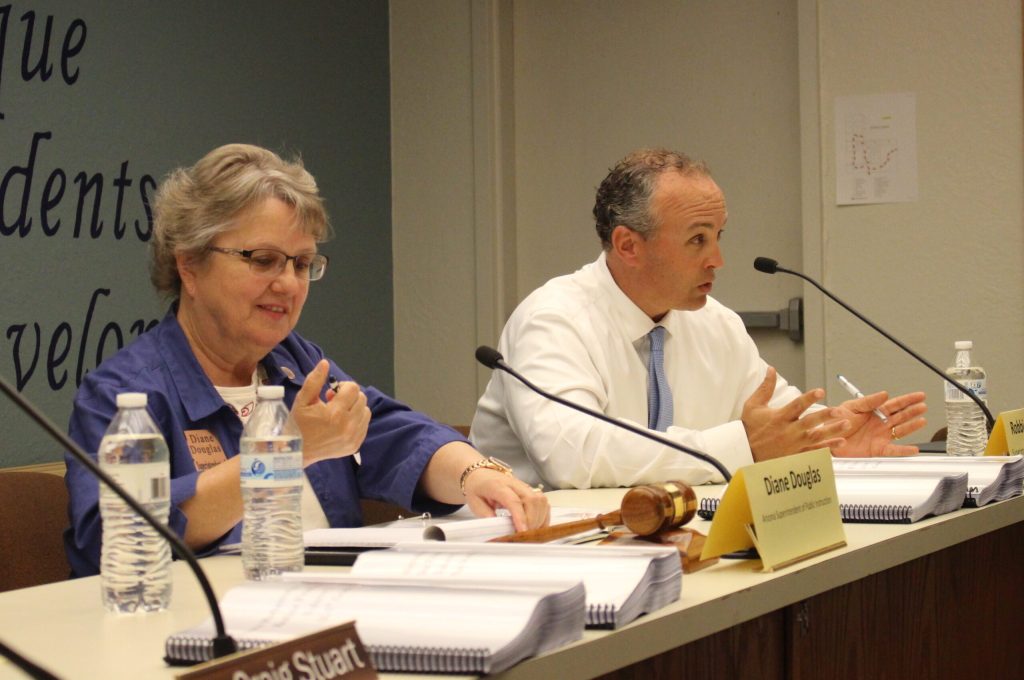
Arizona Superintendent of Public Instruction Diane Douglas came to Holbrook last week as part of her We Are Listening Tour. Prior to meeting with educators, administrators and the public at the Holbrook School District’s offices, Douglas sat down to discuss the issues that she believes are the most important for teachers and students who are part of the K-12 education program.
Douglas said that one of the top priorities of her office is to secure higher pay for teachers. “Teachers want to be paid better and deserve to be paid better,” she noted.
Her office has unveiled a proposal for the extension of Proposition 301, a sales tax set at six-tenths of a cent that sunsets in 2020. Of the total raised by the tax, about 56 percent goes toward teacher salaries and the remainder funds other education needs.
“My recommendation is that we increase it to bring it to the full penny and make it permanent. I don’t want districts and teachers to have to wonder and worry year after year if that funding will be available,” stated Douglas, noting that if passed, the tax would add an average of $5,000 to the annual salary of a teacher.
Douglas said that she was not a fan of a bill passed last year by the state legislature that allows highly qualified professionals who have experience in a subject and possess a higher education degree to be certified to teach.
“There was a time in education where the belief was that if you were trained to teach, if you knew pedagogy, anybody could teach anybody, and now it seems the pendulum is swinging the other way and we’re saying, ‘Oh, as long as you’re a content expert you can go in and teach anybody,’ and it’s not true,” said Douglas.
“You need to have that deep and rich, not just knowledge of your subject, but a passion for your subject, because that’s what lights the fire in other people. But you also have to know how to handle a classroom and how to put a lesson plan together and how to deal with a child whose parents might have had a fight last night or didn’t get breakfast in the morning. Those are challenges that I don’t think people who have been in a content area for a while may be able to do.”
In addressing transportation needs for rural schools Douglas said, “We’ve traveled all over the state and we go to places like Window Rock, where they showed us their buses that are almost up to their axles in mud because the roads aren’t paved. How long is a bus like that going to last? Certainly not the way it does down Mesa roads. We have to recognize that there are very, very different challenges across the state.”
She spoke with optimism of the Corporation Commission’s grant of $100 million that will come to the state in order to provide broadband to rural areas. That application period is still open and Douglas encourages those districts who have not applied for the grant to do so. “We will gladly help anybody through the process, or if they need to work together as districts they can do that,” she said.
In Navajo County, Joseph City Unified School District has taken the lead in applying for rural broadband funds, and has included the Winslow, Holbrook, Snowflake, Heber-Overgaard, Show Low and Blue Ridge school districts, the Navajo County Instructional School in Holbrook and possibly the Kayenta Unified School District as part of its consortium.
Douglas also talked about her Zip Code Project. She explained that her office is in the process of identifying the neediest areas by zip code statistically. The first four that are being addressed include Ajo, Chinle, South Phoenix and Maryvale.
“These are the four that we’ve started with, particularly in terms of disconnected youth. That’s the students and young adults 16 to 24 years old that maybe went to school, graduated, but are not working yet, or maybe they dropped out and didn’t finish their high school diploma and really aren’t engaged in a path to a successful life,” she explained.
According to Douglas, they work with cities, towns and government entities to reach out to those students and get them to re-engage. Although the legislature has denied a request for more funding for the project, Douglas said they would continue to move forward with it and she hopes to expand it to other areas in need.
Douglas also voiced her opposition to the federal Common Core Standards, noting that she was very pleased that the state board repealed them as the standards for schools in Arizona in 2015 and revised standards were adopted in 2016. The state is now in the process of implementing those changes.
“We are the first state in the nation that has foundational writing standards. What that means is our children will not only learn to write cursive, but also learn to read cursive, which was a huge concern in the communities that our children were losing the ability to write and read like that; not be able to sign their names,” she said.
She also noted that there are standards at every grade level for math fluency to ensure that students will have to know their math facts.
“There will be a stronger emphasis on phonics reading. Although that’s been the law of the land here in Arizona, many districts don’t teach reading like that and I think that’s why we see so many of our readers struggling,” she said.
Douglas also said that she’s glad that the state is going away from the Common Core practice of embedded curriculum, which not only specifies what should be taught, but how teachers should teach it. “That’s the decision of our locally elected school boards. What texts you use, what instructional programs, what works best for your kids in Joseph City may not work somewhere else. Washington does not know how our children need to learn,” she said.
According to Douglas, the next step is to work on social studies and science standards, which have not been addressed since 2004. “We now have citizens committees and have set up ways for them to have ongoing input, and to look at standards and what’s really important for them to learn,” she continued.
Any parent in the community interested in participating can go to the Department of Education website at www.azed.gov for more information.
Douglas also noted that Arizona has submitted its Every Students Succeeds Act plan, which replaces No Child Left Behind. “We are very proudly the first state in the nation to file our plan. The initiative from Congress was to return authority to the states. We had a very inclusive process where Arizonans all over the state were brought to the table to give us feedback. The goal was to give districts different ways to meet the needs of their students,” she said. “Once again, local control is back where it belongs. I don’t want Washington telling us what to do and by the same token, I don’t want to tell districts what they need to do, because they know what’s best for their kids and what their needs are.”
Overall, Douglas believes that Arizona is on the path to improving services for students and providing teachers with what they need to be successful in their jobs.
“We have great schools. We have great charter schools and we have great traditional district schools. We struggle with some populations like our English language learners and our Native American students on the reservations, we can certainly do better by those students, but we do a lot of great things,” she concluded.