Howard Noble is a man with a unique talent. Using hammers and steel, he not only creates beautiful works of art, but he’s one of a handful of people who have mastered a skill popular during the Middle Ages and the Renaissance, the making of armor.
Noble began his career as an armorer inadvertently in 1982 while attending the University of Arizona. Studying as a history major, Noble recalls that he came upon a Renaissance re-enactment group performing on campus and was instantly taken with the performance. “I went home and made myself a suit of armor and came back a week later,” he said.
That first armor left a great deal to be desired compared to the work done by Noble today, but he soon found himself creating more armor and continued with the re-enactment performances, fighting and jousting for another 12 years.
Noble felt very fortunate. “In making the armor I had to do a lot of research, so I was able to combine two of my interests, metal work and history,” he said.
Noble is a true armorer, creating his armor by hand, using only hammers in the tradition of 15th century armorers to create his masterpieces. As he gained skill, his pieces became more and more in demand. He built armor for Renaissance festivals throughout the country, museums, Las Vegas casinos and even for the Walt Disney park in China. “By 1985 I was fully entrenched and stayed that way until 2000,” Noble said.
By 2000, he had become known for work that only a handful of people in the world could do well. “I had a full staff and was putting in 60 to 70 hours a week. It was really taking a toll, so I decided to stop,” said Noble.
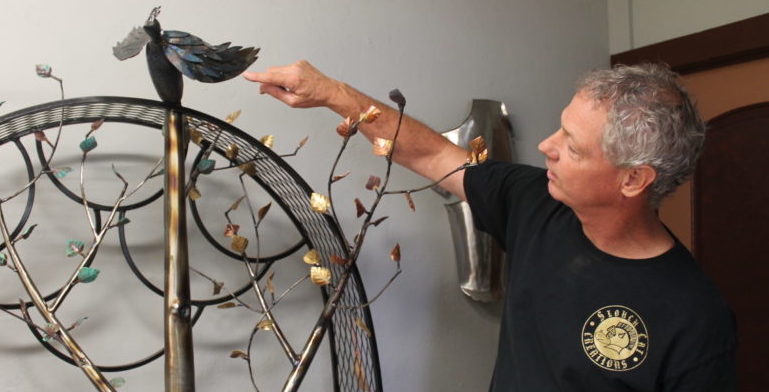
Rather than creating pieces for others, Noble began making art that he wanted. He extended himself beyond armor to create more whimsical pieces, such as flowers and sea life made of copper and steel. Then in 2008 he was approached to teach at Northland Pioneer College. “I didn’t agree right away, it took about nine months before I decided to do it,” he said.
Noble has been working for the college since that time, teaching metal art, armor fabrication and blade making three nights a week. He doesn’t just teach his skills as a blacksmith, bladesmith and armorer to his students, he shares a tradition that has been passed on for hundreds of years. It’s not simply a matter of bending metal, it’s also understanding mechanics, knowing the differences of working with hot or cold metal, the patinas that are created by heat, and the arts of etching and inlay.
“It’s really rewarding,” said Noble. “I focus on teaching the students the concepts to master the skill and let them develop their own talent. I’d like to see the program expand and introduce foundry work.”
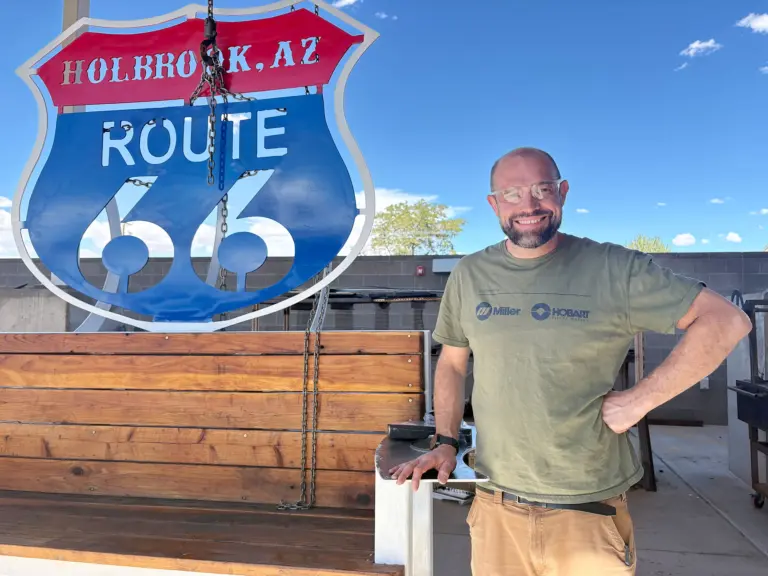
Noble has a shop that he shares with another metalworker in Pinetop. His work can also be found in Scottsdale and at the Arizona Mills Mall in Tempe, where it is featured in a window display for Extreme Lifestyle. He also takes his metalwork to art fairs, and he recently purchased a foundry where he produces metal castings for other artists.
According to Noble, using 12 to 16-gauge steel, it takes about 80 hours to make a full armor. His full suits of armor run around $3,800, with separate components sold, as well, but he also has art pieces for less and his bracelets run as low as $25.
The armor weighs about 60 pounds, the same as the packs infantrymen wear today, but the weight is evenly distributed over the entire body rather than just the back. “The idea that armor is heavy or difficult to move in is a myth. I can do somersaults wearing full armor,” he explained.
Noble’s wife Marla doesn’t share his passion for metal work, but is understanding about his commitment. “I’d be working in my shop and promise to come in for lunch and the next thing I know it’s dark out, and I check my phone and she’s called a dozen times. I just get really focused on the work,” he said.
The Nobles’ four children, Brian, Wyatt, Tyler and Olivia, aren’t old enough to follow in their dad’s footsteps just yet, but that may still come.
“My dad was a metal worker, but not in art; he built bridge girders and things like that, so I guess you could say I’ve followed after my dad,” he noted.
To see samples of Noble’s work, to purchase items or contact him to commission items, go online to slouchcatcreations.com or visit Moseman’s Metal Werks at 1034 W. Woodland Lake Road in Pinetop.