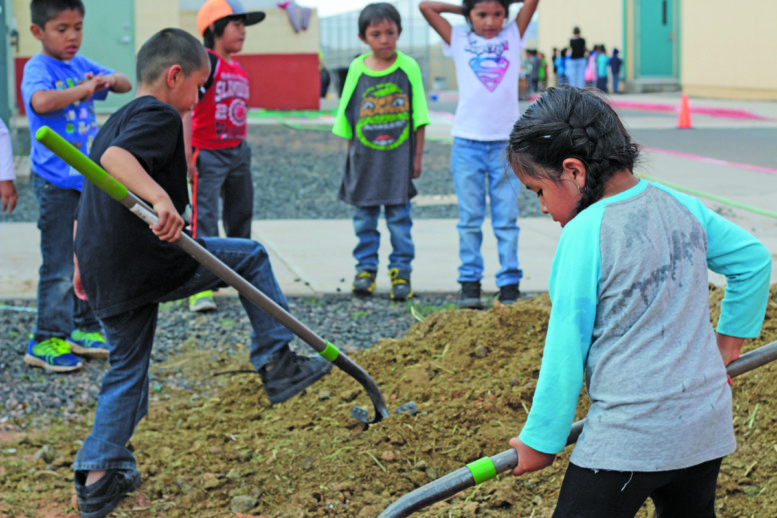
Helping kids eat healthier and exercise more has been a goal of the Navajo County Public Health Services District for many years, and part of that endeavor has included not only providing a variety of fresh fruits and vegetables, but teaching kids and their families how to grow a garden themselves. The Nutrition Services Program used by the district is focused on promoting and influencing health and wellness in kindergarten through eighth grade schools throughout the county. A fundamental aspect of the program is collaborating with the communities in the area. “We want to create a big multi-sector collaboration and use local resources,” said Amanda Chee, district program coordinator. On the Navajo Nation, District Health Educator Violet Nez has provided nutrition lessons to IWES students for many years. Her dedication has led to work with parents during Family Night, where she has provided food demonstrations and nutrition education. According to Nez, it was here that the teachers became more interested in getting a school garden started. With the help of other local partners, the school garden has flourished for two years in a row. “Winslow Indian Healthcare gave donations,” said Nez, “which we used to buy gardening tools at Casey’s in Winslow.” At IWES the students transplanted their seedlings, including tomatoes, sweet peppers, onions, native corn and more. According to Nez, students were also involved in layering raised-beds with garden-friendly material such as cardboard boxes, newspapers, paper-shreds, leaves, horse manure and native top-soil that help amend the soil by adding more nutrients, allowing the seeds a better chance of complete growth. The program has also been implemented at Taylor Elementary School with the support of local businesses, including Ace Hardware and Dollar General. The Nutrition Services Program involves a three-year plan that is personalized by the school’s designated health educator based on what the school wants. The plan helps create a self-sustaining program that enables the school to maintain it once the health district is no longer involved. Nez noted that not only does growing gardens promote healthier eating and teach kids how to take care of themselves, but it also creates an atmosphere for the kids to connect with nature. “It creates a quiet, calming place for the kids,” said Nez, explaining that the garden at IWES was used to soothe a student who was acting out in class by letting him spend some time working in the garden until he could relax. All of the district’s health educators are certified Master Gardeners through UofA’s Cooperative Extension. The grant used to provide these services through the district is targeted toward those who receive Supplemental Nutrition Assistance Program services, and eligible persons and schools.