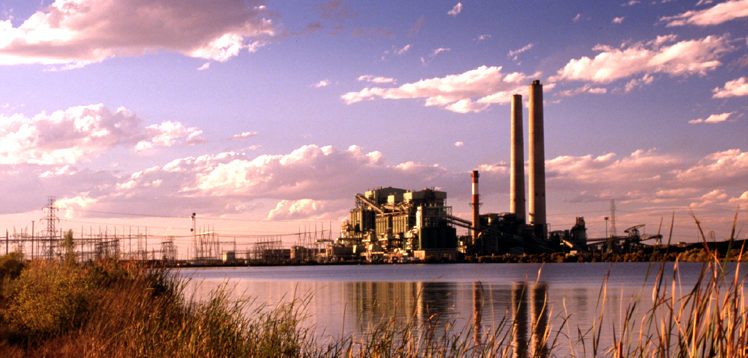
Arizona Public Service Co. officials held meetings last week with employees at Cholla Power Plant in Joseph City, and local community and school leaders to discuss the future of the plant and the impact any changes would have on the area.
While the meeting was closed to the media, the topics discussed included the potential closure of the coal-fired plant in Joseph City in 2025 or conversion of it to a natural gas plant. Both scenarios were visited, but until Environmental Protection Agency officials decide whether they will approve the proposal by APS to convert to natural gas to avoid closure, there are no certainties. APS approached the EPA with the plan last year as an alternative to resolving legal disputes over the demand by the agency for APS to either close the plant or fund a $350 million dollar overhaul of the plant to accommodate the federal government’s Regional Haze Rule.
The plant has already powered down two units as part of its operation and will only be generating power five to six months out of the year through the warmer months. In addition, Unit 2 has been removed from the property, taking a sizeable chunk out of Navajo County’s centrally assessed valuations for 2016. The county has proclaimed a $31 million loss on centrally assessed property valuation revenues this year, in large part because of the infrastructure removal at Cholla.
If the plant should shut down completely over the next nine years, the entire infrastructure would be removed and the property would be returned to its natural state, stripping away property tax funds relied upon specifically by the county, Northland Pioneer College and the Joseph City Unified School District.
If instead the plant converts to natural gas in 2025, it would allow operations to continue at Cholla, but it would require less infrastructure and fewer employees would be needed to operate it. Although APS has been battling with the EPA in an effort to hold on to the power plant in its current state, that possibility is highly unlikely.
Steve Gotfried of APS media relations explained why conversion to natural gas from a coal-fired plant has significant advantages. “Coal fired plants are very costly to shut down and start up, and it can take an entire day to do one or the other. Natural gas plants start up in 10 minutes at a minimal cost, so it can accommodate the needs at the moment,” he said.
He further explained that coal fired plants provide what he called a “base load” of what is needed. “If you take a day in Phoenix that’s not too hot and a day that’s not too cold up here, that’s basically the lowest amount of power that will constantly need to be generated and coal-fired plants provide that. Then you have solar reaching it’s peak at say 1 p.m., then diminishing into the evening so you have to make up that need at night, which is where using natural gas fueled power works well because it’s so flexible,” said Gotfried.
Such flexibility and current cost efficiency make natural gas operations an appealing option, even for the EPA. Since Cholla would already have existing transmission lines that also holds appeal. The one drawback is that at this elevation, natural gas doesn’t produce as efficiently as it would at a lower elevation.
Until APS gets an answer from the EPA, everything is still just speculation. If the proposal is approved by the EPA, studies would need to be conducted to determine the viability of converting the plant to natural gas and in 10 years there could be other options that don’t exist at this time.
As far as future financial impacts on centrally assessed valuations from the possible removal of existing infrastructure, there were no projections made, leaving community and county leaders with an uncertain future regarding revenues generated from property values and how that could affect current operations throughout Navajo County.