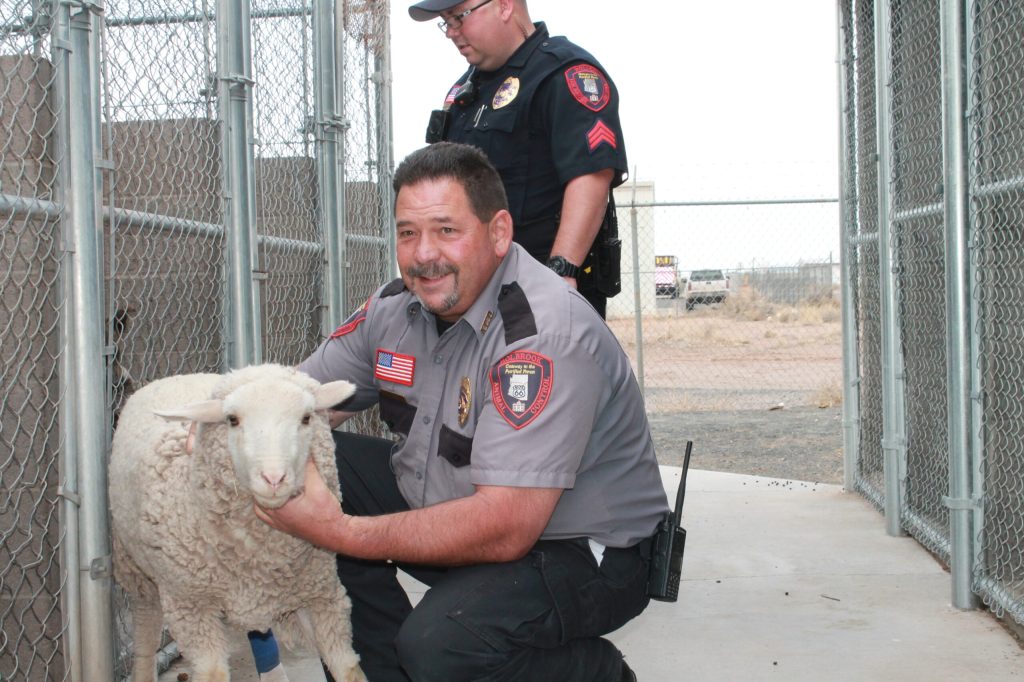
April 10-17 is National Animal Control Officer Appreciation Week, dedicated to recognizing the hard-working personnel of animal care and control who devote their personal time and resources to serving the public, protecting communities from diseases and educating citizens in proper pet care.
The City of Holbrook has had Officer Merrill Young as its resident animal control patrolman for the past 22 years. That’s 154 dog years, by the popular calculation that one dog year is the equivalent of seven human ones. He was appointed to his current role of shelter supervisor in 2001.
Young notes that his staff began with a crew of three–a supervisor and two officers–but was eventually reduced to the current department of one due to city budget constraints.
“It’s a lot different than what people think,” he says. “A lot of people look at my job and see me as the dog catcher. I haven’t dealt with a single dog today. Right now I’ve got a sheep in our kennel, and I got a call for snakes earlier. So I’m not just a dog catcher.”
In addition to handling animals larger and smaller than the bats, bears, birds, skunks, rabbits, mice and livestock he sees on any given day, part of Young’s job also involves euthanizing sick, injured and aggressive animals. Currently, he says, only two other persons in the city are certified to perform the service: Holbrook Police Chief Mark Jackson and the city’s veterinarian, Dr. Abby Reidhead.
“Unfortunately, at one time we used to euthanize between six and eight animals per week. Dr. Reidhead is going to charge $30 to $40 to put a dog to sleep on-call, which can get extremely expensive, and that’s if she’s available. Whereas the city has paid for my training,” he pointed out.
The National Animal Care and Control Association (NACA) offers training courses that cover an exhaustive of list of hands-on training programs for animal care and control officer certification, at a starting cost of $525 per module for a required minimum of three training modules.
Its two-day euthanasia workshop alone includes the goals and history of humane animal euthanasia, animal anatomy and physiology, the pharmacology of sodium pentobarbital sedatives, routes of administration and restraint techniques, how to administer intravenous and intraperitoneal injections, how to deal with stress management, the legal and regulatory issues of humane animal euthanasia, and personnel safety measures.
The officer points out that more recently the number of euthanizations at the shelter has dropped “to almost zero,” with less than 12 being performed within the last 12 months, thanks in large part to the presence and efforts of the Friends of the Holbrook Animal Shelter at the facility.
Young also relates that he plans to approach the city’s mayor and council this month to encourage them to begin considering selecting and/or training his successor, particularly someone with a genuine love of animals. He retires in January 2019.
“It takes a unique individual to do the job. You’ve got to know how to deal with people, you’ve got to deal with emotions and you’ve got to deal with the animals on top of that.”
For more information on NACA training courses, visit http://www.nacanet.org.