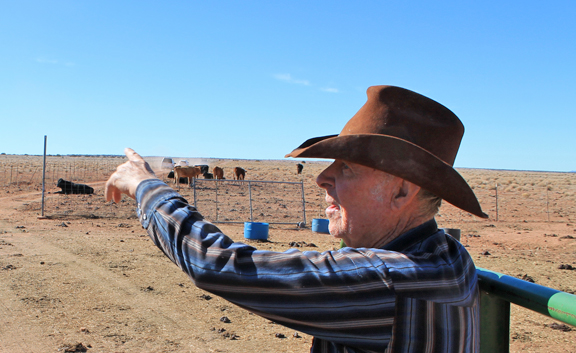
 Photo by Nolan Madden Third-generation Joseph City cattle rancher Brantley Baird says the legal hunting of wild predators, such as coyotes, in the region should be considered as more than simply an issue of environmental ethics.
By Nolan Madden Over the past decade, Brantley Baird has welcomed tourists from around the world to see relics of the Old West and of Native civilizations, right in his own backyard. As owner and operator of Rock Art Ranch in Joseph City, he’s proud that the popular tourist spot is still a working 5,000-acre cattle ranch, where his family settled in 1945. But Baird says lately he’s concerned about his ranch’s viability, in light of mounting issues between the cattle’s natural predators, wildlife management laws and environmental ethics. “I read your article about the coyotes and it kind of made me sick to my stomach,” said Baird, referring to a Feb. 9 story published in The Tribune-News and titled ‘Coyote Killing Contest’ Protested, which reported the 2016 Annual Coyote Calling Championships, hosting today (Feb. 19-21) in Holbrook. North American animal conservation agency Project Coyote is actively protesting the hunt through an online petition submitted to Gov. Doug Ducey and the Navajo County Board of Supervisors, urging them to stop the event. But Baird says that “the animal activists” only tell one side of the story. “The good Lord put animals here for us to protect, and I love animals,” he said, “but I think people should hear another view of this. The ranchers have got to survive. A coyote is a predator, and will kill our calves.” Coyote hunting by legal methods of take is not prohibited by the Arizona Game and Fish Department and is not managed by county law, making them a nuisance to ranchers like Baird. The dogs are indeed a prolific species, logged as ranging from the Sonoran Desert to the alpine regions and plains of Alberta, Canada, to the northern slope of Alaska and as far south as Guatemala. Coyotes are presently the most abundant livestock predators in western North America, and are cited as the cause of the majority of sheep, goat and cattle losses. Officials consistently list coyotes as having killed more livestock annually than any other species. In a 2011 U.S. Department of Agriculture National Agricultural Statistics Service report, cattle and calf losses from animal predators totaled nearly 220,000 head the previous year and resulted in a loss of $98.5 million. “You can’t depend on a good cash crop anymore because of the coyotes,” Baird remarked. Nearly a century ago, the federal government waged its own war on coyotes, attempting to wipe them out with poison, traps, guns, hunting dogs and other methods, which Baird says he witnessed as a youth. He notes that in the 1940s and 1950s, his father, Tom Baird, and his wife’s uncle, Roy Bryant, were paid as coyote trappers throughout Navajo County by the U.S. government. “Back then, the government was for the interests of the rancher. They paid them to poison coyotes and to trap them, just to try to hold their population down. But we’re never going to get rid of them. All we can do is hold their population down,” Baird remarked. “These guys who shoot coyotes, they’re welcome on my ranch anytime.” He explained why: “I have seen a mother cow laid down to give birth to her calf, and seen coyotes attack the cow and actually pull the calf right out,” noting that the incident likely involved a large male coyote, which can reach weights well over 35 pounds. “All we’re trying to do is raise a few cattle and furnish a little meat to our citizens,” he said. When attempting to understand the ethical issues raised over coyote hunting, the rancher states frankly that he feels the situation will get out of control without a balanced regulatory approach. “How should people eat a chicken? Should we eat it alive? Or how about a fish, or pork? These are beautiful animals, but none of them can be eaten alive, no matter what you eat,” said Baird. “I don’t believe in going out and ruthlessly slaughtering anything, but coyotes are predators. To poison a coyote is horrible, it just makes me sick to see an animal hurt that way. I don’t want to see them annihilated; we just want to see them controlled so that we can halfway exist as ranchers. Somewhere down the line, you’ve got to regulate these things, and to use some common sense. That’s what these people don’t seem to have, that I can understand. “Otherwise, what’s a rancher going to do? We’re going to fold up. And now the federal government has introduced the wolves on us. If it weren’t for our tours here, I wouldn’t even be in business. This is what we’re up against, and if things keep going like this there won’t be ranchers anymore.” Bob Greer, a tourist visiting Rock Art Ranch from Boulder City, Nev., remarked, “We see coyotes quite a bit, and I’m a preservationist, too, but I also think it’s important to look at things from a historical perspective. “If you look at the historical balance, there are a lot more coyotes now than there have ever been. They’re one of the most widely dispersed animals on earth. They live in the arctic and they live in the desert. Where we live, they prey on house pets; cats and dogs are their main source of food. My mother lost two or three cats to them, and we’ve lost pets as well. “Coyotes have a use, they play a role in nature’s balance and they’re a part of the whole system. But nature balances itself, and it can’t be healthy as long its unbalanced,” Greer said.