

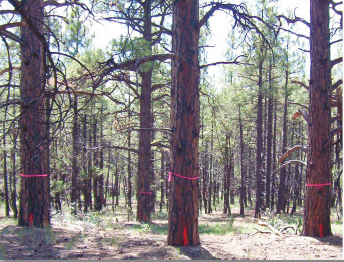
Although work is not expected to begin on the Apache-Sitgreaves National Forests for at least a year, Navajo County officials, Forest Service officials and other stakeholders signed a memorandum of understanding regarding the Four Forest Initiative on Feb. 23.
The agreement provides a basic outline of how the agencies and interested parties will cooperate to accomplish the ultimate goal of restoring the forests to a healthy state. Navajo County Supervisor David Tenney pointed out the historic nature of the agreement, which brought together groups that in the past have been at odds over forest resources.
“Navajo County is proud to stand in partnership with the other members of the Four Forest Initiative stakeholder group and the U.S. Forest Service on this historic MOU (memorandum of understanding). Never before in the history of our nation’s forests has such a diverse group united in support of a project of such significant scale and importance,” Tenney said. “The members of this stakeholder group understand what the residents of Navajo County have known for years: that preventing landscape-scale fires requires a landscape-scale solution that includes industry, science and collaboration. The initiative is Arizona’s, and the country’s, only hope for restoring our forests.”
In addition to Navajo County, entities approving the agreement include the National Forest Service, Northern Arizona Loggers Association, The Nature Conservancy, Northern Arizona University and Northern Arizona Wood Products Association, as well as Little Colorado River Resource, Conservation and Development, and Coconino, Gila and Greenlee counties.
The Four Forest Initiative group noted that, “The MOU is designed to accelerate large-scale restoration across the Mogollon Rim to support resilient, diverse stands that sustain native biodiversity; safely re-establish natural fire regimes; reduce fire threats to communities; create sustainable forest industries that strengthen local economies while conserving natural resources and aesthetic values; and engage the public through increased public outreach, education and support for this initiative.”
Mechanical thinning will take place under the initiative in order to “sustain old growth, promote tree size diversity, reduce fire risk and restore historic grassland areas.” The work is expected to provide jobs, as well as improve the health of the forests.
Kaibab and Coconino National Forests will move through the process first, which includes an environmental analysis. The Apache-Sitgreaves will follow, once the analysis has been completed for the first two forests.
The project has already been years in the making, and once a detailed plan is adopted it will remain in effect for 10 years for each forest. Representatives from the various agencies signing the memorandum of understanding expressed hope that the initiative would eventually set the standard for improving forest health.
“Today marks a turning point for northern Arizona’s forests and the communities and species that call them home,” said Forest Policy Analyst for the Center for Biological Diversity Todd Schulke said. “After a century of ecosystem decline, the long-overdue restoration envisioned by the Four Forest Restoration Initiative will set forested landscapes on a path of recovery.”




