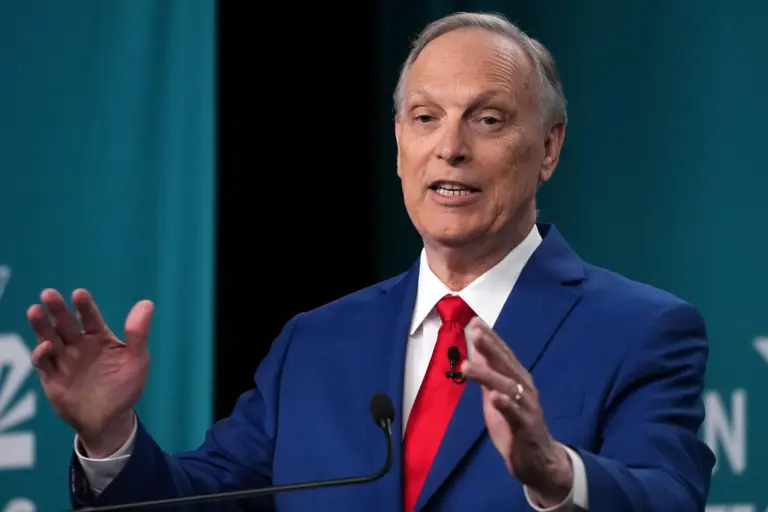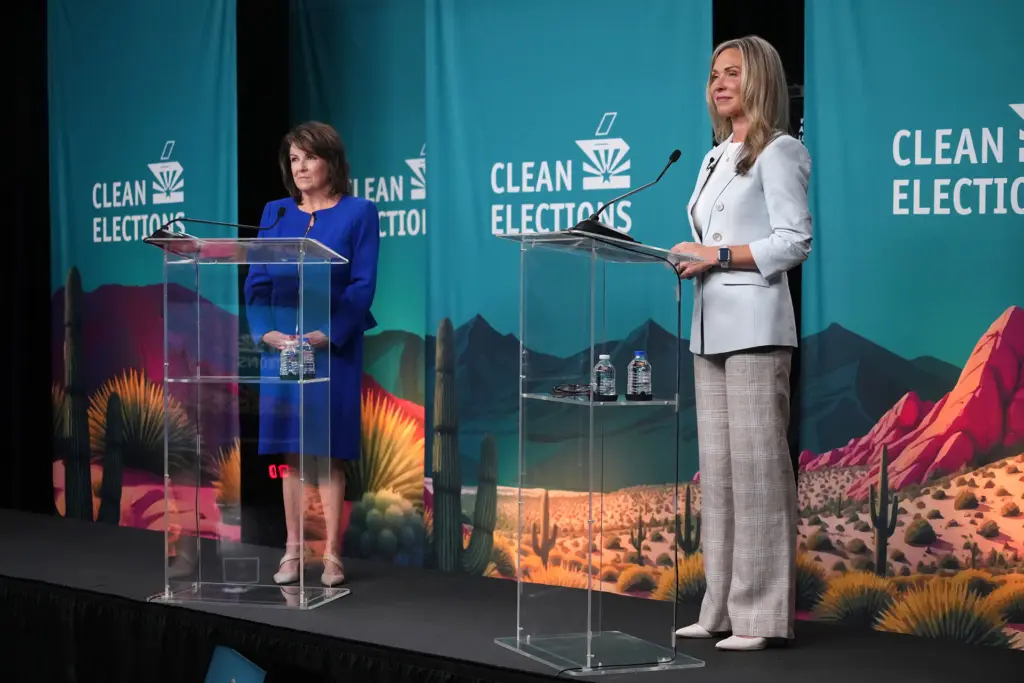
Two of the four candidates seeking to become Arizona’s first lieutenant governor met Monday, Oct. 5, in the first debate for the office in state history. They found common ground on school choice and border security and split over the state income tax, data centers and how urgently Arizona must act on water.
Republican Sine Kerr, the running mate of U.S. Rep. Andy Biggs and Angela Harrolle Mohan, who is running with No Labels Party nominee Teri Hourihan, shared the stage for the hourlong debate hosted by the Citizens Clean Elections Commission. Former Mesa Mayor John Giles, the running mate of Democratic Gov. Katie Hobbs, declined the invitation. Green Party candidate Lisa Castillo did not respond, moderators said.
The absences shaped the evening. Kerr directed most of her criticism at Hobbs rather than at Mohan and no one on stage answered it. “It’s an absolute disgrace that Governor Hobbs and John Giles will not participate in this debate,” Kerr said in her closing statement.
Hobbs, who also declined to debate in 2022, defended the decision the same day. “I believe face-to-face interactions with Arizonans are more effective than a stage that is designed for nothing but political soundbites and theater,” she told reporters, according to ABC15.
The office itself is new. Since statehood in 1912, Arizona’s secretary of state has been first in line to replace a governor who leaves office. Voters changed that in 2022, approving Proposition 131 with about 55% of the vote after rejecting similar measures in 1994 and 2010. Arizona had been one of five states without a lieutenant governor.
The change grew out of a long record of unfinished terms. Five times since 1977, an Arizona governor has left office early. Raúl Castro resigned in 1977 to become an ambassador, and his successor, Wesley Bolin, died in office the next year. Evan Mecham was impeached and removed in 1988, Fife Symington resigned in 1997 after a felony conviction and Janet Napolitano left in 2009 to join the Obama administration.
Twice the handoff gave the office to the other party without an election. Democrat Rose Mofford replaced the Republican Mecham, and Republican Jan Brewer replaced the Democrat Napolitano.
Under the new system, each candidate for governor names a running mate at least 60 days before the general election, and a single vote elects both. The winner must give the lieutenant governor a job, such as chief of staff or director of the Department of Administration. The first term begins in January.
Kerr, a Buckeye farmer and former state Senate majority whip, voted as a lawmaker to send the measure to the ballot. She said voters who elect a governor deserve continuity of ideology if the lieutenant governor has to step in.
Neither candidate committed to a specific post. Kerr said she and Biggs will announce her role after the election, and she suggested she could repair relations between the governor’s office and the Legislature. “We are not going to govern by veto,” she said.
Mohan, a former State Department special agent who later ran a statewide nonprofit supporting public safety workers, said she is ready to serve as chief of staff. She said she first wants a full audit of state government in the administration’s first 60 days.
The two described the partnership with a governor differently. Kerr said her responsibility is “promoting, supporting, and amplifying” Biggs’ policy priorities. Mohan said she and Hourihan do not always agree. “We don’t need to be mirror images of each other, nor do we need to be an echo chamber,” she said.
The sharpest exchange came on taxes. Kerr said a Biggs administration would phase out the individual income tax, go after waste and fraud, speed a fuel pipeline from Texas and sell state land near cities for home building. She blamed Hobbs for job losses and high housing costs.
Mohan’s affordability plan centered on infill housing and what she called the benefits cliff, in which a raise can cost a working family its public assistance. She pledged no new taxes but questioned Kerr’s math. Eliminating the income tax “removes nearly a third of the revenue in our general fund,” she said. “How does that get replaced?”
Kerr said it could be done gradually “without raising taxes elsewhere” and without cutting city and town budgets. She said recovering $2.8 billion to $3 billion in Medicaid fraud, along with economic growth, would offset a tax she said brings in about $5 billion. The Joint Legislative Budget Committee puts individual income taxes at 31.5% of the state’s $18.85 billion general fund, or about $5.9 billion, ABC15 has reported.
On health care, Kerr rejected the premise of a question about Medicaid cuts. “The notion of Medicaid cuts is not true. It is Medicaid reform,” she said, describing a requirement that single, able-bodied adults work or volunteer 20 hours a week. KJZZ reported that the federal changes go beyond work requirements. Mohan said coverage means little where there are no providers and called for incentives to bring medical workers to rural areas.
The two largely agreed on education. Both support school choice and the Empowerment Scholarship Account program. Mohan said the state must also win families back to public schools by paying teachers more and getting money past administration and into classrooms. Kerr pledged to make Arizona schools “the gold standard” and said her son’s struggle with dyslexia in a rural school made her a supporter of the accounts.
Water drew the longest answers. Kerr said Hobbs “has done a huge disservice by putting out the message that Arizona is running out of water, and nothing could be further from the truth.” She pointed to stored groundwater, brackish water and in-state rivers. She blamed Hobbs for the 760,000 acre-foot cut to Arizona’s Colorado River supply and promoted a $19 billion bill Biggs introduced in Congress for storage, recharge and desalination across the river basin.
Arizona takes the largest cut because of the junior priority it accepted in 1968 to win approval of the Central Arizona Project, ABC15 reported. Hobbs has called the criticism political gamesmanship.
Mohan praised Kerr’s knowledge of water policy but said the state needs “greater urgency.” She said Lake Mead and Lake Powell are less than a third full and urged Arizona to follow Nevada in purifying and reusing wastewater. “It’s not a sexy thing that people like to say, but it’s called toilet to tap,” she said. Kerr replied that Arizona already leads in reuse and recharge.
On data centers, Kerr said they should receive no state subsidies and must supply their own water and power. Mohan went further, proposing “a temporary moratorium on applications for new large-scale data centers” until the state sets standards for water use, electricity and community impact.
On immigration, both called for a secure border. Mohan drew a line between people who cross illegally to work and those trafficking drugs or people, and she said the federal government should pay for the agents it sends. Kerr said the state would cooperate with Immigration and Customs Enforcement, encourage local 287(g) agreements, which allows U.S. Immigration and Customs Enforcement (ICE) to delegate federal immigration enforcement authority to state, local and tribal law enforcement agencies, and restore the Border Strike Force. Asked whether she would criticize ICE conduct she disagreed with, she did not answer directly.
On elections, Mohan said the current system is not broken but could add security such as biometrics. Kerr called for faster results through “Florida-style election reform.”
Asked how voters should judge the new office in four years, Mohan proposed a public website tracking the administration’s goals week by week. Kerr listed a more affordable economy, safer communities, better schools and a secure water supply.
Early voting began Oct. 7. Election Day is Nov. 3.