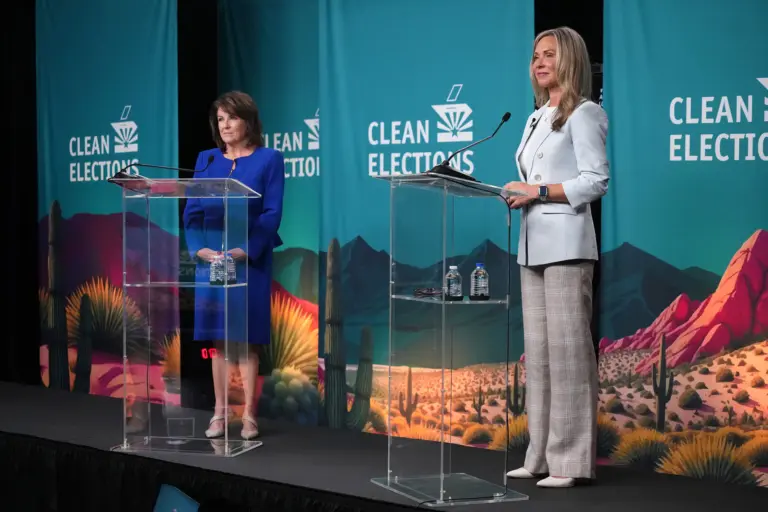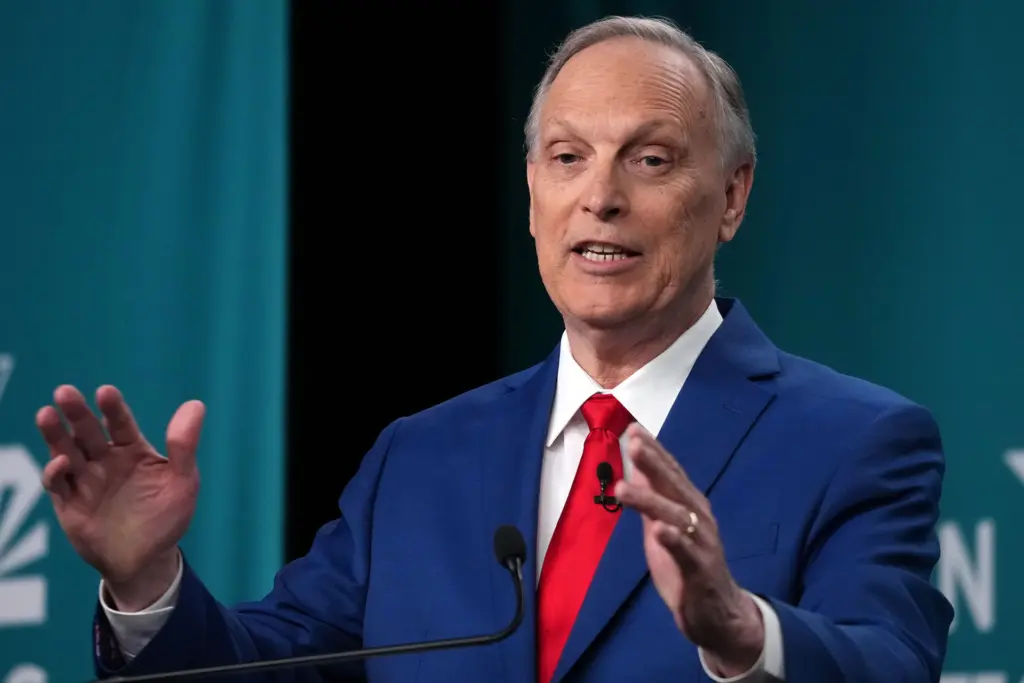
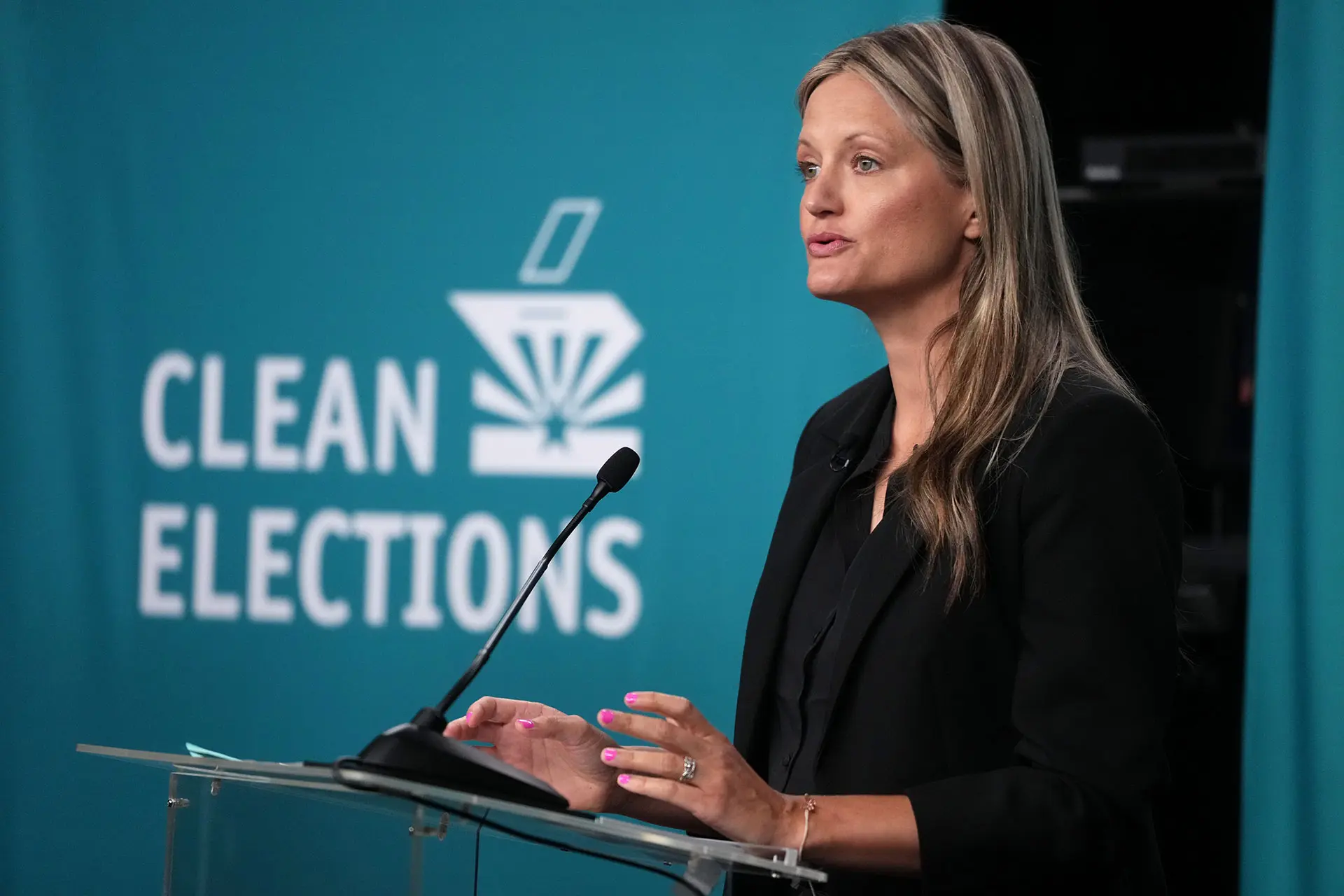
Republican Andy Biggs and No Labels nominee Teri Ann Hourihan debated taxes, Medicaid, water and data centers Tuesday night in the Citizens Clean Elections Commission’s general election debate for governor. Democratic Gov. Katie Hobbs declined to participate and Green Party nominee Risa Lombardo canceled at the last minute.
Biggs, a congressman from the East Valley, directed much of his criticism at Hobbs and her decision not to attend. Hourihan, a licensed counselor and business owner, directed much of hers at Biggs, questioning his record in the Legislature and in Congress.
“Katie Hobbs, on the other hand, refuses to actually come out of her basement and debate with us,” Biggs said. “I think that is disqualifying.” He returned to that word several times during the hour. In his opening statement he blamed Hobbs for job losses, housing costs, cuts to the state’s Colorado River supply and fentanyl deaths and said she is under criminal investigation for corruption. He promised lower taxes, fewer regulations and protection for school choice.
Hourihan, 41, said she was born and raised in Arizona and has “never seen Arizona so bad.” She blamed elected officials in both parties, then used the rest of her opening minute to question Biggs directly. She raised an unverified allegation, circulated online in connection with the Jeffrey Epstein case, that Biggs assaulted a child decades ago. She also asked why he had not signed a second congressional petition seeking unredacted Epstein files. “Yes, false,” Biggs said of the allegation, adding that he had already voted in Congress to release the files. The fact-checking site Snopes found no credible evidence to support the allegation.
One of the longest exchanges concerned taxes and Medicaid. Biggs wants to phase out the state income tax and said doing so would not require spending cuts. “You don’t have to cut anything,” he said, arguing that lower taxes speed up the economy and generate more revenue. He said a state version of the federal DOGE effort would root out waste and fraud, particularly in Medicaid, to help cover the difference.
Hourihan disputed that, arguing that money recovered from Medicaid fraud stays in the Medicaid program. “You do not get to put it into the general fund,” she said. “That’s not how that works.” Biggs acknowledged that some recovered money would return to the federal government but said some would come back to the state. He defended his opposition to Medicaid expansion when he was state senate president, saying enrollment and cost projections at the time proved too low, and said he supports help for those “truly in need.”
Hourihan called him one of the most dangerous people for the program. She said the state wrongly suspended her behavioral health company and took “two years and seven days” to clear it, during which her staff fell from 250 employees to 19. She said she has been in recovery for 18 years and worries about mental health and substance abuse care under a Biggs administration.
Her own affordability plan centers on universal childcare, phased in over about eight years as New Mexico did. She described a system in which people take a job, lose their public benefits and can no longer afford to live. “I call it keeping people poor,” she said. She also called for more housing and competition among utilities, and said she would not raise taxes.
Hourihan also criticized Biggs’s record in Washington, saying he had passed only one law in Congress. Biggs responded that he wrote the House versions of a tribal AMBER Alert law, the Right to Try Act and an anti-corruption bill, all of which were enacted under senators’ names. He said Hourihan did not understand how the legislative process works.
On water, the candidates disagreed about whether Arizona faces a crisis. Biggs acknowledged the state is losing a large share of its Colorado River supply, a cut set at 760,000 acre-feet a year under the final federal plan. But he said Arizona has enough groundwater to support 12 million to 15 million people for 250 years if the state builds the pumps, treatment plants and pipelines to use it.
“We have plenty of water,” he said. “It’s just managing it.” He also called for desalination and expanded reservoir storage, and said he would negotiate with other Colorado River states instead of suing them. Hourihan said experts see it differently. She called for stricter conservation modeled on Nevada, desalination and extending regulated groundwater management areas into rural Arizona.
Both candidates said they oppose tax breaks for data centers. Hourihan criticized the three-year moratorium Hobbs signed this year because it paused only the tax incentives, not construction, and said 113 applications arrived before it took effect. She would impose a temporary pause of about six months on new applications while the state studies water, energy and health effects.
Biggs would end the tax breaks permanently. “They don’t need them,” he said. He would bar data centers from taking power or water needed by current and future residents and businesses, then let local governments decide whether to allow them.
On education, both said they support school choice. Biggs would raise the state’s Empowerment Scholarship Account award from about $7,300 to roughly $9,500 to draw schools into underserved areas, and said he would immediately opt Arizona into a federal scholarship tax credit that Hobbs has vetoed. Hourihan, whose children attend public schools, said she would keep the scholarship accounts but wants tougher audits of the broader education system. She did not directly answer a question about the federal credit.
On the border, Hourihan said she supports legal immigration and border control, along with an easier path to citizenship for people who have lived here since childhood and due process for those in detention. Biggs said he would appoint a border chief, revive the state’s border strike force and meet directly with leaders in Sonora and Mexico City to protect trade.
Hourihan challenged that answer. “You’re the person that I would least trust to protect our borders,” she said. She pointed to a 2013 bill that would have allowed the state to disband the police force in Colorado City, home to a polygamous sect. The bill died in the Senate while Biggs was president, and she said girls there were left unprotected from marriages to adult men.
“It’s an outrageous lie,” Biggs said. He cited his years as a prosecutor handling domestic violence cases and his work on child protection bills in Congress. He said he voted for a narrower measure in 2012 and that police agencies warned him the 2013 version was too broad. He added that he was baffled that someone with so little knowledge of the legislative process would attack his character.
The exchange took up most of the time allotted to a question on housing. Hourihan called for building on vacant land within cities, changing permitting rules and cracking down on price gouging, while Biggs did not address the topic.
In the final minutes, moderators asked Biggs whether he would accept the results of the election. “I will accept the outcome,” he said, adding later that he would be happy to certify it. He said mail voting should stay but that Arizona should adopt Florida-style rules to speed up the counting of early ballots dropped off late.
In his closing statement, Biggs called Hobbs “the one I consider my opponent.” Hourihan responded in hers. “I am also your opponent,” she said. “I realize that you want to ignore me and pretend I don’t exist, but I do.” Hobbs has led Biggs in public polls. Early ballots went out Wednesday, and Election Day is Nov. 3.