On the afternoon of Sept. 16, the U.S. House voted 415 to 9 to pass the Water Resources Development Act of 2026, a bill that directs the Army Corps of Engineers to expedite the Winslow levee.
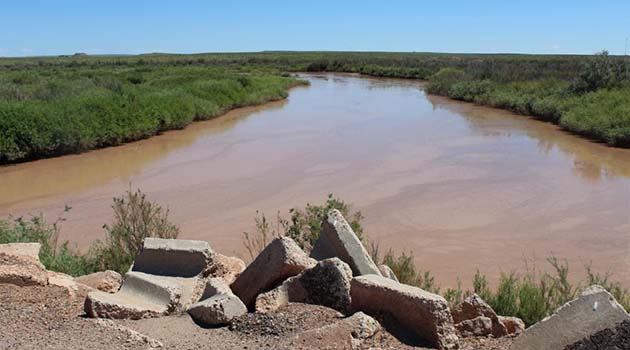
That morning, Winslow flooded but it wasn’t due to overflow from the Little Colorado River. Highway 87 went under and so did Ruby Wash and water stood in streets and yards across the south side of town before the rain had finished falling. The U.S. Geological Survey gauge on the river below Winslow crested at 14.31 feet on Wednesday morning, before the storm arrived and fell through the day while the town was filling up. What flooded Winslow was stormwater with nowhere to go and that distinction matters, because the thing Winslow has been waiting on for years is a levee. A levee holds back a river. It does not drain a street.
The levee matters because of a map more than a wall. The existing levee along the Little Colorado no longer meets federal certification standards, so FEMA’s floodplain maps treat the south side of Winslow as if no levee were there and more than 1,500 buildings and the BNSF corridor sit inside that line carrying incredibly costly and mandatory flood insurance for a town with a higher than national average poverty rate.
A new, certified levee would redraw the map and lift that burden. City Manager David Coolidge told the council in March what that timeline looks like: design and engineering continuing toward a bid, construction starting in 2030, finishing around early 2032 and then roughly a year of federal recertification before the maps change. The relief Winslow is waiting on is about seven years out and efforts have been more than a decade in the making.
The delay has been the money. The project was funded through the 2021 federal infrastructure law with a base allocation of about $101 million and the most the Corps can spend under its current authorization is about $140.6 million. Updated engineering estimates last October put the certified cost at $175.7 million. A federal water project whose cost outgrows its authorization cannot simply spend more; it has to go back to Congress and Congress authorizes water projects on a two-year cycle or find alternative ways of funding. Coolidge told the council in March that Winslow and Navajo County would likely have to wait for the 2028 water bill to ask and that the alternative was to cut roughly $35 million from the estimate to bring the project back inside the cap.
That is what the city and the Corps have spent the summer trying to do. A value-engineering workshop in May put Corps engineers and a consultant team in a room and produced more than 20 ideas across five areas, among them keeping the existing levee in place and building on it rather than tearing it out, realigning the levee near Interstate 40 and using soil cement and stabilizers in place of riprap hauled in from a distance. By August, Supervisor Fern Benally told the council, the Corps had identified more than $20 million in potential savings, enough to bring the estimated construction cost below the authorized amount, with the total project cost now put at $120 million to $130 million. The savings were not final. The Corps was to make its determination after the project reached 35% design, expected around the end of July and Coolidge pressed the Corps on the point that matters most to Winslow, that whatever gets built has to be FEMA-certifiable when it is done.
The city’s own levee fund holds about $4 million. The city skipped its planned $500,000 transfer this year and Coolidge has said bond financing will likely be needed for the local share.
That is the project the House voted to expedite. The Water Resources Development Act is the bill Congress passes every two years to authorize the Corps’ civil works and the 2024 version already carried a provision directing the agency to accelerate Winslow. The 2026 version, H.R. 9497, does it again. Winslow appears in the bill’s text once, under a section titled Expedited Completion, which directs the Corps to expedite the project’s general reevaluation report, the study that decides whether the redesigned levee fits inside its cap. The bill also raises the ceiling on a separate environmental-infrastructure program for Winslow from $3 million to $9 million, money for water and wastewater work, not for the levee.
Rep. Eli Crane, whose district includes Navajo County, said in a Sept. 18 release that the bill “authorizes significant investment for rural Arizona through flood mitigation projects, upgraded wastewater treatment systems and infrastructure.” Winslow Mayor Roberta “Birdie” Cano said in the same release, “We are grateful to Congressman Crane for his leadership in securing language in the Water Resources Development Act of 2026 directing the U.S. Army Corps of Engineers to expedite the Winslow Levee Project.”
The House vote is not the end of it. The Senate’s version of the bill, S. 4949, cleared the Environment and Public Works Committee 18 to 0 on July 15 and has been sitting on the Senate calendar since and the two versions will have to be reconciled before anything reaches the president’s desk. That will not happen before the election. Both chambers are scheduled to leave Washington at the start of October and stay out through Election Day on Nov. 3 so members can campaign and the Senate’s published calendar has it back for two days the following week before the Veterans Day break. Whatever the Senate does with the water bill, it does in a lame-duck session, with a Dec. 11 government funding deadline competing for the same weeks.
Expediting a report is not the same as raising the cap. When a Corps project’s cost outgrows its authorization, only Congress can reauthorize it at the higher figure and Flagstaff’s Rio de Flag project got exactly that in this bill, reauthorized at its updated cost so construction can proceed. Winslow’s project did not. Lt. Gen. William H. Graham Jr., the Corps’ chief of engineers, told the Senate committee on Feb. 27 that Winslow would miss this year’s bill and wait for the next one, in 2028 and nothing that passed the House on Sept. 16 changed that. If the value engineering brings the levee under the cap, Winslow will not need the 2028 bill at all. If it does not, the bill that just told the Corps to hurry is not the bill that can let it.
Whenever it is built, the levee will stand between Winslow and the river and on the morning the House voted to hurry it, the river was not what came through town. The gauge below Winslow never approached its banks and the water came down the washes and off the streets the way it has before. The first shovel is still four years off by the city’s own schedule, the maps change about seven years from now and on Sept. 16 the town was already wet.