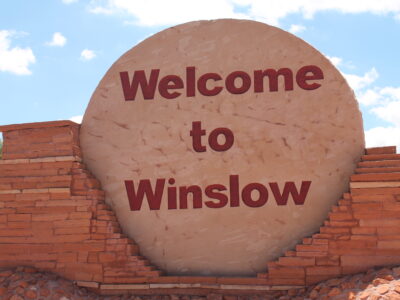
The U.S. Army Corps of Engineers has identified more than $20 million in potential cost savings on the Winslow Levee project through a value engineering process, bringing the estimated construction cost below $100 million and potentially positioning the project below its congressionally authorized cap. Navajo County Supervisor Fern Benally told the Winslow City Council during her quarterly report last week that a workshop held in May brought together Army Corps engineers and a consultant team that identified over 20 ideas across five functional areas for cutting costs.
“The cost savings are not final. The Corps is actively evaluating the new potential design recommendations to achieve the most cost reduction while maintaining the value and integrity of the project,” Benally said. Recommendations under evaluation include limiting full levee replacement to areas of greater uncertainty, more efficient levee alignment near Interstate 40 and alternatives to riprap for shoring up the levee.
The project was expected to reach 35% design by the end of July, at which point the Corps will make a final determination on whether the project falls below the authorized amount. Pre-construction work continues, including a utility survey initiated in May, planning for meetings with BNSF Railway and a field pump testing contract expected to be awarded within weeks. City Manager David Coolidge emphasized to the Corps the importance of FEMA certification once improvements are complete.
Funding remains a challenge with a total project cost is estimated between $120 million and $130 million, up from the original $107 million authorization and the city’s levee fund holds about $4 million. But this is down from a $150 million dollar figure that was reached by inflation before the cuts conversation.
The city skipped its planned $500,000 transfer to the fund this year due to higher-than-expected project costs elsewhere, though it may still make the transfer at year end. Coolidge said bond financing will likely be needed to cover the city’s share. “We’re doing a good job for a small city, building that fund proactively. Even if we don’t make it, at least we’ll have a big portion of it,” Vice Mayor Jim Maclean said.
The council also unanimously approved an ordinance for a planned area development zoning amendment for property east of North Park Drive and north of North Road. The project includes 35 RV park spaces with a gift shop and restaurant, plus 101 manufactured home spaces, with amenities including a swimming pool, ball courts and a playground. Phase one covers the RV park; phase two adds the homes and amenities.
The developer, Steve Pyles, said construction could begin in November pending plan approvals. “We’re going to try to fast track this. We’ve got a lot of cooperation from the city. I think we’ve gone through most of the hoops and answered most all of the questions,” he said. The homes will be factory-built to current building codes and HUD standards, set on permanent foundations with wood wallboard exteriors. “Our intent is to keep it affordable, but not cheap. And that’s why we’re putting all the money into the common areas, to create a sense of community for these folks out there and buy in ownership,” Pyles said.
Council members welcomed the project as a response to the city’s housing shortage. “I’m just very excited to have some new housing coming in,” Councilmember Samantha Crisp said. Mayor Birdie Cano added, “This will be quality. It’s not going to be what people normally consider a manufactured home. They own their own home. They’re going to have a common facility where they can get their sense of community.” After the vote, one member declared, “Let’s turn some dirt.”
On broadband, Benally reported the county’s middle mile fiber project is complete and in final closeout with the Arizona Commerce Authority. Contractor X2 will continue to lease and maintain the infrastructure and the county has signed a lease agreement with Verizon, with other long-term leases in discussion, including those needed for the federal BEAD broadband program. Arizona Public Service is working to connect the county’s fiber to infrastructure at the Cholla Power Plant in Joseph City, though a start date for the BEAD program is not yet known.
During his update, City Manager Coolidge told the council the city’s $500,000 annual street budget doesn’t stretch far. Some roads are now in such disrepair they can no longer be chip sealed and must be fully replaced. Engineering is underway to determine how many segments can be replaced with available funds, with work expected in spring since fall is too cold for street projects. Most street funding comes from state highway revenue funds, which covers basic upkeep but not major repairs, forcing the city to lean on its capital fund.
The sidewalk program gets $100,000 a year and crews have begun repairing damaged and missing segments. “One of our big priorities is to make sure that we have continuity of sidewalks and ADA ramps for those individuals that are disabled,” Coolidge said, with several ADA ramps expected to be finished by the end of September.
The downtown restrooms project has $150,000 budgeted this fiscal year. The parking lot and train cars were completed last fiscal year and the city is finalizing a bid and construction management agreement before going out to bid. Coolidge cautioned the timeline is uncertain because interior work often takes longer than exterior, pointing to the Circle K project, which has its exterior up but won’t be finished until the end of November.
On finances, the city ended fiscal year 2026 with $16.5 million in total cash and investments as of June 30. The General Fund brought in $18.5 million in revenue with spending at about 95% of budget. The Wastewater Fund exceeded revenue expectations at 107%, while the Water Fund lagged at 51% of revenues and 43% of expenditures because an anticipated grant was delayed to fiscal year 27. The Sanitation Fund hit 100% of budgeted expenditures after waste management raised its rates shortly after the budget was adopted, though the fund performed far better than the prior year’s deficit.
The council also received a certificate of appreciation from Anne Evans honoring the city’s 9/11 Remembrance and Reflection Garden. Winslow was the first community in the nation to receive steel from the World Trade Center for a permanent memorial, the largest amount loaned to any community until the USS New York was commissioned in 2009. This September marks the 25th anniversary of the attacks that killed 2,977 people and the city’s memorial ceremony is set for 6 p.m. on Friday, Sept. 11.
The chamber reported 2,862 visitors to the visitor center over the past four months, with out-of-state tourism up thanks to Route 66 centennial travel offsetting a dip in foreign visitors. Upcoming events include the Route 66 Centennial 5K Color Run and a new community garden mural unveiling in September, along with the Standin on the Corner Festival September 25-26. The city also extended its farmers market night markets into August and an annual community cleanup is expected in late August or early September.
In other business, the council:
* Approved the check register and past meeting minutes.
* Approved a liquor license application for Clarion Pointe located at 1701 N. Park Drive.
* Approved waiving fees for the Arts Council to host Fab Fest at the Standin on the Corner Plaza.