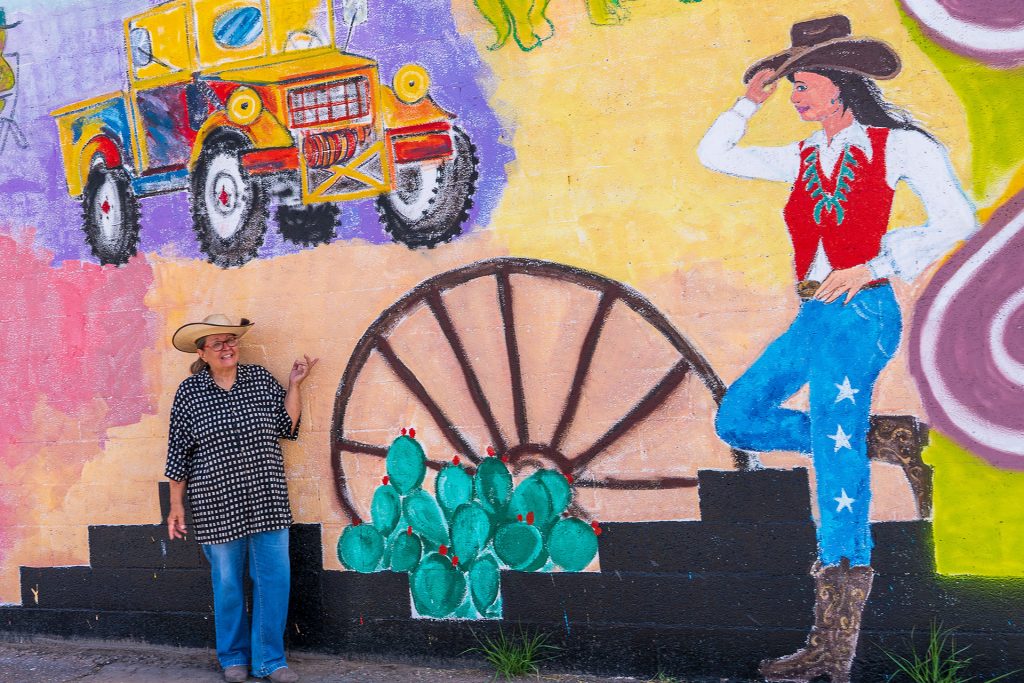
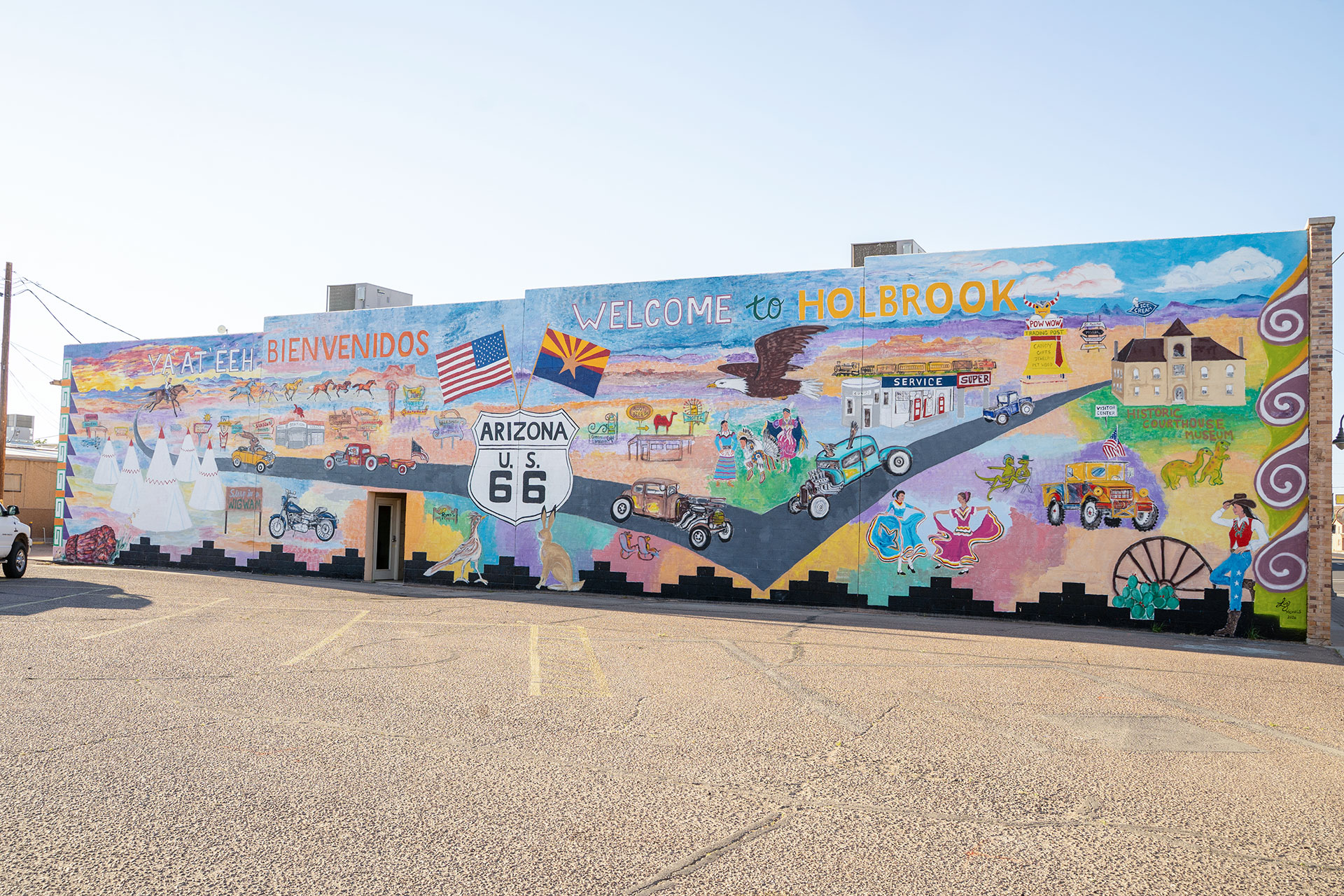
Liz Nichols did not set out to paint a directory of Holbrook history. But by the time she finished the new Route 66 mural located at the corner of Hopi Drive and Navajo Blvd., the wall had become something close to that, filled with old signs, local businesses, family names, Native designs, patriotic images and memories that belong to the people who grew up with them.
The lifelong Holbrook artist recently completed the mural, replacing the one she painted on the same wall 25 years ago. The new version is bright and crowded with meaning, the kind of piece that can be understood quickly by visitors taking photos but rewards longtime residents who stop and look longer. Nichols points out there are many images inside the mural, some were suggested to her by other residents and some appeared to her in her dreams.
“I didn’t get everything,” Nichols said. “But, I mean, there’s 45 different images on there.”
The design along the bottom of the mural is Navajo-inspired and represents the Four Mountains, with four steps built into the pattern. The mural also includes dinosaurs, a jackrabbit, a motorcycle, horses, dancers, the historic courthouse, service stations, old motel signs and other pieces of Holbrook’s past. Some details are easy to spot. Others are tucked into the mural like small gifts for people who know what they are looking at.
That is part of what makes the mural personal. Nichols included Campbell’s Coffee House, the Desert View Motel, the Mobile station that was torn down, the Plainsman sign, the Holbrook Hotel sign, Whiting Brothers and a reference to the old bowling alley. Those were not just businesses to Nichols. They were part of the map of daily life in Holbrook before Interstate 40 changed the way people moved through town.
Nichols remembered the days when Route 66 was still the main road and young people would spend evenings taking laps. “Those were the lowrider days,” she recalled. “We would put a dollar or two of gas in the car and drive all night.” She would drive all around town cruising on Route 66 during its heyday and she knew when it was time to go home from looking at the Holbrook Hotel sign because it had a clock on it, which is also depicted in the mural.
For Nichols, those memories are why the mural matters. A visitor will see the colorful painted desert palette greeting them on their way through town. But a longtime Holbrook resident will see a town that no longer exists in quite the same way. The mural brings back signs that have disappeared, buildings that have burned down, businesses that have closed and a version of Holbrook that survives mostly in memory. “That’s why this means so much to people my age,” Nichols said.
The reason she knew what belonged on the wall is that the town’s history is her own. Nichols was born and raised in Holbrook and said her connection goes back generations. She was born at the old hospital near where the bank is now. Her father was born in Holbrook, her grandmother was born in Holbrook, and her great-grandparents, she says, were the first people to build a house in Holbrook located on Arizona Street and First Avenue. “I’m, like, fifth generation Holbrook,” she said.
That history is part of why the mural feels so specific. Nichols said another artist could have painted something beautiful on the wall, but the meaning behind the old signs, Route 66 references and small local details comes from having lived with them. She knew what people missed because she missed it too.
The new mural also carries a message beyond nostalgia. Nichols said the image came to her naturally, almost spiritually, with the road, flags, central symbol, courthouse, cowgirls, dancers and cars falling into place as she worked. She said the mural came to her in dreams and carried a feeling she wanted people to experience when they saw it. “When it came to me in my dreams, it kept coming, it was about love and happiness and welcoming,” Nichols said.
That theme is visible in the words “Yá’át’ééh,” “Bienvenidos” and “Welcome to Holbrook,” which came from the original mural concept. The new mural also ties into Holbrook’s centennial, Route 66 and the coming 250th anniversary of the United States, with the American flag and eagle included as part of that patriotic theme.
The wall itself has been part of Nichols’ life for decades. The first mural came about after a building in front of the wall burned down, leaving a large open space. Nichols said Vicky Cox, then director of Main Street, secured a $78,000 grant for a mural. Earlier plans involving several artists did not come together, and Nichols was eventually asked if she would paint it while following a committee’s direction.
Nichols said Matthew Barger, the former owner and publisher of The Tribune, helped create the original design by using old photos of Holbrook and combining them into a scene with the train, the city’s main streets of Hopi Drive and Navajo Blvd., and Hashknife riders. Nichols reworked the concept, created a mock-up and painted the mural. Severo Barela, a well-known local sign painter at the time, helped prime the wall and lay down some of the early background colors, while Nichols painted the buildings, people and other details.
Getting the new mural painted took years of trying. The first version took Nichols from September to January to complete; the new one took from January to June. She said she had been trying for about five years to repaint it before Kenny Larson helped make it happen. Carolyn Castillo volunteered early in the project and helped prime over the old mural. The city paid $10,000 for the work, with the understanding that about half would go toward supplies and half would go to Nichols, but the cost of supplies ended up higher than expected.
Much of the mural was painted with automotive paint so it would last longer. Nichols said the flags, vehicles, horses, motorcycle, courthouse, service stations and many other images were done with automotive paint. She said some small jars of this kind of paint cost about $40 each.
The flags also had to be repainted after Nichols learned the American flag had been placed on the wrong side and made slightly smaller than the Arizona flag. She said Bill Perkins told her the placement did not follow proper flag protocol, so she bought more paint and redid them.
Nichols’ life in art began long before either mural. She worked as a graphic designer at her family’s business The Print Place for more than 36 years and said art runs through her family. Her mother taught art at Northland Pioneer College and was an artist, her grandmother was an artist and her grandfather painted.
Nichols also helped start the Painted Desert Artist Association, a now defunct organization, with her mother, grandmother and other local artists and art supporters. The group held monthly workshops, with artists teaching techniques and others giving art history lessons.
Today, Nichols is still painting and still learning. She said she has been taking online classes through the Milan Art Institute since April and is already seeing improvement in her work. She has also placed paintings in the new Gandy Dancer Gallery on Joy Nevin Avenue, which she hopes can become part of a stronger arts presence in Holbrook. She would like to see the town build more of an arts district, with galleries, studio spaces, classes and places where artists can work together.
For now, her latest contribution is on the wall along Route 66, where tourists can take photos and longtime residents can find pieces of the town they remember. The mural is not just a replacement for the one that came before it. It is a new version of Holbrook’s story, painted by someone who has lived enough of that story to know what belongs on the wall.
Asked whether she thinks of the mural as a love letter to her hometown, Nichols did not hesitate. “Oh, yeah,” she said. “Definitely.”