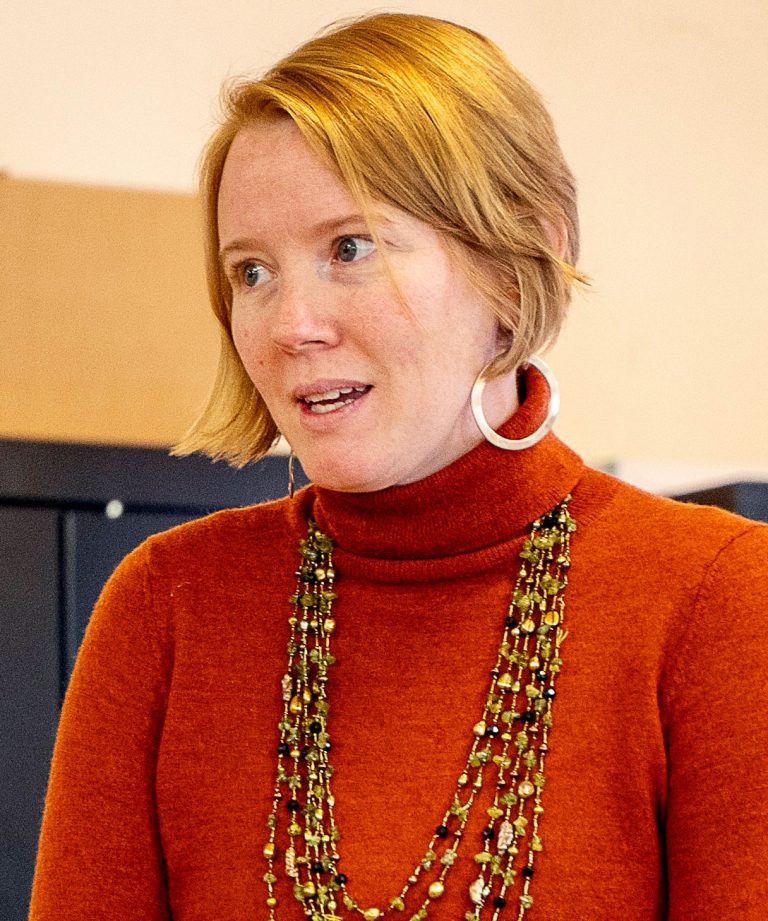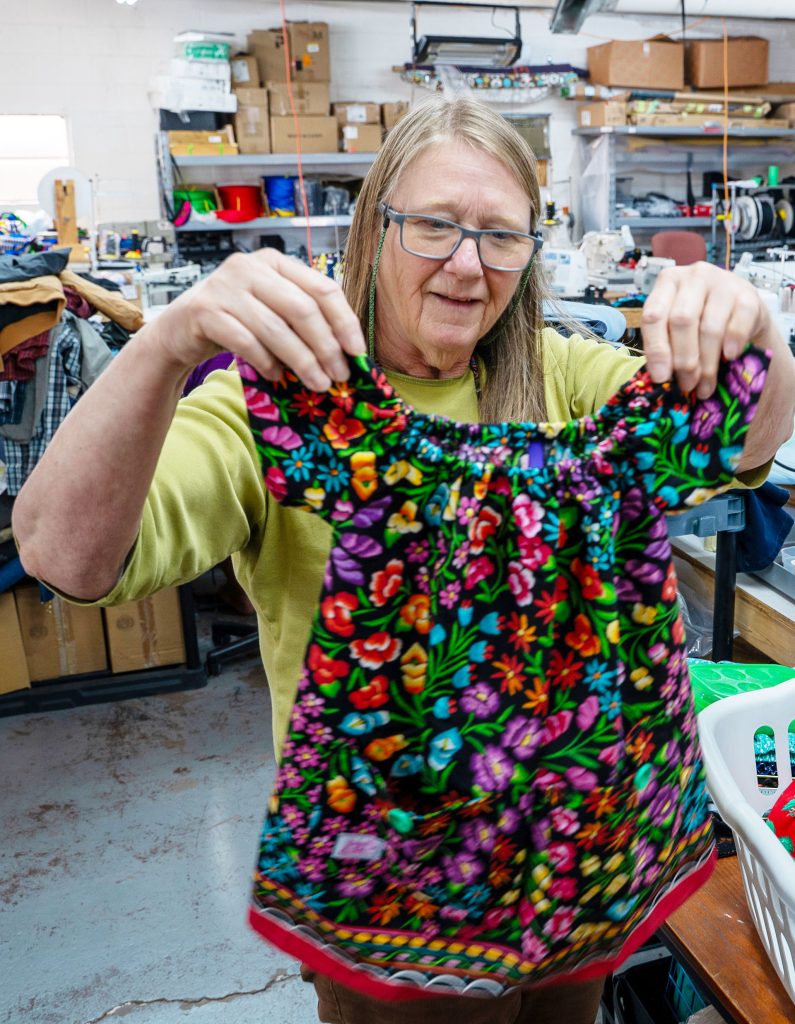
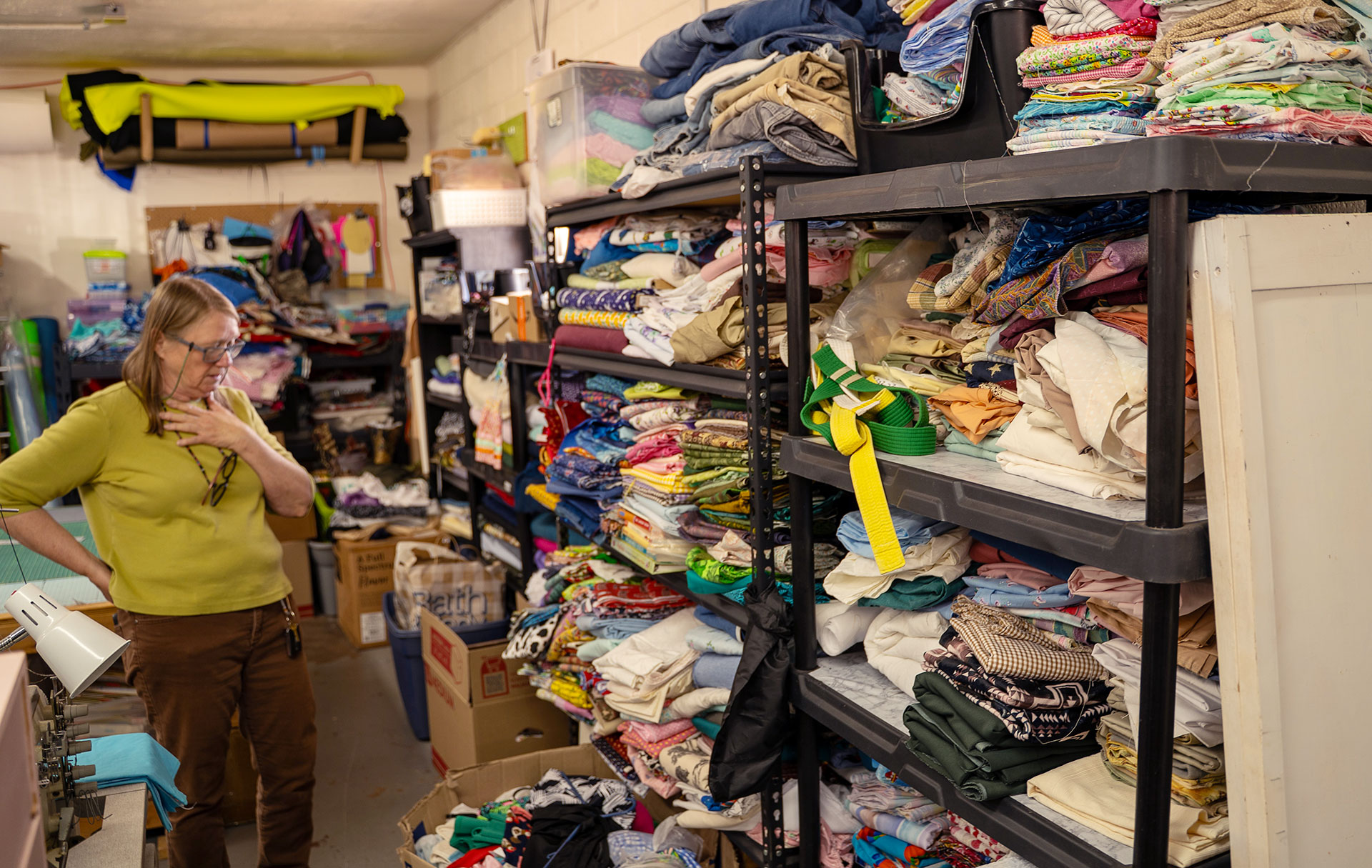
There is an overflowing rack of donated fabric inside Stitchin’ on the Korner in Winslow and Berry Larson and the Winslow Stitchers, including Linda Chambers, Mary Grayeske and Deidre Burton are turning it into clothing and handmade goods for children in Winslow and as far away as Paduaguda, Odisha, India.
Stitchin’ on the Korner, a fabric and sewing shop owned by Deidre Burton at 309 W. Second St. in Winslow, has become the working home of the Winslow Stitchers, a group that uses donated material to help others. Bolts of cotton, bright prints, loose remnants, zippers and buttons arrive from closets, garages and sewing rooms across the community. All of which are waiting to be given new life.
That mission has taken the group’s work in several directions at once. Locally, the Winslow Stitchers have made book bags for the library, tote bags for Alice’s Place, activity aprons for residents at Campus of Care and, most recently, ribbon skirts, aprons and small purses for girls connected to Naomi House. At the same time, the sewing done by the women has reached children in India through Larson’s sister the Rev. Dr. Lori McMacken’s charitable work with Butterfly Effect Global and through connections with Dress a Girl Around the World.
The India effort began when Larson realized her sister’s trip could give the dresses a direct path to children who needed them. Larson had joined the Sedona group of Dress a Girl Around the World after Burton introduced her to the program, and she now travels there once a month to help cut fabric and prepare sewing packets. When she learned McMacken was going to India through Butterfly Effect Global, she asked whether her sister could take about 100 dresses with her.
Her sister agreed, and in February 2026, those dresses went to children in the village of Paduaguda, Odisha, India. Some had been made through the Dress a Girl group and others had been made in Winslow. Larson said the children were nervous at first, but the mood changed when they received the dresses and discovered the pockets.
“Once they got them and all the kids put their hands in their pockets the first time, they had these big smiles,” Larson said.
The response made clear that the need was larger than one trip. After McMacken left India, Larson said the liaison working with Butterfly Effect Global began receiving calls from other villages asking if there were more dresses. That was when Larson also realized the first effort had left out the boys. “After my sister donated dresses this past February, the boys had nothing,” Larson said. “So I started making stuff for boys.”
For the next trip, planned for February 2027, Larson is preparing a broader shipment: 50 boys’ sets and 50 girls’ sets. The boys’ sets are expected to include a T-shirt, shorts, a beanie cap and underwear, while the girls’ sets are expected to include a dress, underwear, bloomers and a beanie cap. The additions came from Larson thinking through the practical realities of what children need, not just what looks nice in a photo. After the first round of dresses, she realized many children did not have underclothes, and that even mild weather by Arizona standards could be cold for children without warm clothing.
The dresses are generally made for girls ages 2 to 8, Larson said, because older girls often begin wearing traditional clothing. The boys’ clothing is intended for younger children who cannot provide for themselves and may be wearing worn, damaged or handed-down clothes. Larson said some children in the villages have so little clothing that they may not even be able to come outside until they grow into something available to them.
“They can’t fend for themselves,” Larson said. “And it’s not that often in their life they’re ever going to get brand new clothes.”
The clothing is tied to a larger effort through Butterfly Effect Global, the organization operated by Larson’s sister. McMacken’s work in India began after their mother died during the COVID period, when a donation helped fund a water well and eventually led to deeper involvement in remote villages. Larson said her sister has since helped raise money for wells, medical care and other support, including help for leper colonies and village residents with limited access to basic necessities.
Larson said Butterfly Effect Global’s work is focused largely in Odisha, where McMacken works with a local liaison who helps identify villages, coordinate wells, translate, transport people for medical care and make sure aid reaches the intended communities. That direct connection matters to Larson. She said she feels confident sending the clothing because someone physically carries it to the people who need it, rather than shipping it into an uncertain system where it could be lost, stolen or resold.
“I’m just one person sending this through one person who physically is going there to make sure that it really goes to the people,” Larson said.
Larson has found her own role in the same chain of service. The contribution of Larson and the other Winslow Stitchers is time, skill and the steady use of a sewing machine. She estimates she makes about seven outfits a week, including dresses, skirts and shorts. When she finds clearance T-shirts and shorts, she buys them in bulk and adds small patches so each child receives something individual, even if the basic garment started out the same.
“I’m not donating money to her, but you know what? I can donate my time and make dresses and little shorts,” Larson said. “I mean, how hard is that?”
That same sense of connection drives the local work, especially the projects for Naomi House, which is an orphanage for local Native American children. The women are making 21 ribbon skirts for seven girls, along with bluebird aprons and small purses, for a mission this summer. The Naomi House project feels different to Larson because it is close to home. She may never meet the children who receive dresses in India, but the local projects move through the same community where she lives, shops and sews.
That purpose has shaped the Winslow Stitchers’ other local projects. For the library, they made book bags. For Winslow domestic violence shelter, Alice’s Place, they made tote bags for a fundraiser. For residents at Campus of Care, they made activity aprons with zippers, ties, fur pieces and other textures meant to give seniors something to fidget with. For other organizations, they have made zipper pouches, tote bags and whatever else seems useful.
“Again, we’re using the donated fabric to take care of others,” Larson said.
The donations themselves have become part of the story. Larson said many women have fabric stashes at home and may not know what to do with them, especially with fewer local thrift options available. Stitchin’ on the Korner gives those materials a place to go, and the Winslow Stitchers give them a purpose. Residents from around Winslow have donated different things other than fabric like zippers and other accessories, all of which gets incorporated into the clothes they make for the underserved.
Even fabric that cannot be used for children’s clothing is not wasted. Some material is bundled and sold to raise money for additional supplies, while handmade Route 66 dresses, ribbon skirts and tote bags are also sold at the shop to support the group’s work. The point, Larson said, is to keep the material moving toward something useful.
The work continues to expand. Larson expects to provide 100 dresses to a charity called Quenched, who Larson was connected through another Winslow local, Lisa MacLean, whose son-in-law is involved with the charity. The dresses will make their way to Africa in November with Quenched says Larson. She also plans to make dresses and boys’ clothing sets for Operation Christmas Child, the shoebox gift program coordinated locally through Winslow’s First Baptist Church on Warren. Those boxes are sent around the world with toys, clothing and other items for children, some of whom may receive little else.
For Larson, each effort begins with the same question: what can be made from what is already here? A bolt of fabric can become a skirt. A donated zipper can become part of an activity apron. A stack of cotton can become dresses for girls in Paduaguda, shorts for boys, book bags for children at the library or tote bags for a local fundraiser.
Sewing has become Larson’s daily rhythm. After years working for the Arizona Prison system including Warden of the Winslow state prison, she jokes that the only drama now is a broken thread or an empty bobbin. She photographs every dress she makes, and when her sister sends pictures back from India, Larson can recognize her own work on children she may never meet.
“It’s really exciting,” Larson said of seeing the dresses reach children in India. “Because it’s doing something that’s good.”