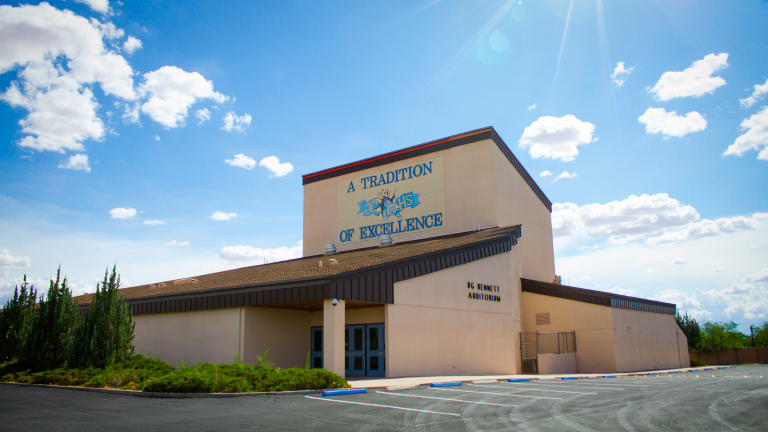
The Joseph City Unified School District Governing Board met earlier this month with a presentation by Arizona Auditor General’s (AAG) Office after a report by that office showed JCUSD to be one of nine schools in the state listed as one of the highest-risk schools in the state in its annual report. Round Valley Unified School District was another in that category from this region.
AAG Accountability Services Manager Chris Votroubek spoke before the board, “We use the most currently available (information) for 10 financial measures to identify districts at the highest risk of not being able to operate within their available budget constraints and past resources based on both current and potential financial difficulties.” He added that the purpose of the analysis is to inform district decision makers and stakeholders to help them better understand the district’s financial risk and to use the data when making finance decisions.
AAG Senior Accountant Michael Carnahan also spoke, referencing the report, which is available on the AAG website. “The district is at high risk for five measures,” he stated. Regarding the first measure Carnahan stated, “The district is experiencing substantial student count decreases and has not adjusted its spending accordingly.” The district’s weighted student count has consistently declined every year since 2022, with an overall 11% decline, including a 2.5% decline in 2026, impacting its budget limits and student-count-generated revenues.
The next two measures pertained to the capital budget reserves. The district accumulated a peak operating budget limit reserve balance of $888,728 in FY 2022, but it steadily declined to $20,798 in FY 2025, representing a 29% decline during FY 2025. With its steadily decreasing operating and capital budget limit reserves, the district is limiting the resources available to meet its current and future operating and capital needs.
The district reduced general fund spending from FYs 2024 to 2025, but the general fund expenditures still exceeded available revenues in those years, leaving with a reserve balance that would cover less than one month of expenditures going into FY 2026.
While the district has not yet exceeded its statutorily prescribed budget limits or cash resources, it must identify and implement appropriate risk-mitigation measures to prevent future overspending and cash deficits.
“Your district is at high risk for the operating budget reserve measure since it reduced its reserves by 83.5% before 24 and 25 and then 97.5% over the four years since 2021. Additionally, it has decreased its capital budget limit by 29.28% in fiscal year 25 and 75.93% over the four years,” stated Votroubek.
“I’d like to point out that the districts operating capital budget limit reserve actually increased in 2022 from 2021 because of the additional COVID 19 monies that were available at those times,” he noted.
The final measure is pertaining to the risks related to the general fund. It shows the general fund reserves compared to total expenditures from the previous year. “The district is high risk due to its fiscal year 24 and 25 general fund spending, exceeding its revenues by 5% and 6% respectively and had less than two months reserves by end of school year 2025,” stated Carnahan.
In providing an overview of the analysis Votroubek stated, “The district’s decline in area student enrollment is an area of concern and the board should consider how it affects budget decisions going forward. The district’s substantial decline in budgetary reserves in 2025, along with these declining student counts should be another major factor in district’s decisions in the current year and in planning the 2027 budget. The district’s general fund exceeded its revenues and the district left less resources available for future needs than it has in previous years. The district should consider how this will influence current year expenditures and finally, while the district has not exceeded its statutorily prescribed budget limits or cash resources, it must identify appropriate risk mitigation measures to prevent further overspending and cash deficits.”
In response, Superintendent Bryan Fields presented the mitigating actions that the district will be taking. “Declining enrollment has hit us pretty hard, but it looks like it’s hitting everywhere hard.” He noted that he is hopeful that with new industry coming to the area that that can add to the taxing district, particularly if Cholla Power Plant should begin producing power. “Even though our enrollment went down, our special ed students get weighted (for student count) and actually went up.”
He noted that the district was required to spend the COVID funds received within a certain timeframe, which is why there was a sudden reduction. “Some of the things that we are looking at doing is we are looking at reducing staffing costs wherever we can. If things don’t change it will be through attrition (when people quit) or maybe through some rearranging. We’re going to have to look at programs in order to build this budget back up as well,” stated Fields.
He added, “To be able to spend our budget before taxes are paid in our district has been an issue. Specifically, last year that was a big issue for us,” stated Fields.
According to Fields, the district has already taken action to address this shortfall. Specifically, the district submitted A.R.S. §15-915 requests to correct transportation data for FY 2023, FY 2024 and FY 2025. These were approved and resulted in a state equalization adjustment payment of $500,885 in December 2025. The district is expecting another payment of $224,287 in January 2026 for a total of $725,172. The district will continue to work with the county to resolve this issue and restore access to appropriate short-term financing.
The district intends to pursue state equalization advances to help mitigate future cash flow timing gaps and pursue measures with the county to reduce the gap between tax assessments and collections in future years. Fields stated that these actions would result in a $725,172 one-time equalization adjustment. As wells as a $1 million dollar restoration of short-term credit line to cover cash flow timing differences. He also mentioned a reduction of $50,000 – $100,000 per year to reduce the amount of uncollected taxes with possible state equalization advances.
Board Member Dayton got right to the heart of the matter. “Just how much trouble are we in?”
Fields replied. “I’m appreciative of the information but it is what it is. They (AAG) approved this plan and this plan will get us on the right track.”
In other business, the board was informed that the district received several bids for the roofing projects at the high school campus. The bids ranged from $487,424 to $938,025 and Superintendent Fields will be meeting with the architect to decide which quote meets the needs of the district.
The replacement of all smoke detectors at both campuses has been completed. The project cost was approximately $75,000 and the district is waiting on the School Facilities Board for reimbursement.
Due to recent concerns, the district is initiating a campaign to reduce and hopefully eliminate bullying incidents on its campuses.
The district is preparing to renew the leases for water shares. According to a report by Fields, the district owns 53 water shares through the irrigation company. The ‘shares’ cost the district $28 per share/per year. “We charge the public $90 every two years for each share. We charge employees $50 and limit them to five shares. If someone chooses not to renew their lease, we let employees know to see if there is any interest. If not, we could contact current public shareholders to see if they are interested in leasing anymore to their current amount.”
Also shared was the itinerary for this year’s senior trip scheduled for May 18-19. Students will stay at the Great Wolf Lodge in Phoenix and the next day they will shop at Chandler Fashion Square before returning home.
The board approved expense vouchers including general and special funds totaling $570,922, auxiliary operations funds totaling $13,018 and student activities funds totaling $4,224.