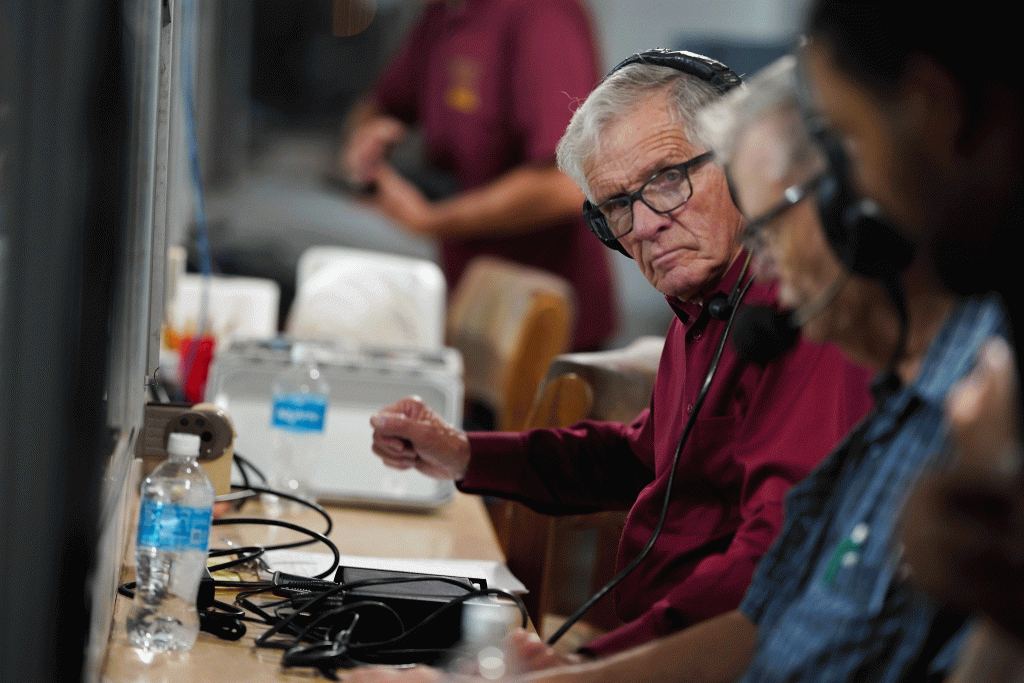
Loy Engelhardt was already running. The final buzzer had sounded only seconds before and he was on his feet, coiling several hundred feet of phone line as fast as his hands would move. Around him the gymnasium at Arizona State University had become a wall of noise—students rushing the court, parents clutching one another in the bleachers, cheerleaders in tears, the Winslow Bulldogs hoisting a state championship trophy under fluorescent lights that buzzed and flickered with the voltage of the moment. It was March 1979. The boys’ basketball team had just won it all the sound of it—the roar, the sneakers squeaking on hardwood, the way joy echoes off cinder block filled every corner of the building.
Engelhardt had no time to celebrate. The game had gone out live over KINO Radio, carried on a dedicated phone line back to the station in Winslow, almost 200 miles away, where families had gathered around their receivers in living rooms and kitchens, listening to every word. Now he grabbed his equipment— a microphone, a tangle of cords—and sprinted through the parking lot to his car.
At Mesa Community College, the girls’ championship game was about to begin. He put the pedal to the metal and rushed east and arrived just as the team began warming up on the court. He found a phone jack, plugged in, established the line and began calling the game. By the time the night was over, he had broadcast two state championships boys and girls, back-to-back for a town that hung on every word. In Winslow, people who had never met Loy Engelhardt knew his voice as well as they knew their neighbors’.
It was his first full year covering Winslow athletics. For any broadcaster, it would have been the story of a career. For Engelhardt, it was only the beginning.
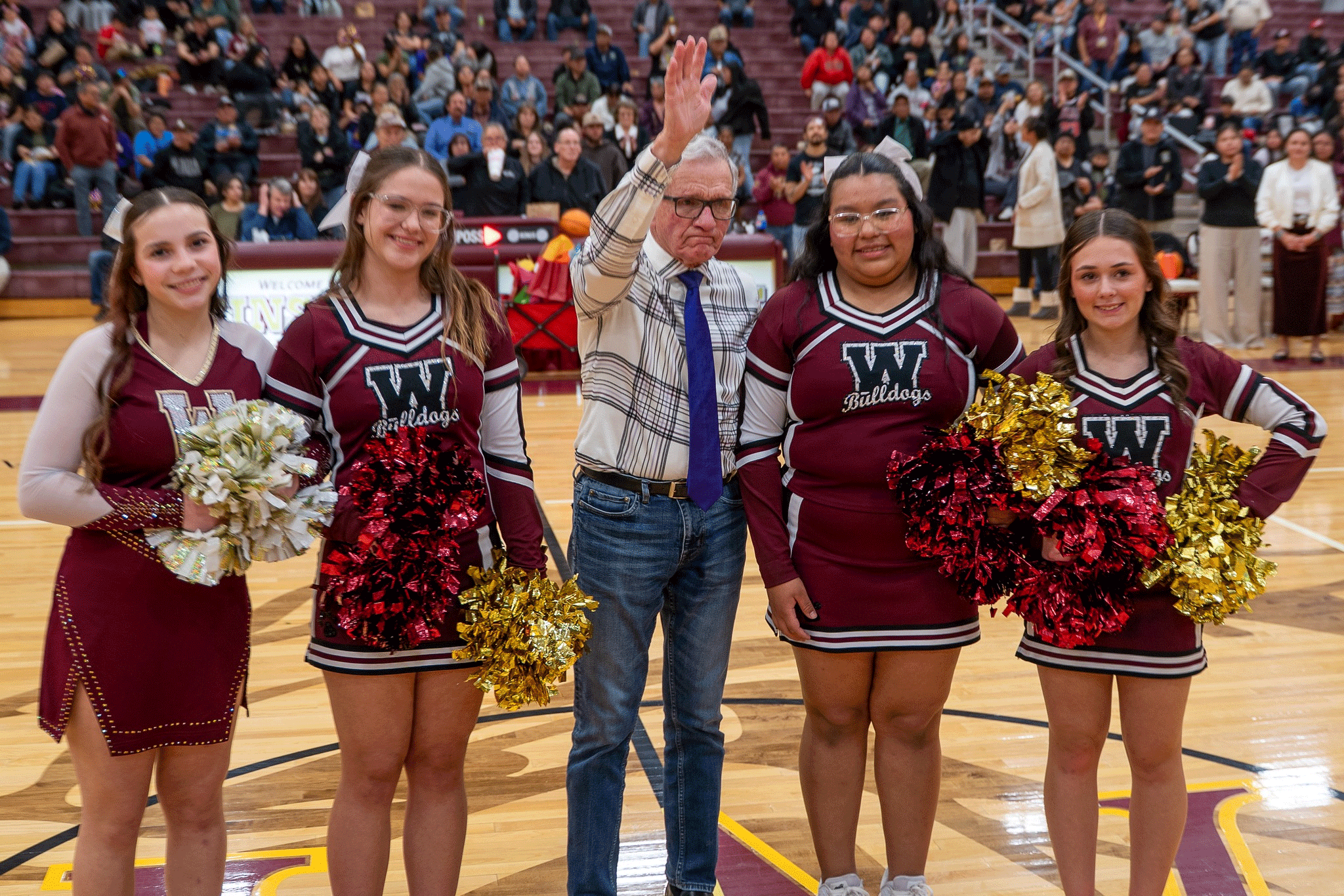
Over the next six decades, his voice would become the most familiar sound in Navajo County. An essential fixture in the homes of many. The kind of presence people stopped noticing precisely because they could not imagine its absence, for 60 years of Bulldog sports people could assume if there was a game, Loy was at it they were almost always right. Generations of Winslow residents grew up hearing Engelhardt call their games, announce their scores, narrate the small dramas of high school athletics that, in a town of 10,000 people, were not small at all.
Loy Engelhardt was not born to Winslow. He came from Idana, Kansas, “a little widening of the road,” as he liked to describe it, a speck of a town on the Great Plains where the horizon stretched unbroken in every direction. It was there, listening to the radio crackle with the play-by-play of St. Louis Cardinals games, that he first understood what a voice could do.
The voice belonged to Harry Caray, the legendary broadcaster whose enthusiasm was so boundless it seemed to spill out of the speaker and fill whatever room contained it. Caray made baseball feel urgent, alive, close enough to touch. For a boy in rural Kansas, it was a kind of magic. The game was happening hundreds of miles away, yet here it was, arriving in real time, translated into language so vivid you could see the arc of the ball and feel the tension in the count.
“From then on, I got the bug,” Engelhardt recalled years later with a chuckle that suggested the memory still delighted him.
He found his way into the profession almost by accident. While working at a clothing store in Salina, Kansas, he spotted a job listing: a local radio station needed someone to read a 15-minute daily news segment. He applied. He got the job. The work was modest and the news was good but not up to what would eventually become of the standards of news broadcasts on KINO. However, by then the bug had taken hold and would not let go.
It was around this time, too, that he met Pat through a church youth group in Salina. They would be together for more than half a century. What followed was a series of progressions familiar to anyone who has built a life in local broadcasting: longer shifts, better opportunities, a gradual move toward the work that truly mattered to him. He landed at a station in Abilene, Kansas, where he finally got to do what he had always wanted—call games. It was in Abilene, too, that he met Steve Adams, who would become his business partner.
One day, thumbing through a trade magazine, Engelhardt and Adams came across a listing that would change everything: a radio station for sale in Winslow, Arizona. “At that time, it was nothing more than a two-room shack,” Engelhardt remembered. But it was enough.
In 1977, Loy, Pat and Steve packed up and drove southwest, trading the familiar flatlands of Kansas for the high desert of northern Arizona—red rock and juniper, thin air and wide sky. They bought KINO Radio and set about building something.
He learned a lot about the town after moving. He learned that Winslow is the kind of place that either claims you or doesn’t. A railroad town, an old Route 66 town, a town that at that time had seen better days and knew it yet refused to surrender its identity. The high school teams were called the Bulldogs and being a Bulldog meant something. It meant you belonged.
Engelhardt arrived as an outsider, a Kansan with a microphone, no history with the town, no roots in its arid soil. What he had was a willingness to show up. To learn the names. To be there when it mattered and when it didn’t, too.
Less than a year after buying KINO, he received an invitation that would shape everything that followed. Art Griffith, the longtime baseball coach and beloved history teacher at Winslow High School, asked Engelhardt to ride the team bus with him on a road trip. “He didn’t have to do that for me,” Engelhardt said, decades later. “And I’ve been grateful ever since.”
The two men became friends—a friendship that would last more than 50 years, built on shared miles and shared silences, on a mutual understanding of what high school sports meant to a community like Winslow. Griffith was a teacher in the truest sense: a man who invested in young people without needing recognition, who believed that showing up was its own reward. Engelhardt operated the same way, just from a different angle. One that shaped students in classrooms and dugouts. The other made sure their moments reached the people waiting to hear them.
Over time, their work became inseparable from the town itself. They watched the generations grow up, stumble, succeed and move away. They stayed. Year after year, game after game, they stayed.
Today, on the campus of Winslow High School, there is a building called the Art Griffith Student Union, a congregation place for the young people Griffith spent his life serving. It sits on a road renamed Loy Engelhardt Drive. The two honors are not separate. They tell a single story: a teacher who prepared young people for what came next and a broadcaster who made sure their moments were heard beyond the gymnasium, beyond the baseball diamond, out into the town and the desert beyond.
If you listened to KINO Radio over the years, you knew Loy Engelhardt’s voice. What you did not know, what almost no one knew, was the labor that made that voice possible.
Pat Engelhardt worked full shifts at the Indian Health Service hospital in Winslow. She came home and made dinner. She helped with homework. She put the children to bed. She did this while her husband was on the road, in the broadcast booth, coiling cables at midnight and driving hundreds of miles. She did it for years, largely unseen.
“There were a lot of lonely nights,” Loy said quietly. He paused. “She did it all so I could do this.” Another pause. “She’s one in a million.”
It is the part of the story that rarely gets told. The voice on the radio is remembered. The hidden scaffolding that supports it, the meals cooked, the homework checked, the bedtimes kept, disappears into the background. Winslow heard Loy Engelhardt for nearly six decades. What it didn’t see was what happened at home, night after night, that made such consistency possible. And Loy takes as much opportunity as he can to speak about how blessed he was to have someone like Pat.
Engelhardt’s influence extended far beyond the games he called. Through KINO, he mentored more than 250 high school students, many of them stepping behind a microphone for the first time. He taught them how to prepare, how to be accountable, how to understand that being heard came with responsibility. For some, it led to careers in broadcasting. For others, it was simply a lesson that stayed with them about discipline, about showing up, about caring for the thing you had been entrusted to do.
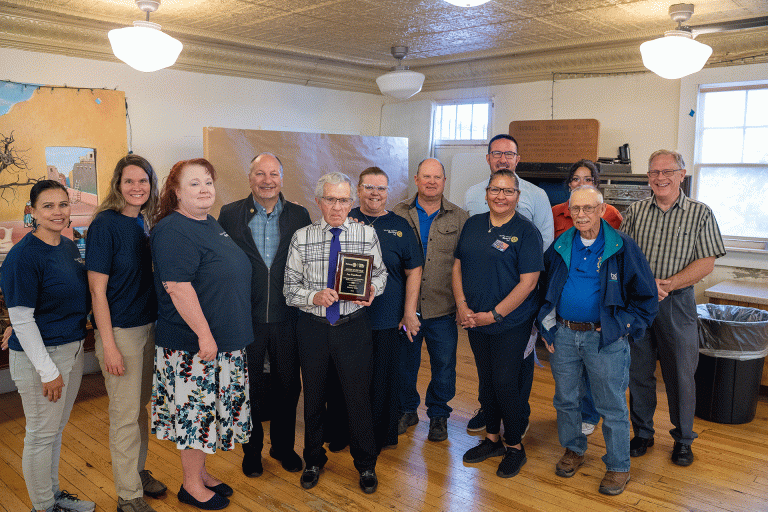
He served on the Winslow Chamber of Commerce. He volunteered with local organizations. He conducted interviews that ranged from Winslow residents to national figures like Barry Goldwater and Sam Walton. KINO itself became something stable in a town that, while Route 66 was changing in popularity, experienced more than its fair share of change and uncertainty. But KINO was a place people trusted, a voice they recognized, a signal they could count on. In 2019 more than four decades after he first arrived in Arizona, he was inducted into the Arizona Broadcasters Hall of Fame, an honor that came to the surprise of no one, except Loy.
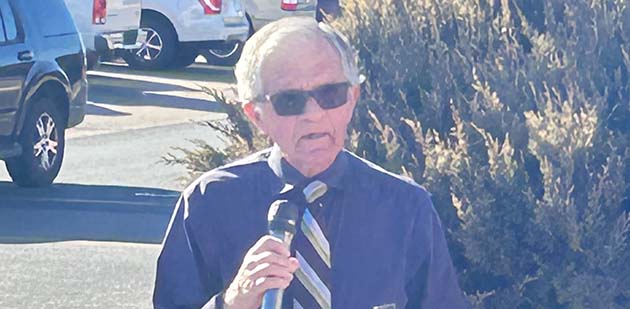
Engelhardt always maintained a peculiar humility. He spoke of himself as a guest—”a guest in their house,” he called it. It was his way of explaining the care he took, the line he never crossed. He was not there to insert himself into the story. He was there to make sure the story reached the people waiting for it.
That understanding guided him to the end. No grand farewell. No attempt to sum it all up. Just the quiet satisfaction of having shown up again, having stayed connected, having done the work. When asked about legacy, he deflected. He talked instead about responsibility; about being ready. About doing the job the same way whether the gym was full or nearly empty, whether the team was winning or losing, whether anyone was listening or not.
When the final broadcast faded and the signal went quiet, it did not feel like an ending so much as a pause long enough for the town to notice what had always been there. A voice that arrived on time. A presence that never asked for attention. A commitment that held, year after year, decade after decade, through championships and losing seasons, through blizzards and heat waves, through all the ordinary Fridays that make up a life.
Winslow had become a place where Loy Engelhardt was woven into the fabric so completely that people forgot he had ever been a newcomer. “Being a Bulldog is a special thing,” he once said. “But being an adopted Bulldog is a very special thing.”
Long ago, on a night in 1979, a young broadcaster sprinted through a parking lot in Tempe with a tangle of cables under his arm, chasing a game he had not yet called, for a town he had only just begun to know. He could not have imagined then what would follow, the decades of Friday nights, the generations of athletes whose names he would learn and speak into a microphone, the friendships forged on team buses, the students he would mentor, the wife who made it all possible, the way a place that was not his own would slowly, irreversibly, become home. He was just a man with a job to do, running toward the next broadcast, trusting that if he got there in time, someone would be listening.
Someone always was. For nearly 60 years, Winslow listened to Loy Engelhardt to the station he helped build. On Feb. 28, KINO Radio will sign off for the last time. The signal that carried his voice across the high desert, into kitchens and living rooms and car radios on the commute, will go quiet. But what carried the record of a town’s triumphs and heartbreaks, the proof that someone cared enough to show up and bear witness will remain. That was always the point. Not the voice itself, but what it made possible: the knowledge, in a small town a long way from anywhere, that the moments that mattered would not be lost.