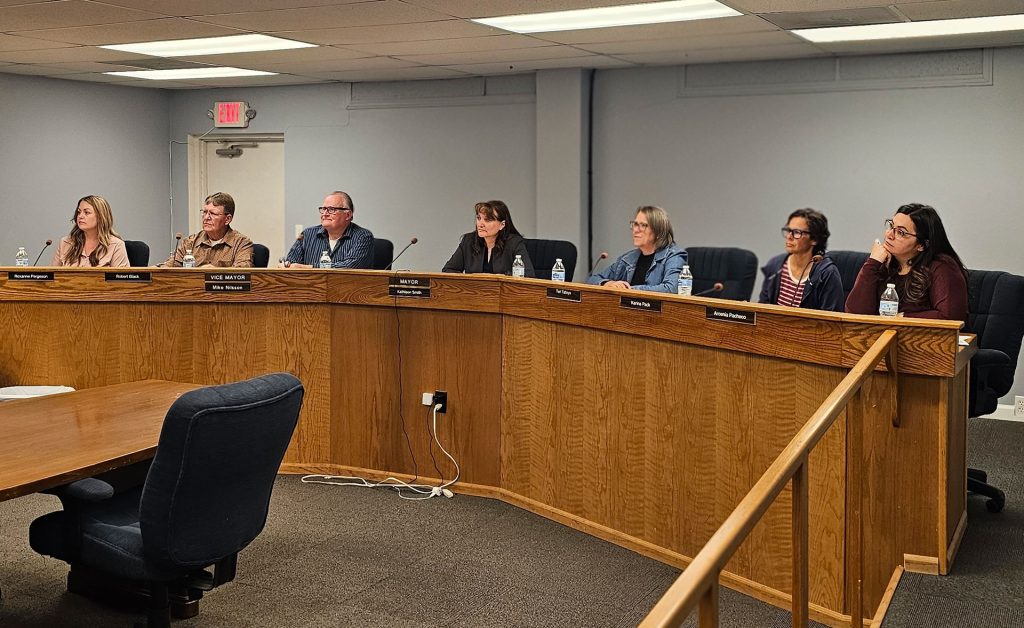
Following Holbrook City Council’s meeting last week, the council held a work session with administration to discuss two items. The first was to provide the council with information pertaining to the potential rezoning of Hopi Drive and the second was regarding a leadership planning and organizational chart by administration. Midway through the work session, Councilmember Robert Black walked out of the meeting, visibly agitated on the topic of the separation of council from administrative operations.
Regarding the rezoning of Hopi Drive, Mayor Kathleen Smith explained that when discussing re-zoning, the process begins with the planning and zoning commission (P&Z), which was represented at the work session by Vice Chair Aaron Colon. Smith explained that P&Z fine tunes the plan then presents a proposal to the city council for approval.
“For tonight, we’re not trying to get into the fine details. That’s what P&Z is going to be doing. They’re going to work with (city) administration to make sure everything’s legal there, and then they’ll be bringing it back to us. But as a council, it’s important for us to say we want to have a direction, understand what’s going on, what’s being worked on, and if there’s any concerns or things we want P&Z and staff to be aware of.”
Commercial Code Administrator Barbara Blythe opened by stating that the city has been working specifically on Commercial 1 (C1) zoning and Commercial 2 (C2) zoning on Hopi Drive, from Joy Nevin Avenue to Buffalo Street. “We’re just looking at the C2 and C1 because it’s kind of split on Hopi and I did an inventory of all the businesses we have along Hopi Drive and what we found, and through Planning and Zoning with Aaron, that a good amount of the businesses that are on there are not zoned to be there, like tire repair shops and other businesses and the hotels that have turned into apartments. So, that’s something we’re trying to work on.”
She emphasized that the effort does not involve “throwing people out in the street or closing businesses.” The objective is to either come up with a new zoning designation that would encompass the other businesses that are there to make everybody come into compliance or creating some type of form-based zoning area where it’s not been.
“Specifically, you look at what the business is first and then zoning second. Because a lot of communities are running into the same thing we are, where hotels have turned into apartments that are not zoned for it, and other businesses that are not zoned properly.”
City Manager Randy Sullivan stated that currently, almost no one is compliant in any of the zones on Hopi Drive, making it difficult to enforce code. “We don’t have the vision to even take that to P&Z to move forward on something like that. So, we’re kind of starting from ground zero on how we want to envision this. And maybe the idea isn’t a C1 and C2. Maybe the vision from council is we create a whole other zone then staff can start working on coming up with recommendations and presenting those recommendations to Planning and Zoning. This is going to be a long process and a visionary thing to make this happen, because right now, nothing’s been enforced, and now businesses have been running down there for 20 to 30 years, and they’ve never been zoned correctly. It’s going to be a balance on how we start enforcing it.”
Blythe also explained that the city can require a certain aesthetic in a given area, such as facades, colors and even styles such as Southwestern or historic. It was noted that any appearance changes would be challenging to apply to existing businesses but could be enforced with new ones coming to downtown.
She explained that to assist businesses, the city could potentially apply for funds similar to those obtained for housing rehabilitation to assist business owners with beautification. “The city has the authority to be a sub grantee. We are the only ones who can apply for the funds as a government, and then they apply as a recipient. We manage it, we develop it all, we inspect it all, we handle the whole thing. The money does not get turned over to them.”
Colon added that P&Z has been discussing many aspects of town, because the zoning in the city code book is antiquated. “It was written a very long time ago, when businesses that are popular now did not exist, such as Airbnb’s and so many other businesses that are very popular now that weren’t popular when the code was written.”
The discussion continued regarding options, including an historic corridor, but Smith cautioned making specific façade requirements, suggesting that the requirements would serve all businesses better if they focused on looking updated and clean. She also emphasized that it was important that any zoning not be so restrictive as to prevent businesses from coming to the city.
Blythe then reiterated that the changes would address new businesses and not those already in place, other than existing ones that may be dilapidated, stating that this can be enforced as each business will be required to have a business license and the correct building permitting.
In the conversation pertaining a leadership planning and organizational chart by administration Smith started by admitting that she, as well as others have stated positions she would like to see filled at the city offices but cautioned that the roll of council is to set policy and strategic goals, not direct the city manager on staffing or on how staff should be doing their job. The council can recommend, as part of the strategic plan, what position they believe should be filled in order to further the plan but administration may determine that an existing position can also fulfill those needs and make that choice. If the plan is hindered by choices made by the manager, that can be addressed during the manager’s review.
Councilmember Robert Black asked if there was a reason this was being addressed. “The charter states what positions should be filled,” he said, to which Smith replied, “Yes, but the budget specifies what positions can be filled.”
Manager Sullivan explained that one of the positions not filled is for a city attorney but that it’s not necessarily needed at this time. “We’ve had a lot of discussion on whether or not we should hire an attorney. In my opinion, as long as I manage the attorneys now and keep those rates down, I don’t think we need to hire one. Robert (Black) said we needed a finance director. Again, I’d rather have a succession plan and move somebody into that position and in the meantime, if I save the city $100,000 and do other projects with it or hire another person with that, then I feel we can get more bang for our buck.
“Right now, we cannot afford a finance director, we can’t afford an economic developer, we can’t afford an attorney — is what I’m saying. We can’t afford all these big executive positions. However, if we pick one, and it’s our glaring need, then that can move us forward quite a bit,” said Sullivan.
He indicated that the organizational chart provided to council shows where the city is lacking. “We’re lacking in that planning side, we’re lacking in the economic development side, we’re lacking in code enforcement. We’re lacking in quality-of-life kind of things.”
Black interjected stating, “Can you see where this going? I mean, this is so easy for everyone to see. When you start talking about ‘bang for your buck’ and what the city needs, we can’t afford not to have a financial director.” Black then went on to discuss a situation in another nearby community where he said the city manager and the finance director realized that by virtue of their control, the city had to do whatever they wanted. The city removed those administrators, and they had to hire an interim manager because, “they thought they had a stranglehold on that city and we’re doing the same thing here.”
After his comment, Mayor Smith attempted to continue the conversation but Black interrupted indicating that he wasn’t through, at which time Smith apologized saying she didn’t realize he wasn’t done. Black continued, “So when we start talking about things like this, I’m not comfortable at all. City council – basically, why do you even have them? Because everything goes down to the city manager. City manager makes all the decisions. He can say who we can hire, who we can’t hire. I don’t think that is the way this is supposed to work.”
Councilmember Arcenia Pacheco responded to the statement saying, “We set policy, that’s it.” Black replied, “That’s what Misty tells me constantly. We set policy and once we set it, administration does whatever they want with it. How do you hold them accountable?”
Pergesen then asked what the value was of being a charter city, to which Smith replied that it allows the smaller cities to have more control over what they need so that the state doesn’t hold them to the same standard as larger cities such as Phoenix. As Smith concluded her reply, Black said, “Can I go back to where I was, please? Before I was interrupted again, and again, and again?”
Smith told him he could go ahead, with Black complaining that all he wanted was his time and that Smith “spoke for 10 minutes” (Smith’s response to Pergeson’s question had taken approximately 20 seconds). “I get very aggravated with the way this whole roll procedure starts just like when I went on the milling mess we had. There was a safety issue out there so (a staff member) is trying to take care of it, he…” at which point Smith interrupted Black to caution him about going off topic.
Black then arose from his seat and began walking from the chambers stating, “I’ve got things I need to do if you’re not going to listen.” Smith asked Black to stop so that she could inform him as to why she stopped him and asked him to be respectful of the agenda. His reply was to tell Smith, “You be respectful” before he exited the building.
Smith had it noted in the meeting minutes that she stopped Black from speaking because they were required by law to only discuss items on the agenda. “By law we are required, if we are going to talk about something different, we have to give the public an opportunity to come here.” After Black left, the council continued its discussion.
Hatch said, “For the City of Holbrook, in order for a city to grow, you have to have succession planning. If you don’t have succession planning, you have in and out all the time. You’re losing knowledge, you’re losing good people going elsewhere because they don’t have anywhere to grow. So, putting together and having succession planning, like having a really good finance brain coming in and learning to go into finance, that’s a brilliant move because you’re funneling and we’re growing Holbrook with our own.
“Second point on this is when you have a chart, you can also see not only that succession planning and growth of Holbrook, but you can see those gaps of where we are lacking. The City of Holbrook is a tree. If a whole branch is broken off, the rest of it is slowly dying. So, we have to fill those branches, can we do it all at once? No. We have to pick and choose where the water is going to go and funnel to have the most growth so that the rest can prosper, right? So that’s how it is as an administration and that’s how we’re looking at it, is how do we grow Holbrook, how do we grow the employees within Holbrook where they know they have opportunities. They know they can move up and they know they can retire from here.”
Sullivan also pointed out to those who may have concerns regarding accountability, even though he’s also the finance director he is not over payroll but double checks that department’s work, just as Hatch checks accounts payable that is done by Sullivan. Watching over all operations is the auditor that audits the city finances.
As a work session, no action was taken on either of the items discussed but future action may be required as things progress.