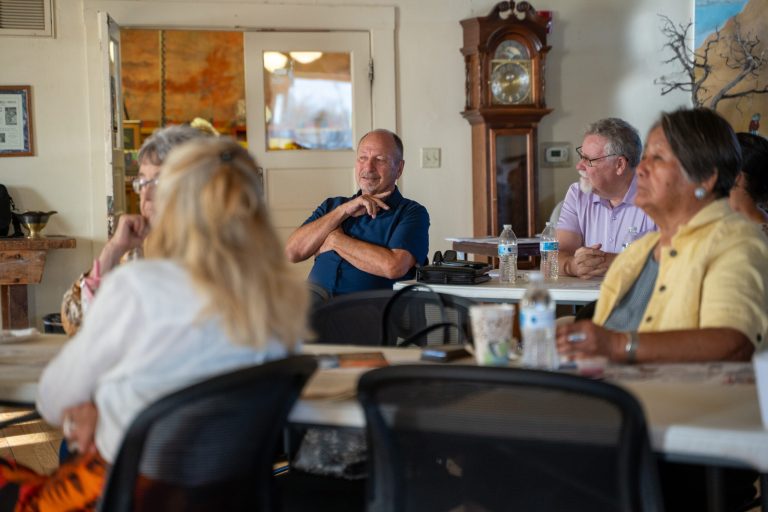
During last week’s meeting of the Winslow City Council, City Manager David Coolidge presented several updates about ongoing efforts and possible legislative changes that could affect local operations.
Coolidge began by updating the council on the broadband expansion process the county has been involved in for over a year now. Coolidge mentioned that the Arizona Commerce Authority had opened a first round of applications for providers. He said the original deadline had been set for early February but was extended into March and that Navajo County and nearby municipalities submitted support letters for one specific firm. He explained that final decisions on awarding project areas might occur near the end of March, after which the process to eventually get shovels in the ground can begin.
He next spoke about a group of grant-funded city projects that are underway. At the 9/11 Memorial Park, contractors installed bases for new lighting, while staff continued to gather quotes for a planned gazebo and prepare for repaving in the spring. Coolidge said cost increases had posed challenges, but he expected the project to stay on track.
The city manager then turned to Coopertown Park, explaining that the city had removed the old basketball court, planned to have new concrete poured shortly and was installing poles for new lighting. Benches and playground equipment were on order, and he anticipated that crews would coordinate further improvements once the larger components were delivered and placed.
Coolidge also described upgrades in store for both Henderson Park and Triangle Park, saying new benches and other amenities would be incorporated, along with shade covers and updated playground elements.
At Hayden Walton Sports Complex, new ramadas had been delivered, and he said demolition of the old ones would move ahead under a contract authorized at that same meeting. He added that any damage to turf or irrigation would be remedied afterward.
Coolidge then turned to possible state legislation that could affect Winslow’s budget and local authority. He outlined proposals that would preempt municipal zoning procedures, explaining that these could remove or limit local input into new development, constricting what cities are able to allow and ban under their zoning code.
He mentioned another proposed measure to eliminate food tax, remarking that such a cut would leave Winslow with a significantly smaller general fund. He said it would be difficult to reduce certain expenses if a separate bill prevented any decrease in law enforcement funding, which he noted comprises a large portion of city spending. In addition, he described a measure that would change how online sales tax is directed, moving from a destination-based system to the location of the shipping source. He warned that such a move would divert local revenue away from towns that do not host large fulfillment centers. He stated that the city was watching each of these items carefully and that officials were working in collaboration with the League of Cities to address them.
Later in the meeting, Michelle Stinson a member of the city attorney’s office presented an overview of proposed amendments to the municipal code related to recreational marijuana. According to existing rules, a dispensary in Winslow must hold both a medical marijuana license and a recreational license, which is known as a dual license requirement. The recommended revision would remove that extra layer, allowing prospective dispensaries to operate under only the recreational license if they choose, with all remaining oversight at the state level still in place. It was stated that medical dispensaries would continue to follow state requirements just as before, but the city would no longer insist on having both licenses at once.
The council did not take a final vote on the suggested change. Instead, members gave instructions for the proposal to move through the usual process, which involves public hearings under city zoning procedures, followed by a future meeting where a formal ordinance could be considered. The discussion closed with an understanding that staff would begin the steps needed to carry out that approach.
The council also discussed the fate of several city-owned properties. Staff presented a list of vacant and underused parcels and explained how each might be sold, leased, or retained. Councilmembers and staff settled on a plan to take certain small or infill lots and list them directly for sale on the open market. In contrast, a pair of larger parcels near Henderson Park were identified for a more formal proposal process, meaning prospective developers would submit ideas and the city would negotiate terms based on what best met local needs. Officials agreed there were also properties that should remain under city ownership, either because of future municipal use or because they were in the floodplain and not suitable for sale. The council did not finalize any transactions that night but instead gave staff clear direction on which parcels should be prepared for direct sale and which should require a proposal process before disposition.
In other business, the council:
* Approved two proclamations. One proclaiming February as Teen Dating Violence Awareness and Prevention Month and another recognizing Winslow High School Dance Line for back-to-back state championships.
* Approved the reappointment of Jim MacLean to the Municipal Property Corporation.
* Approved a contract with McCauley Construction and Trucking, LLC, for installation of ramadas at Hayden Walton Sports Complex at a cost of $101,960.
* Approved a declaration of housing emergency in Winslow within Winslow and urging the state legislature to address the impacts of short-term rentals.
* Approved a cancellation of the March 11, regular meeting.
The next meeting of the Winslow City Council will be held at 6:30 p.m. on Tuesday, June 24, in the meeting room located at 523 W. Second St.