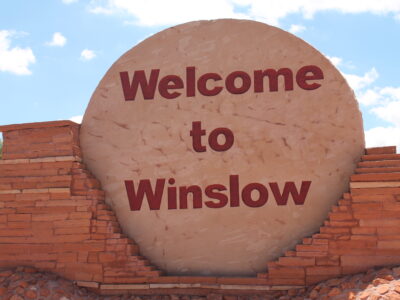
The Winslow City Council approved its new Adopt a Street program at the Jan. 14, meeting, with Public Works Director Tim Westover explaining how it will help keep roads and neighborhoods across the city clear of litter.
The program works by allowing individuals, families, businesses, or community groups to commit to a specific street segment for two years. During that period, volunteers agree to organize at least four cleanups per year, collecting debris and reporting any potential hazards, such as potholes, damaged signs, or low-hanging branches, that they might be hazardous or untidy. Westover emphasized, “We’re asking that the cleanups be only during daytime hours, and that’s for safety reasons.”
Participants receive the tools they need directly from the city. According to Westover, “These participants will be provided trash bags, safety vests, gloves, sharps containers, and clean-up event signage.” Public Works staff will coordinate to pick up the filled bags at a designated drop-off point and transport them for disposal. In recognition of each group’s effort, a sign will be placed at the beginning of the adopted street to display the volunteer organization or individual’s name.
Westover underscored the broader purpose of the program at noting, “By adopting a street, we’re not just picking up litter. We’re building a city we can all be proud of.” He added that the city hopes to have the program up and running soon. “We do have everything ready to go, hoping to kick this off in the spring season as early as March.” Anyone interested is encouraged to contact Winslow City Hall for details on how to sign up.
Ann-Mary Lutzick the director of the Old Trails Museum delivered its quarterly report during the Winslow City Council’s Jan. 14, meeting, focusing on recent publications, community programs, and new additions to its archival collection. She explained that the new book, Past & Present: Winslow, follows a then-and-now format, pairing historic photos of local buildings with contemporary images taken by local photographer Jim Buckley.
Lutzick said, “I did do a book talk in November at La Posada, and that particular book talk I’m going to be doing it for the Rotary in February.” She invited the public to purchase the book. However, it should be mentioned that the museum only benefits from the sale of the book if it is purchased directly from them or from La Posada. Lutzick stated that the organization does not make any money off the sale of the book from major retailers like Amazon.
Lutzick also highlighted the museum’s 2025 calendar, “The 2025 calendar is Winslow in the 1960s, so a lot of fun pictures in there.” The calendar goes through the many photos from the archive of Winslow during its golden era. She added that the Old Trails Museum’s online newsletter went out in November and is available on their website, where supporters can also sign up to receive future editions.
The museum has been collaborating with other organizations on local history projects. Lutzick mentioned, “The museum also submitted text and images for some new entries in the Historic Winslow Walking Tour,” referring to the new informational signs around downtown. She told the council that tourists are already stopping to read these signs and learn more about the area’s history.
In discussing recent and upcoming programs, Lutzick spoke about a free presentation, “The Atomic Legacy on Route 66,” co-hosted at the First United Methodist Church. Then she recapped the museum’s annual meeting held in November in the council chambers, which welcomed two new board members. “We welcomed two new board members, Lani White and Shawn White,” she said, adding that White is serving as the museum’s new treasurer.
One of the more exciting developments was the donation of a Trans World Airlines (TWA) collection. Lutzick explained, “A man named Dale Norgaard was in Williams and heard that Winslow had a former TWA airport, so he came over here and found out about the Old Trails Museum.” He ultimately decided to give his extensive TWA memorabilia to the museum, which will be useful for historical research and for future exhibits about Winslow’s aviation past.
Lutzick closed her presentation by inviting the public to visit and support the Old Trails Museum. She emphasized that buying items such as the new book directly from the museum is the best way to help fund exhibits, preserve artifacts, and continue sharing Winslow’s unique heritage with locals and visitors alike.
In other business, the council:
* Approved the purchasing of three police vehicles at a cost of $269,365.
* Approved purchase of a reel mower for the Parks Department at a cost of $61,435.
* Approved an agreement with the Navajo County Justice of the Peace to perform duties of the city magistrate.
* Approved an agreement between Off Duty Management and the Winslow Police Department for records management software and computer aided dispatch software at an annual cost of $110,925.
* Approved an amendment to the agreement between the city and its lobbyist The Kruse Group, to extend the length of the agreement to Dec. 31.
* Approved a change to fees regarding mobile and manufactured and factory-built buildings installation fees. Mobile home permits are $350 and will be changed to $650, factory built residential buildings will go from $450 to $650 and factory built commercial buildings will go from $4.50 per linear foot to $6. The installation fee will go from $150 to $175.
The next meeting of the Winslow City Council will be held at 6:30 p.m. on Tuesday, Jan 28, in the meeting room located at 523 W. Second St.