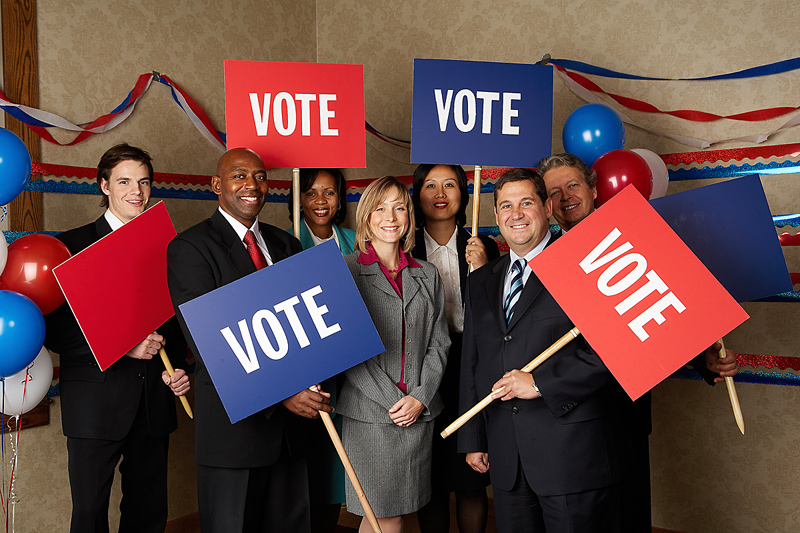
The recent elections in Navajo County have brought significant changes to local leadership and highlighted the community’s values and most pressing concerns. According to the unofficial results, voter turnout was strong, with 72.73% of registered voters in Navajo County making their voices heard in this election, giving Navajo County one of the strongest voter turnout rates in the state.
In a notable victory for education, the Winslow and Joseph City unified school districts’ Budget Override Continuations were approved by voters. Winslow passed with 2,233 votes in favor and 1,193 against, ensuring that the district can maintain honors classes and offer all-day kindergarten. Joseph City’s override passed 494-273. Kayenta Unified School District (KUSD) also, similarly, had a bond measure approved by voters 2,240 votes in favor to 1,414 votes against. This outcome reflects the region’s commitment to investing in educational excellence for its students.
KUSD also had a board election with James D. Nez receiving the most votes at 1,749, Glenda Lynn Fuller receiving the second most votes with 1,715, and third place Iverna Parish-John at 1,680 votes, all were elected to the school board. The race was close compared to many other races with Kurt Claw getting 1,582 votes and Royd Lee receiving 1,446 votes but not winning a seat on the school board.
In the Heber-Overgaard Unified School District No. 6 board election, the top three candidates also secured seats. Patricia J. Weber led with 1,465 votes, followed by Christin R. King with 1,382 votes, and Tim R. Leedy with 1,017 votes. David Talerico received 924 votes and Rusty Ulmer received 838 but did not secure seats on the board.
In the Winslow municipal elections, current Mayor Roberta “Birdie” Wilcox-Cano won re-election with 1,558 votes, defeating Heather Pruett, who received 993 votes.
The Winslow City Council race featured incumbents Peter Cake and James “Jim” MacLean, who retained their seats with 1,668 and 1,604 votes, respectively. Melcor Salazar, who received 1,277 votes, also won a seat on the council and will take the place of Melissa Nelson, who did not seek re-election. Lisa Rubi-Pugh narrowly lost to Salazar with 1,240 votes and former councilmember Judy Howell received 773 votes.
Turning to the county positions, in more than a couple instances Democratic incumbents lost their seats to Republican challengers. For County Assessor, Republican Mike Montandon defeated incumbent Democrat Cammy Darris with 25,973 votes to 21,904.
In the County Recorder race, Republican Timothy Jordan won against incumbent Democrat Michael Sample, garnering 25,749 votes to Sample’s 21,976.
Danielle Earl, a Republican, unseated incumbent Democrat Kari Hernandez-Lopez for County Treasurer with a vote count of 26,477 to 21,338.
Additionally, for County School Superintendent, Republican Rachael Lewis defeated Democrat Susan Cash, receiving 27,360 votes compared to Cash’s 20,578. The similar vote totals across these races suggest that voters were consistent in their party preferences, indicating a rally around party lines.
Incumbent County Attorney Brad Carlyon, a Democrat, ran unopposed and received 31,329 votes.
Similarly, County Sheriff David Clouse, a Republican, also ran unopposed, securing 37,764 votes.
For Navajo County Board of Supervisors, most incumbents, including Dem. Fern Benally for District I (7,135), Dem. Alberto Peshlakai for District II (6,793), Rep. Jason Whiting in District III (9,901), and Rep. Daryl Seymore (10,566) for District IV, all were unopposed in their races.
District V did see a competitive race, with incumbent Democrat Dawnafe Whitesinger winning with 4,534 votes to Republican Robert “Scott” Waddle’s 4,179, which is about a 4% margin of victory.
In the Navajo County Superior Court races, all candidates ran unopposed. Melinda Hardy, running for Division 2, received 34,296 votes. Jon Helaman Saline, in the race for Division 3, garnered 34,958 votes. For Division 4, Michala Ruechel secured 33,889 votes.
In federal and state elections, Navajo County continued its trend of favoring Republican candidates, a trend seen on many levels across the country.
In the presidential race, the Trump/Vance ticket received 29,168 votes, while the Harris/Walz ticket garnered 20,411 votes. This large margin underscores the county’s consistent Republican dominance. Despite the closer race at the state level, where the election was much tighter, Trump ultimately defeated Harris by a significant margin both in the popular vote and the Electoral College nationwide.
The U.S. Senate race further highlighted these trends. Kari Lake, the Republican candidate, won Navajo County with 26,945 votes against Democrat Ruben Gallego’s 21,817. While Lake secured a substantial lead in the county, the state-level race was more competitive, with Gallego remaining in the lead during much of the ballot-counting process.
In the U.S. House of Representatives race for District 2, incumbent Republican Eli Crane faced a strong challenge from Democrat Jonathan Nez, the former president of the Navajo Nation and a former Navajo County Supervisor. Crane received 26,395 votes, while Nez secured 22,869 votes. The closer margin in this race, compared to the presidential results, may be attributed to Nez’s significant local influence and recognition within the community.
For the Arizona legislature, District 6 incumbent Democrat Theresa Hatathlie ran unopposed for state senate and received 16,867 votes. The state house incumbents Democrat Mae Peshlakai and Democrat Myron Tsosie received more than three times their Republican counterparts Rich King and Lloyd Johnson. Peshlakai and Tsosie received 12,416 and 12,428 respectively. King and Johnson received 3,540 and 3,925 votes respectively.
District 7 was much more favorable to the Republicans. Republican Wendy Rogers received more than three times the votes of Democrat Haley Creighton, 22,594-6,250.
For the state house in District 7, Walter Blackman and David Marshall Sr., both Republicans, far outperformed their Democratic opponents Kevin Chiquete and Nancy Hartl. Blackman and Marshall received 20,995 votes and 20,738, respectively. Chiquete and Hartl only received 4,990 and 5,744 votes, respectively.
The way Navajo County voted does represent the overall election outcomes, with Democrats losing a lot of ground to Republicans nationwide. One notable ballot measure had very different outcomes in Navajo County versus the state at large, and that was Prop 139 dealing with inscribing abortion rights into the Arizona Constitution. County voters voted 24,294 against and 24,240 in favor. This ballot would have failed if the rest of the state had voted in line with Navajo County, but on the state level, this measure passed with more than 60% of the vote being in favor.
Navajo County voters considered several state propositions on topics ranging from electoral reforms to criminal justice. The county showed strong support for measures enhancing benefits for first responders and increasing penalties for serious crimes.
For instance, on Proposition 311, which proposed establishing a $250,000 death benefit for families of first responders killed due to criminal acts, 68.1% of Navajo County voters supported it (32,354-15,131).
Similarly, Proposition 313, mandating life sentences without the possibility of release for certain child sex trafficking offenses, received 69.1% approval among county voters (33,184-14,805)
Proposition 314, introducing new state crimes related to false documentation and setting stricter penalties for selling fentanyl and illegal entry, was supported by just shy of 70% of voters in the county (33,352-14,423)
Conversely, Navajo County voters opposed changes to the judicial system and electoral processes. Proposition 137, aiming to eliminate set terms and automatic retention votes for judges, was rejected by 69.7% of county voters (32,599-14,184).
Proposition 140, proposing the implementation of ranked-choice voting and the elimination of party-exclusive primaries, was turned down with 61.6% voting against it (29,023-18,119).
Measures that would reduce wage protections for tipped workers, such as Proposition 138, were also opposed, with 66.9% voting ‘No’ in the county (31,658-15,692).
Close votes were observed on propositions like Proposition 134, which sought to change signature-gathering requirements for initiatives, and Proposition 139, aiming to add abortion rights to the state constitution up to the point of fetal viability. Both measures were narrowly defeated in Navajo County, indicating a divided electorate on these issues. For example, Proposition 139 was rejected by 50.1% (24,294-24,240) and Proposition 134 was similarly rejected by 50.1% (23,531-23,425).