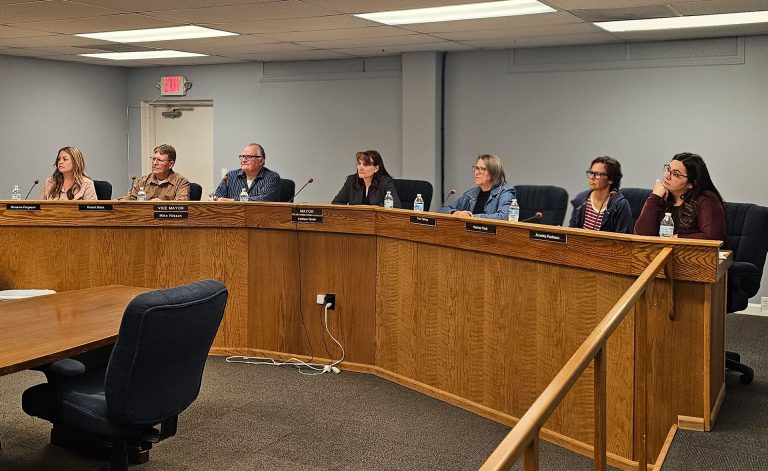
The Holbrook City Council held a work session on Wednesday, Nov. 15. moderated by Center for the Future of Arizona (CFA) Community and Economic Prosperity Director Evelyn Casuga to discuss strategies for the city. Casuga prompted discussion by presenting the council with conversation topics which were expectations, accomplishments, risks and opportunities, focus areas and ideal city manager candidate traits. When asked what the council’s expectations for the current and future work sessions were, council members mentioned creating an outline of the strategic and general plans for the city. They also noted a need to have a mutual understanding for what they want Holbrook to become and an overall prosperity for the city. Casuga opened the next discussion with a question to the council. “What are some good things that have happened in the community within the last 12 to 18 months?” Members noted there were new businesses within the city, an improvement of street maintenance such as street cleaning and repairs, as well as the Holbrook Cemetery receiving a facelift. There has also been a refocusing on the internal workings of the city, with the hiring of a code enforcement officer as well as employee raises. Mayor Kathleen Smith noted the effort to re-evaluate city policies, such as fees and zoning, has also begun to take shape as well. Councilmember Karina Pack added another accomplishment to the list, “I think we’ve gotten better with communication within the council.” Risks faced by the city are a limited skilled workforce and a lack of affordable housing. Teachers were noted specifically, with Councilmember Teri Tafoya explaining that they are forced to live in other towns and commute to work. Mayor Smith added sometimes teachers won’t even accept jobs just based on lack of housing. Mayor Smith stated that the city struggles with landlords and property owners, who increase prices for housing to acquire more money. The Cholla Power Plant closure projected for 2025 was also noted, as well as no urgent care or hospital within the city. Being along Interstate 40 was discussed as both a risk and opportunity. Due to the high rate of drug arrests near Holbrook, it implies that the drug problem lies withing the city, not along interstate travel. An opportunity that comes with the interstate is that it’s a busy thoroughfare that could be utilized to bring tourism into the city. Another opportunity is access to rail spurs for local manufacturing develop with access to the BNSF railway. Other opportunities that were mentioned included the airport, Hidden Cove Golf Course and the nearby Petrified Forest/Painted Desert National Park. Councilmember Arcenia Pacheco stated that she recently talked with tourists visiting Rock Art Ranch who explained they were staying in Sedona, which was over two-hour drive, since they couldn’t find accommodations in Winslow. Pacheco stated that they never even thought to stay in Holbrook. “But I mean, Winslow only has one street that looks nice,” she added. Mayor Smith stated that she had spoken with the economic developer for Show Low, who said that they’re working to get more outdoor recreation companies to their city and that it might be a good idea for Holbrook as well. Areas in which the council discussed would be good to focus on for city improvement were tourism and recreation, new industry, beautification and athletic events. Councilmember Tim Dixon stated he would like to see a future relationship with Arizona Department of Transportation (ADOT) where they install trees along West Hopi, which according to Dixon is property belonging to ADOT. Councilmember Pack added that making hiking trails visible and enticing would also be a good idea. More opportunities for entrepreneurs were mentioned by Mayor Smith, stating, “Cities are creating spaces because people can’t afford buildings and things like so a lot of cities are taking over that and making entrepreneur space. That way they can get their feet on the ground.” Casuga emphasized the importance of having an updated general plan, stating that a common way to be disqualified for funding is not having an up-to-date plan. “This is how they can screen communities out and really put the resources to communities that have already said, ‘here’s the vision of what our community needs to look like.’” Another focus area was improving infrastructure such as more street and road repair, along with water and sewer line improvements. Councilwoman Pacheco stated, “I think our roads have issues because of lack of experience.” She went on to give an example of roads where there’s been an area patched, but the wooded forms are not removed, which she explained will split and break. “If it’s just done correctly, which I mean, maybe it is done correctly, that’s not my area of expertise. But it’s common sense. I mean, if you’re constantly temporarily fixing it, but you don’t have experience to fix it correctly, then you’re just repairing it.” Mayor Smith added that the issues might be related to budget constraints, with Casuga also saying it could be related to resources available. Several councilmembers mentioned their dislike for the concrete roads in the city, to which Mayor Smith stated having an engineer come in and explain the pros and cons to concrete versus asphalt may be the best option. The council also outlined traits for what they would like to find in an ideal city manager. Effective communication skills, including being a good listener and open to constructive criticism, were emphasized. Someone with a community-centered approach, as well as creativity and optimism. Council also listed characteristics such as proactive, innovative and resourceful in finding solutions. Professionalism, as well as candor with the mayor, council, commissions and volunteers was stated as well. Providing realistic options for achievement, experience and cultural sensitivity. The council mentioned the importance of being able to translate vision into actionable plans and encourages a collaborative, give-and-take approach to decision-making. Councilmember Pack asked Casuga, who has an experienced background working as a city manager in multiple cities, what she would look for in a city. “A community that has a clear sense of direction of what they want to be when they grow up,” she noted. She also discussed long-term investment, referencing Winslow in particular. “They had a hard time getting where they’re going. They started their downtown beautification process a number of years ago; it looks great now, but it didn’t always look great.” Councilwoman Pacheco followed up on Casuga’s comment on Winslow’s dedication by stating her issue is what the newspaper writes about in reference to Holbrook. “An investor is not going to sit on Facebook and find the little Facebook page about Holbrook gossip, they’re going to go to the newspaper. And if there’s negative articles or write-ups in that newspaper, someone’s not going to want to invest.” Casuga stated that the council needs to be conscious of how they’re perceived, especially when looking for a city manager. “As council members you know, you all need to be conscious of the appearance that you project and so when you’re trying to find the ideal candidate these are the kinds of skills before you know, they’re going to be judging you as well.”