Winslow is taking a giant leap into the future with an anticipated “smart living city” development by World Homes Initiative (WHI) and its partner companies. The proposal is to bring thousands of new homes to the city built with technology-based infrastructure, industry with high paying jobs, and a communal society based on self-reliance, agricultural development, onsite utilities and economic opportunities all within the next five years.
Last week Winslow citizens and leaders attended a Winslow City Council work session and another public meeting later in the week to hear presentations from WHI. President and Founder Charles Hedensten explained that a smart living city is one in which the community is self-sustaining. That includes implementing technologies and philosophies in manufacturing, education, housing, water, soil, food production and more.
To make the transformation, WHI has partnered with many technology giants, construction and contracting professionals, engineers, designers and inventors. The group has already purchased 1,200 acres in the Winslow industrial complex just south of the town and plans to build its first homes in the next six to 12 months. Other land purchases will be private land located north of I-40 and to the east of the city.
Hedensten stated, “There are a lot of opportunities we think we can bring to Winslow. We have been developing a lot of the core technologies over the last 15 to 20 years that will enable all of the things that we will talk about.
Hedensten explained that once the foundation is poured his company will be able to build a home in five days that’s move-in ready. “On top of that, we can build one with six people that do not have to have any skills. I can take someone right off the street and get them into construction,” he stated, adding that training would be provided at a facility that will also be built in Winslow.
“A standard house would be a two-bedroom, one bath house starting at $250,000. That will also come with options for size as well as power and water options. The power technology we call Marshall Energy, does not use any fossil fuels but works as a magnetic gyro tech system that allows us to do clean energy at net zero carbon footprint. It is a quiet, portable machine that generate two megawatts per generator.”
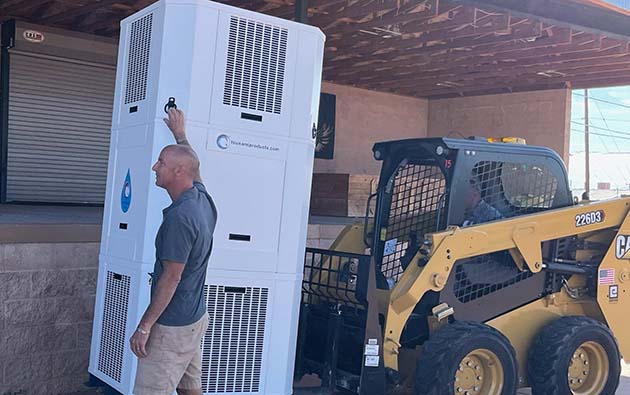
The goal for the development is to not rely on surface water and the aquifer to provide water to the community. Partner entity Tsunami Products hopes to provide atmospheric water generation to the project.
A demonstration of Tsunami’s machine was given to meeting attendees who sampled the water it produced. Winslow Mayor Roberta “Birdie” Cano said, “We know now that water is not an issue. This is life changing.”
World Homes Initiative will also have large scale systems assuring Winslow would never have a shortage of water or electricity as there will be redundancy in place.
To help make all of this possible, Hedensten explained, manufacturing facilities will have to be brought into the town. “We are looking at over 5.7 million square feet of buildings and close to 12,000 jobs. These jobs will range from light manufacturing to high tech engineering, any skill set in this spectrum.”
He also spoke of the need to replace and upgrade most of Winslow’s infrastructure; not only water and sewage, but also other public utilities such as emergency services and health care facilities. “We will need to make sure the city can handle the influx of population as we fill these homes and these jobs.”
It won’t be just Winslow that will benefit from this proposal. In fact, as Hedensten said, “Joseph City and Holbrook will also be a part of this.”
Funding for these enormous projects and proposals is self-contained as well. As Darin Torres, co-founder and vice president of WHI pointed out, “We have customers for the technologies that we have already built, we have investors. Besides, once we are taking advantage of the air, rail and automotive transportation hub that Winslow is, more revenue will be coming into the city.”
The group is focused on improving and growing Winslow in the present time but, as Hedensten pointed out, they are more focused on the future of the city and the planet. “Smart city function is utilities, education, technology, manufacturing, and all of the other components working together to future proof this idea. In order to do that, we need to educate our children on how to run such a community. Therefore, we will be aiding schools in bringing arts, sciences, math, and tech back. A lot of places do not have the funding to teach kids current and upcoming technology and we hope to change that so that future generations are able to continue what we have started and improve on it as well. This will naturally create and bring in better jobs and better quality and equity in the city.”
He also talked about carbon footprints by saying, “We can argue about what global warming is and what the impact of it will be, or we can utilize technology that we already possess to offer net zero or even negative carbon emissions. If we are building a better community, where everyone has access to good food, clean water and energy, we have to do that with cleaner technologies.”
City of Winslow’s Administrative Assistant Larrilynn Oso pointed out an important aspect. She said, “We have a lot of Indigenous populations in our area and the surrounding area. How does this work to not only respect them but also benefit them?”
Hedensten responded stating, “We have been working with indigenous groups already and we have the honor of trying to bring back opportunity to them. We want to create a pathway, even though we know there is a lot of failed trust there and we want to build a bridge to learn from traditions and Native ways as well as help them with their needs for food, water and energy. We will sit down with the individual tribes and find out what their needs are and make sure everyone is benefitting.”
Managing principal of partner entity Palmer Development Dan Lupien added, “There is a lot of synergy between the two visions of sustainable development and living in the world between our philosophy and that of say, the Hopi. We are hoping to expand on that dialogue and understand that and learn how we can support those.”
Torres said, “Some people think capitalism is the way to go, and some people think it’s socialism but we are somewhere in what we call, “compassionism,” which is communities taking care of their people. To us, that means all of the people. We are very conscious, not only to the indigenous of this land, but to others around the world.”
The initial meeting was well attended and included those who had doubts about such an ambitious endeavor. Winslow business owner Dan Lutzick voiced his concerns stating, “What I can’t understand in all of this, is where you will find the capacity to do this?” Hedensten responded by stating that they are aware that to invest in Winslow, it’s going involve quite a bit of money. “We are committing to this. We are investing in manufacturing our Marshall systems here for one thing.”
Torres added, “This is a team that has built some of the most complicated manufacturing devices on the planet, if we can do that, is housing not easier? It’s just a matter of understanding the practices and disciplines and we believe in the modality.”
Lutzick remained doubtful and accused the developers of operating a fraudulent enterprise, “I don’t think you have the capacity and I think this is a scam. You’re going to build multi-billion dollar buildings here? You’re not going to do that.”
Lupien countered stating, “We are hoping to understand what the vision for Winslow is from you, the citizens. We are here to solve the affordable housing crisis here. If we don’t solve it, this town will not survive. It is already deteriorating. This is our way to give back and make a difference. We are all successful in our own right, so we are only here to build this model and to help this town. We want to make Winslow a sustainable community as it is in decline.” Winslow was chosen because as Torres said, of its impact need and socioeconomic situation as well as its location close to air, rail and highway. “We want to make Winslow the showcase so we can share the model with the world,” Hedensten said.
The timeline on this project long term is five to 10 years. However, infrastructure work is set to begin in the next six to 12 months as long as city leadership approves the next steps regarding zoning and planning.
Torres said, “Our hope is that through innovation, through understanding information and using our resources wisely, we develop this culture that says we are more than just sustainable, it’s actually thriving. There is no limitation based on the science. We know this all starts with housing, but we need the first few steps of planning as far as what the city is going to look like.”
The Tribune will be providing more in-depth stories of the individual components for development presented by WHI in future editions.