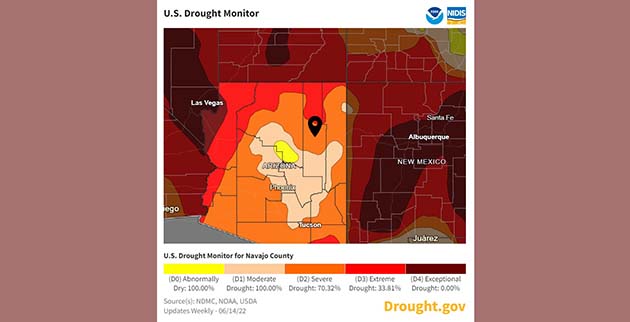
The State of Arizona is in a decades-long drought. According to the NOAA (National Oceanic and Atmospheric Administration). For this region that can mean not only a lack of precipitation but also water supply issues and extreme fire danger.
Drought can have many levels and in Arizona, most of the state is in moderate to severe drought but 100% of the state is abnormally dry.
Furthermore, studies are showing that the American Southwest has been experiencing what is called a “megadrought,” for the last 22 years.
In February, a study led by the University of Californian, Los Angeles (UCLA) geographer Park Williams was published in collaboration with NASA (National Aeronautics and Space Administration). The area of study was from southern Montana to northern Mexico and from the Pacific Ocean to the Rocky Mountains, encompassing Arizona.
The study found the megadrought to be the driest since at least the year 800. It reads, “Models show that climate change is adding to the severity of the drought with higher temperatures that increase evaporation. This turns a dry period into the most extreme dry period in 1,200 years.”
Dry conditions are evident in and around Navajo County, as the area recently experienced the tenth driest May on record in 128 years. Rainfall in 2022 for the county is down .43 inches from normal as well.
Monsoon season 2021 did hit Navajo County with heavy rainfall which resulted in floods and a near breach of the Winslow Levee. According to U.S. Drought Monitor, the season’s rainfall totals surpassed the previous two seasons combined.
However, as Navajo County Emergency Management Director Catrina Jenkins said, “This year, our drought was lower than the previous year, because of our rains, however drought is still very present. Drought and climate change do have impacts on wildfire conditions each year and is one of the pieces of information that is routinely analyzed.”
According to Jenkins, numerous data points, including soil moisture, precipitation and projected rainfall factor in to making decisions on fire restrictions.
In May, Stage 2 fire restrictions were enacted throughout Navajo and Apache counties, as well as Pinetop-Lakeside and Show Low. This restricted fires, campfires, charcoal, coal and wood stoves as well as smoking in open areas.
Based on analysis, the White Mountain Fire Coordinating Group recently lifted fire restrictions previously imposed.
Jenkins said, “The decision to rescind restrictions included analysis of data including the energy release components (ERC) of fuels in the region. This index tells fire managers how hot and fast fuels will burn. Currently, the ERC has fallen to the fiftieth percentile, a good indicator of fuel moisture content. Another key data set is the number of fires throughout the region which have been at record lows this year.”
The projected rainfall for the area also helped determine whether to lift restrictions.
Jenkins said, “The weather forecast is for ample monsoon activity to be widespread across Northern Arizona with daily relative humidity levels in the 30-45% range.”
Unincorporated areas of Apache and Navajo counties, Pinetop-Lakeside, Taylor, Snowflake, Eager, Springerville, Show Low and the Apache-Sitgreaves National Forest rescinded restrictions last week.
This does not mean the area is out of drought conditions or fire risk.
Jenkins said, “That being said, even with having received some much-needed moisture and more forecast in the future, it is imperative that our community members and visitors stay vigilant and follow good land stewardship practices that will ensure our forests, homes and businesses are protected year-round. Therefore, we ask that our residents and visitors continue to practice fire safety with campfires and debris burning. When extinguishing any fire, be sure to drown it with water, stir the water in, and feel the area with the back of your hand for any heat, repeating as necessary to ensure the fire is completely out. Further, at no time should you ever leave a fire of any kind unattended.”
The UCLA study went on to state, “One wet year will not be enough to turn around drought conditions. We advise long-term conservation strategies to ensure that water will be available in the future as climate change continues to exacerbate droughts.”
Williams said, “Dramatic shifts in dryness and water availability happened in the Southwest prior to the effects of human-caused climate change. Existing climate models have shown that the current drought would have been dry even without climate change but not to the same extent.”
The NOAA Climate prediction center website at www.drought.gov, shows that with the precipitation outlook leaning toward a wet monsoon season, some short-term drought improvement is likely for the region. According to the site similar to what happened in the summer of 2021, a robust monsoon season will not eliminate long-term drought. The megadrought is projected to persist at least through 2022, and possibly longer matching the duration of past megadroughts.